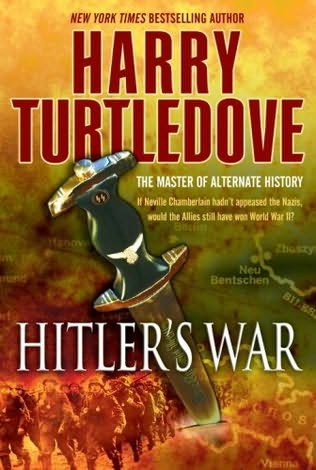
Hitler's war
- Автор: Тертлдав Гарри Норман
- Серия: The War that came early #1
- Язык: английский
- Жанр: Альтернативная история

Электронная книга - «Hitler's war». Краткое содержание книги:
Now, in this thrilling, provocative, and fascinating alternate history by Harry Turtledove, another scenario is played out: What if Chamberlain had not signed the accord? What if Hitler had acted rashly, before his army was ready-would such impatience have helped him or doomed him faster? Here is an action-packed, blow-by-blow chronicle of the war that might have been-and the repercussions that might have echoed through history-had Hitler reached too far, too soon, and too fast.
Turtledove uses dozens of points of view to tell this story: from American marines serving in Japanese-occupied China to members of a Jewish German family with a proud history of war service to their nation, from ragtag volunteers fighting in the Abraham Lincoln Battalion in Spain to an American woman desperately trying to escape Nazi-occupied territory-and witnessing the war from within the belly of the beast.
A novel that reveals the human face of war while simultaneously riding the twists and turns that make up the great acts of history, Hitler's War is the beginning of an exciting new alternate history saga. Here is a tale of powerful leaders and ordinary people, of spies, soldiers, and traitors, of the shifting alliances that draw some together while tearing others apart. At once authoritative, brilliantly imaginative, and hugely entertaining, Hitler's War captures the beginning of a very different World War II-with a very different fate for our world today.
“Heh.” Nigel chuckled sheepishly. “Put it like that and you’ve got something, all right. Taken all in all, though, I do believe I’d sooner win the Irish Sweepstakes.” He lit a Navy Cut and passed around the packet. He might talk like a toff, but he didn’t act like one.
With one of Nigel’s fags in his mouth, Walsh didn’t feel like arguing any more. Sure as hell, a cigarette was better than a soft answer for turning away wrath. Then the German artillery woke up, and he forgot about everything else.
He hoped the Fritzes were sending back counterbattery fire. If they wanted to drop some on his own gunners’ heads, he didn’t mind…too much. But no such luck. The first shells burst a little closer to his position than the German rounds had. Then they walked west.
“Christ, we’re for it this time!” he shouted, and dove under the dining-room table. It was the best shelter around. The other Tommies knew what they were doing, too. They all ended up in a mad tangle under there. That table, a great, solid hunk of oak, had to date back to the last century. It would keep the rest of the roof and the ceiling from coming down on their heads if anything could.
If anything could. That table wouldn’t stop a shell burst on the house or right outside of it from filling them with fragments. Walsh knew that painfully well-and, with somebody’s boot in his eye, somebody else’s elbow in his stomach, and somebody else altogether squashing him flat, painfully was le mot juste.
An explosion to the right. Another to the left. Two more behind the house. Bits and pieces of things came down. Something about the size of a football thumped on top of the table and banged away. Another chunk of the ceiling? Whatever it was, Walsh wouldn’t have wanted it landing on him. But it didn’t. That table might have let a tank run over him, not that he was anxious to find out by experiment.
The bombardment pressed on, deeper into the Allied position. It was almost like the walking barrages the British had used in the last go. That memory galvanized Walsh. “Up!” he shouted urgently, lifting his face from the small of-he thought-Nigel’s back. “Get up! We’ll be arse-deep in Boches any second now!”
Getting out from under the table was more complicated than getting in there had been. They’d packed themselves in too tightly. After mighty wrigglings and much bad language, they got loose. Bill had a gash on his left leg. It might have come from broken glass on the floor or a graze by a fragment. In civilian times, Walsh would have thought it was nasty. Neither he nor Bill got excited about it now.
Walsh ran up to the top floor. Sure as dammit, here came the Fritzes. Their storm troops had submachine guns and lots of grenades. They’d learned that stunt in 1918. They’d bring real machine guns along, too. The current models were more portable than Maxims had been back then. And they were Fritzes. That alone gave Walsh a healthy respect for their talents.
He took a quick look at the Bren-gun position across the street. It didn’t seem to have taken a hit, but the gun stayed quiet. With luck, the crew was playing possum, luring the Boches forward to be mown down. Without luck, somebody else would have to get over there-if he could-and use the Bren.
An unwary German (yes, there were such things: just not enough of them) showed himself for rather too long. Walsh’s Enfield jumped to his shoulder almost of its own accord. The stock slammed him when he pulled the trigger. The German went down. By the boneless way he fell, Walsh didn’t think he’d get up again.
“Now they know we’re here,” Nigel called from downstairs. He didn’t sound critical-he was reminding Walsh of something he needed to remember.
“We couldn’t have kept it secret much longer,” the veteran noncom answered. “As long as they haven’t got any tanks, winkling us out’ll take a bit of work.” He hadn’t seen any mechanical monsters right around here. They did less well in built-up places than out in the open. They grew vulnerable to grenades and flaming bottles of petrol and other dirty tricks.
A machine gun started barking from most of a mile away. Bullets slammed into the east-facing stone wall. It wasn’t aimed fire, but it made the Englishmen keep their heads down. A rifle could hit at that range only by luck. The machine gun stayed dangerous not because it was more accurate but because it spat so many rounds.
German infantry advanced under cover of that machine-gun fire. Walsh had been sure the Boches would. They knew what was what. And then, like the cavalry riding to the rescue in an American Western, the Bren gun in the wreckage across the street opened up. Walsh heard the Fritzes shout in dismay as they dove for cover. This wouldn’t be so easy as they’d thought.
The machine gun that had been firing at Walsh and his chums forgot about them and went after the more dangerous Bren gun. The Germans didn’t use light machine guns in this war. They had a general-purpose weapon that filled both the light and heavy roles. It wasn’t ideal for either. But, being belt-fed, it could go longer than a box-fed Bren.
Not that that did the advancing Landsers much good. The Bren-gun position was secure against small-arms fire. The Tommies manning it ignored the other machine gun and kept the foot soldiers in field-gray at a respectful distance.
And Walsh and his pals and the other riflemen in the half-wrecked suburb made the Germans pay whenever they stuck their heads up. The only thing he dreaded was that the German artillery would come back. It didn’t. After half an hour or so, the attack petered out. The Fritzes had taken a good many casualties, and Walsh couldn’t see that they’d gained an inch of ground.
Nigel passed around the packet of Navy Cuts again. Bill found a bottle of wine the French family had forgotten. They passed that around, too. It didn’t take long to empty. Once it ran dry, Walsh set it aside. If he got the chance, he’d make a petrol bomb out of it. He opened a tin of steak-and-kidney pudding-the best ration the Army made. A smoke, some wine, a tin of food…He was happy as a sheep in clover. A soldier could be satisfied with next to nothing, and often was.
* * *
When Milt Wolff went down, Harvey Jacoby took command of the Abraham Lincoln Battalion. He’d been a labor organizer in Seattle before he came to Spain. Chaim Weinberg thought he was a pretty good guy. He was brave and smart. But nobody would ever call him anything like El Lobo. He had neither the name nor the personality for it-he ran things with brains and common sense.
He came back from a meeting of International Brigade officers muttering to himself. “They’re going to pull us out of the line here,” he announced, his tone declaring that it wasn’t his idea and he didn’t like it for hell, but he couldn’t do anything about it.
He must have known the news would bring a storm of protest, and it did. “What for?” Chaim yelped, his voice one among many. “We can hold the Ebro line forever!?No pasaran!”
“The Republic is going to transfer the International Brigades to where they need us more,” Jacoby said, picking his words with obvious care.
That only made the Abe Lincolns hotter than ever. Next to Chaim, Mike Carroll called, “They can’t do that! The Party wouldn’t like it!” Again, he was far from the only man with the same thought.
“They can. They are.” Jacoby held up a hand, which slowed but didn’t stop the torrent of vituperation. At last, something resembling quiet except for being much noisier prevailed. It was enough to satisfy Jacoby, anyhow. “Listen to me,” he said, and then again, louder, “Listen to me, goddammit! Things aren’t the way they used to be, and we’d better get used to it.”
“What’s so different?” Chaim challenged.
“Here’s what-the Republic doesn’t have to worry about the Party line any more,” Jacoby answered. “Back when we were getting most of our stuff from the Soviets, the government had to pay attention to what the Party wanted. But when’s the last time a Russian ship tied up in Barcelona?”