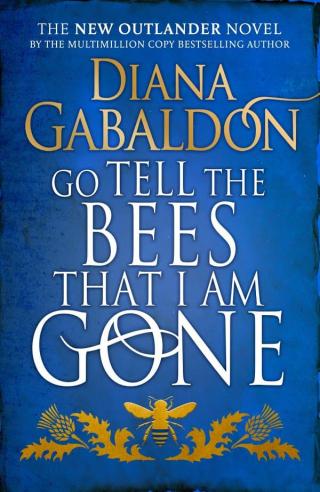
Go Tell the Bees That I Am Gone
- Автор: Гэблдон Диана
- Серия: Outlander #9
- Год: 2021
- Язык: английский
- Год: Delacorte Press
- ISBN: 978-1-473-51900-8
- Жанр: Исторические приключения

Электронная книга - «Go Tell the Bees That I Am Gone». Краткое содержание книги:
The past may seem the safest place to be . . . but it is the most dangerous time to be alive. . . .
Jamie Fraser and Claire Randall were torn apart by the Jacobite Rising in 1746, and it took them twenty years to find each other again. Now the American Revolution threatens to do the same. It is 1779 and Claire and Jamie are at last reunited with their daughter, Brianna, her husband, Roger, and their children on Fraser’s Ridge. Having the family together is a dream the Frasers had thought impossible. Yet even in the North Carolina backcountry, the effects of war are being felt. Tensions in the Colonies are great and local feelings run hot enough to boil Hell’s teakettle. Jamie knows loyalties among his tenants are split and it won’t be long until the war is on his doorstep. Brianna and Roger have their own worry: that the dangers that provoked their escape from the twentieth century might catch up to them. Sometimes they question whether risking the perils of the 1700s—among them disease, starvation, and an impending war—was indeed the safer choice for their family. Not so far away, young William Ransom is still coming to terms with the discovery of his true father’s identity—and thus his own—and Lord John Grey has reconciliations to make, and dangers to meet . . . on his son’s behalf, and his own. Meanwhile, the Revolutionary War creeps ever closer to Fraser’s Ridge. And with the family finally together, Jamie and Claire have more at stake than ever before.
“Merde,” Cinnamon said, turning to glare back at the house. “Jane?”
“Wh—how—where did you get that name?” William demanded. The lead in his belly had caught fire and melted, leaving a seared hollow behind. He could still see her hands, small and delicate and white, as he’d laid them on her breast—crossed, the torn wrists neatly bound in black.
“You say it in your sleep sometimes,” Cinnamon said with an apologetic shrug. He hesitated, but his own urge was strong and he couldn’t keep from asking, “So?”
“Yes.” William swallowed and repeated more firmly, “Yes. He’s here. Number Twelve Oglethorpe Street. Come on, then.”
THE HOUSE WAS modest but neat, a white-painted clapboard with a blue door, standing in a street of similarly tidy homes, with a small church of red sandstone at the end of the street. Rain-shattered leaves had fallen from a tree in the front garden and lay in damp yellow drifts upon a brick walk. William heard Cinnamon draw in his breath as they came to the gate, and saw him glance to and fro as they went up to the door, covertly taking note of every detail.
William hammered on the door without hesitation, ignoring the brass knocker in the shape of a dog’s head. There was a moment of silence, and then the sound of a baby crying within the house. The two young men stared at each other.
“It must be his lordship’s cook’s child,” William said, with assumed nonchalance. “Or the maid. Doubtless the woman will—”
The door swung open, revealing a frowning Lord John, bareheaded and in his shirtsleeves, clutching a small, howling child to his bosom.
“You woke the baby, damn your eyes,” he said. “Oh. Hallo, Willie. Come in, then, don’t stand there letting in drafts; the little fiend is teething, and catching a cold on top of that won’t improve his temper to any noticeable extent. Who’s your friend? Your servant, sir,” he added, putting a hand over the child’s mouth and nodding to Cinnamon with a fair assumption of hospitality.
“John Cinnamon,” both young men said automatically, speaking together, then stopped, equally flustered. William recovered first.
“Yours?” he inquired politely, with a nod at the child, who had momentarily stopped howling and was gnawing ferociously on Lord John’s knuckle.
“Surely you jest, William,” his father replied, stepping back and jerking his head in invitation. “Allow me to make you acquainted with your second cousin, Trevor Wattiswade Grey. I am delighted to meet you, Mr. Cinnamon—will you take a drop of beer? Or something stronger?”
“I—” Panicked, Cinnamon looked to William for direction.
“We may require something a bit stronger, sir, if you have it.” William reached for the baby, whom he received gingerly from Lord John’s wet, relieved grasp. His father wiped his hand on his breeches and extended it to Cinnamon.
“Your servant, s—” He stopped abruptly, having evidently got a good look at Cinnamon for the first time. “Cinnamon,” he said slowly, eyes fixed on the big Indian’s face. “John Cinnamon, you said?”
“Yes, sir,” said Cinnamon huskily, and dropped suddenly to his knees with a crash that rattled the china on the sideboard and made little Trevor stiffen and shriek as though he were being disemboweled by badgers.
“Oh, God,” said Lord John, glancing from Trevor to Cinnamon and back again. “Here.” He took the child from William again and joggled it in a practiced fashion.
“Mr. Cinnamon,” he said. “Please. Do get up. There’s no need—”
“What in God’s name are you doing to that baby, Uncle John?” The furious female voice came from the doorway on the far side of the room, and William’s head swiveled toward it. Framed in the doorway was a blond girl of medium size, except for her bosoms, which were very large, white as milk, and half-exposed by the open banyan and untied shift that she wore.
“Me?” Lord John said indignantly. “I didn’t do anything to the little beast. Here, madam, take him.”
She did, and little Trevor at once thrust his face into her bosom, making bestial rooting noises. The young woman caught a glimpse of William’s face and glared at him.
“And who the devil are you?” she demanded.
He blinked. “My name is William Ransom, madam,” he said, rather stiffly. “Your servant.”
“This is your cousin Willie, Amaranthus,” Lord John said, coming forward and patting the top of Cinnamon’s head in an apologetic fashion as he pushed past him. “William, may I present Amaranthus, Viscountess Grey, your cousin Benjamin’s … widow.” It was almost not there, that pause, but William heard it and glanced sharply from the young woman to his father, but Lord John’s face was composed and amiable. He didn’t meet William’s eye.
So … either they’ve found Ben’s body—or they haven’t, but they’re letting his wife believe he’s dead.
“My sympathies, Lady Grey,” he said, bowing.
“Thank you,” she said. “Ow! Trevor, you beastly little Myotis!” She had stifled Trevor by stuffing him under a hastily pulled-forward wing of her banyan, evidently pulling down her shift in the same movement, for the child had battened onto her breast and was now making embarrassingly loud sucking noises.
“Er … Myotis?” It sounded vaguely Greek, but wasn’t a word William was familiar with.
“A vesper bat,” she replied, shifting her hold to adjust the child more comfortably. “They have very sharp teeth. I beg your pardon, my lord.” And with that, she turned on her bare heel and vanished.
“Ahem,” said Cinnamon, who, ignored, had quietly risen to his feet. “My lord … I hope you pardon my coming here without warning. I didn’t know where to find you, until my friend”—nodding at William—“found out your house just now. I should maybe have waited, though. I … can come back …?” he added, with a hesitant movement toward the door.
“No, no.” Relieved of the presence of Amaranthus and Trevor, Lord John had regained his usual equanimity. “Please—sit down, will you? I’ll send—Oh. Actually, there’s no one to send, I’m afraid. The manservant’s joined the army and my cook is quite drunk. I’ll get—”
William took him by the sleeve as he made to exit toward the kitchen.
“We don’t need anything,” he said, quite gently. Paradoxically, the chaos of the last few minutes had settled his own sense of agitation. He put a hand on his father’s shoulder, feeling the hard bones and warmth of his body, wondering whether he would ever call him “Papa” again, and turned him toward John Cinnamon.
The Indian had gone as pale as it was possible for someone of his complexion to go, and looked as though he was about to be sick.
“I came to say thank you,” he blurted, and clamped his lips shut, as though fearing to say more.
Lord John’s face lightened, softening as he looked the tall young man up and down. William’s heart squeezed a little.
“Not at all,” he said, and stopped to clear his throat. “Not at all,” he said again, more strongly. “I’m so happy to meet you again, Mr. Cinnamon. Thank you for coming to find me.”
William found that there was a lump in his own throat, and turned away toward the window, with an obscure feeling that he should give them a moment’s privacy.
“It was Manoke who told me,” Cinnamon said, his voice husky, too. “That it was you, I mean.”
“He told you … well, yes, now that I recall, he was there in Quebec when I took you to the mission—after your mother died, I mean. You saw Manoke—recently?” Lord John’s voice held an odd note, and William glanced back at him. “Where?”