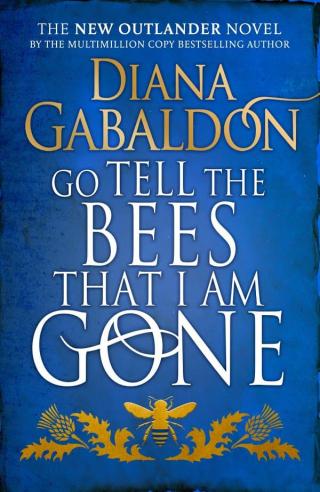
Go Tell the Bees That I Am Gone
- Автор: Гэблдон Диана
- Серия: Outlander #9
- Год: 2021
- Язык: английский
- Год: Delacorte Press
- ISBN: 978-1-473-51900-8
- Жанр: Исторические приключения

Электронная книга - «Go Tell the Bees That I Am Gone». Краткое содержание книги:
The past may seem the safest place to be . . . but it is the most dangerous time to be alive. . . .
Jamie Fraser and Claire Randall were torn apart by the Jacobite Rising in 1746, and it took them twenty years to find each other again. Now the American Revolution threatens to do the same. It is 1779 and Claire and Jamie are at last reunited with their daughter, Brianna, her husband, Roger, and their children on Fraser’s Ridge. Having the family together is a dream the Frasers had thought impossible. Yet even in the North Carolina backcountry, the effects of war are being felt. Tensions in the Colonies are great and local feelings run hot enough to boil Hell’s teakettle. Jamie knows loyalties among his tenants are split and it won’t be long until the war is on his doorstep. Brianna and Roger have their own worry: that the dangers that provoked their escape from the twentieth century might catch up to them. Sometimes they question whether risking the perils of the 1700s—among them disease, starvation, and an impending war—was indeed the safer choice for their family. Not so far away, young William Ransom is still coming to terms with the discovery of his true father’s identity—and thus his own—and Lord John Grey has reconciliations to make, and dangers to meet . . . on his son’s behalf, and his own. Meanwhile, the Revolutionary War creeps ever closer to Fraser’s Ridge. And with the family finally together, Jamie and Claire have more at stake than ever before.
Unable to take thought for the son he’d made and left behind. Malcolm had never mentioned the boy to Grey, nor asked after him.
“I see,” Cinnamon said bleakly. He pressed his lips together and focused his gaze on the silver coffeepot sitting on the sideboard. Grey didn’t try to speak further; he could only make matters worse.
Finally, Cinnamon’s eyes cleared and he looked at Grey again, serious. The young man had very beautiful dark eyes, deep-set and slightly slanting. Those had come from his mother—Grey wished that he could tell him so, but this was not the moment for such details.
“Then I thank you, sir,” he said softly, and bowed, deeply, toward Grey. “It was most generous in you, to perform such a service for your friend.”
“I didn’t do it for Malcolm’s sake,” Grey blurted. His glass was empty—how had that happened?—and he set it down carefully on the little drum table.
They sat regarding each other, neither knowing quite what to say next. Grey could hear Moira the cook talking outside; she often talked to the faeries in the garden even when not drunk. The carriage clock on the mantel struck the half hour, and Cinnamon jerked in surprise, turning to look at it. It had musical chimes, and a mechanical butterfly under a glass dome, that raised and lowered its cloisonné wings.
The movement had broken the awkward silence, though, and when Cinnamon turned back, he spoke without hesitation.
“Father Charles said that you gave me a name, when you left me at the mission. You did not know what my mother called me, I suppose?”
“Why, no,” Grey said, disconcerted. “I didn’t.”
“So it was you who called me John?” A slight smile appeared on Cinnamon’s face. “You gave me your own name?”
Grey felt an answering smile on his own face, and lifted one shoulder in a deprecating way.
“Oh, well …” he said. “I liked you.”
33
Spoilt for Choice
WHATEVER PAPA AND JOHN Cinnamon were doing, they were taking the devil of a long time about it. After a few minutes, during which Trevor yowled unceasingly, Amaranthus had made her excuses and withdrawn to the house in search of clean clouts.
Without occupation or acquaintance in town or camp, and reluctant to go into the house himself, William found himself at loose ends. The last thing he wanted was to encounter anyone he knew, in any case. He pulled the black slouch hat well down over his brow and forced himself to stroll, rather than stride, through the town toward camp. The place was full of private soldiers, sutlers, and support troops; it would be easy to escape notice.
“William!”
He stiffened at the shout, but smothered the momentary impulse to run. He recognized that voice—just as the owner of it had undoubtedly recognized his height and figure. He turned reluctantly to greet his uncle, the Duke of Pardloe, who had emerged from a house directly behind him.
“Hallo, Uncle Hal,” he said, with what grace he could muster. He supposed it didn’t matter; Lord John would tell his brother about William’s and John Cinnamon’s presence, in any case.
“What are you doing here?” his uncle inquired—mildly, for him. His sharp glance took in everything from William’s mud-caked boots to the stained rucksack on his shoulder and the worn cloak over his arm. “Come to enlist?”
“Haha,” William said coldly, but felt immediately better. “No. I came with a—friend, who had business in camp.”
“Seen your father?”
“Not really.” He didn’t elucidate, and after a thoughtful pause, Hal shook out his own gray military cloak and slung it over his shoulders.
“I’m going down to the river for a bit of air before supper. Come along?”
William shrugged. “Why not?”
They made their way out of the town and down from the bluffs without being accosted, and William felt the tightness between his shoulder blades ease. His uncle didn’t indulge in idle conversation, and didn’t mind silence in the least. They reached the edge of the narrow beach without exchanging a word, and made their way slowly through scrubby pines and yaupon bushes to the clean, solid sand of the tidal zone.
William placed his feet just so, enjoying making prints in the silty gray sand. The summer sky was vast and blue above them, a blazing yellow sun coming slowly down into the waves. They followed the curve of the beach, ending on a tiny spit of sandy gravel inhabited by a gang of orange-billed oystercatchers, who eyed them coldly and gave way with ill grace, turning their heads and glaring as they waddled sideways.
Here they stood for some minutes, looking out into the water.
“Do you miss England?” Hal asked abruptly.
“Sometimes,” William answered honestly. “But I don’t think about it much,” he added, with less honesty.
“I do.” His uncle’s face looked relaxed, almost wistful in the fading light. “But you haven’t a wife there, or children. No establishment of your own, yet.”
“No.”
The sounds of slaves working in the fields behind them were still audible, but muted by the rhythm of the surf at their feet, the passage of the silent clouds above their heads.
The trouble with silence was that it allowed the thoughts in his head to take on a tiresome insistence, like the ticking of a clock in an empty room. Cinnamon’s company, disturbing as it occasionally was, had allowed him to escape them when he needed to.
“How does one go about renouncing a title?”
He hadn’t actually been intending to ask that just yet, and was surprised to hear the words emerge from his mouth. Uncle Hal, by contrast, didn’t seem surprised at all.
“You can’t.”
William glared down at his uncle, who was still looking imperturbably downriver toward the sea, the wind pulling strands of his dark hair from his queue.
“What do you mean, I can’t? Whose business is it whether I renounce my title or not?”
Uncle Hal looked at him with an affectionate impatience.
“I’m not speaking rhetorically, blockhead. I mean it literally. You can’t renounce a peerage. There’s no means set down in law or custom for doing it; ergo, it can’t be done.”
“But you—” William stopped, baffled.
“No, I didn’t,” his uncle said dryly. “If I could have at the time, I would have, but I couldn’t, so I didn’t. The most I could do was to stop using the title of ‘Duke,’ and threaten to physically maim anyone who used it in reference or address to me. It took me several years to make it clear that I meant that,” he added offhandedly.
“Really?” William asked cynically. “Who did you maim?”
He actually had supposed his uncle to be speaking rhetorically, and was taken aback when the once and present duke furrowed his brow in the effort of recall.
“Oh … several scribblers—they’re like roaches, you know; crush one and the others all rush off into the shadows, but by the time you turn round, there are throngs of them back again, happily feasting on your carcass and spreading filth over your life.”
“Anyone ever tell you that you have a way with words, Uncle?”
“Yes,” his uncle said briefly. “But beyond punching a few journalists, I called out George Mumford—he’s the Marquess of Clermont now, but he wasn’t then—Herbert Villiers, Viscount Brunton, and a gentleman named Radcliffe. Oh, and a Colonel Phillips, of the Thirty-fourth—cousin to Earl Wallenberg.”
“Duels, do you mean? And did you fight them all?”
“Certainly. Well—not Villiers, because he caught a chill on the liver and died before I could, but otherwise … but that’s beside the point.” Hal caught himself and shook his head to clear it. Evening was coming on, and the onshore breeze was brisk. He wrapped his cloak about his body and nodded toward the town.