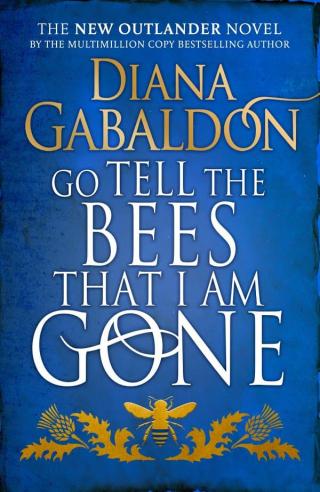
Go Tell the Bees That I Am Gone
- Автор: Гэблдон Диана
- Серия: Outlander #9
- Год: 2021
- Язык: английский
- Год: Delacorte Press
- ISBN: 978-1-473-51900-8
- Жанр: Исторические приключения

Электронная книга - «Go Tell the Bees That I Am Gone». Краткое содержание книги:
The past may seem the safest place to be . . . but it is the most dangerous time to be alive. . . .
Jamie Fraser and Claire Randall were torn apart by the Jacobite Rising in 1746, and it took them twenty years to find each other again. Now the American Revolution threatens to do the same. It is 1779 and Claire and Jamie are at last reunited with their daughter, Brianna, her husband, Roger, and their children on Fraser’s Ridge. Having the family together is a dream the Frasers had thought impossible. Yet even in the North Carolina backcountry, the effects of war are being felt. Tensions in the Colonies are great and local feelings run hot enough to boil Hell’s teakettle. Jamie knows loyalties among his tenants are split and it won’t be long until the war is on his doorstep. Brianna and Roger have their own worry: that the dangers that provoked their escape from the twentieth century might catch up to them. Sometimes they question whether risking the perils of the 1700s—among them disease, starvation, and an impending war—was indeed the safer choice for their family. Not so far away, young William Ransom is still coming to terms with the discovery of his true father’s identity—and thus his own—and Lord John Grey has reconciliations to make, and dangers to meet . . . on his son’s behalf, and his own. Meanwhile, the Revolutionary War creeps ever closer to Fraser’s Ridge. And with the family finally together, Jamie and Claire have more at stake than ever before.
He couldn’t tell her it would be all right. But neither could he leave her to stand alone here like a lightning rod.
“If I have to pick ye up, I’ll likely fall off the roof and we’ll both be killed,” he said, and took her cold hand. “Come down, aye?”
She nodded, straightened, and wiped her eyes on the sleeve of her shift.
“It’s not wrong to be alive,” he said quietly. “I’m glad you are.”
She nodded again, raised his hand to her cold lips, and kissed it. They made their way down the ladder in the dark one after the other, each alone but together, toward the distant glow of the hearth below.
30
You Should Know …
WE BURIED AMY THE next day, in the small, high meadow that served the Ridge as a graveyard. It was a peaceful, sunny day, and every step through the grass revealed some flash of color, the purples and yellows of asters and goldenrod. The warmth of the sun on our shoulders was a comfort, and Roger’s words of prayer and commendment held something of comfort, too.
I found myself thinking—as one does, at a certain age—that I’d rather like to have a funeral like this. Outdoors, among friends and family, with people who’d known me, whom I’d served for years. A sense of deep sorrow, yes, but a deeper sense of solemnity, not at odds with sunlight and the deep green breath of the nearby forest.
Everyone stood silent as the last shovelful of dirt was cast on the heaped grave. Roger nodded to the children, huddled mute and shocked around their father, each clutching a small bouquet of wildflowers. Brianna had helped them pick the flowers—and Mandy had of course insisted on making her own bouquet, a loose handful of pink-tinged wild clover and grass gone to seed.
Rachel stood quiet, next to Bobby Higgins. She gently picked up his limp hand and put a small bunch of the tiny white daisy-like flowers of fleabane into it. She whispered something in his ear, and he swallowed hard, looked down at his sons, and then walked forward to lay the first flowers on Amy’s grave, followed by Aidan, the little boys, Jem, Germain, and Fanny—and Mandy, frowning in concentration on doing it right.
Others stopped briefly by the grave, touching Bobby’s arms and back, murmuring to him. People began to disperse, drifting back toward home, work, dinner, normality, grateful that for now, death had passed them by, and vaguely guilty in their gratitude. A few lingered, talking quietly to one another. Rachel had appeared again beside Bobby—she and Bree had been taking it in unspoken turn not to leave him alone.
Then it was our turn. I followed Jamie, who didn’t say anything. He took Bobby by the shoulders and tilted his head so they stood forehead-to-forehead for a moment, sharing grief. He lifted his head then and shook it, squeezed Bobby’s shoulder, and stood aside for me.
“She was beautiful, Bobby,” I whispered, my throat still thick, after all the tears already shed. “We’ll remember her. Always.”
He opened his mouth, but there weren’t any words. He squeezed my hand hard and nodded, tears oozing unheeded. He’d shaved for the burying, and raw spots showed red and scraped against his pallid skin.
We walked slowly down the trail toward home. Not speaking, but touching each other lightly as we went.
As we neared the garden, I paused.
“I’ll—get some—” I waved vaguely toward the palisades. What? I wondered. What could I pick or dig up, to make a poultice for a mortal wound to the heart?
Jamie nodded, then took me in his arms and kissed me. Stepped back and laid a hand against my cheek, looking at me as though to fix my image in his mind, then turned and went on down.
In truth, I didn’t need anything from the garden, save to be alone in it.
I just stood there for a time, letting the silence that is never silent sink into me; the stir and sigh of the nearby forest as the breeze passed through, the distant conversations of birds, small toads calling from the nearby creek. The sense of plants talking to one another.
It was late afternoon, and the sun was coming in low through the deer palings, throwing dappled light through the bean vines onto the twisted straw of the skep, where bees were coming and going with a lazy grace.
I reached out and put a hand on the hive, feeling the lovely deep hum of the workings within. Amy Higgins is gone—is dead. You know her—her dooryard is full of hollyhocks and she’s got—had—jasmine growing by her cowshed and a good patch of dogwood nearby.
I stood quite still, letting the vibration of life come into my hand and touch my heart with the strength of transparent wings.
Her flowers are still growing.
Part Three
THE BEE STING OF ETIQUETTE AND THE SNAKEBITE OF MORAL ORDER
31
Pater Familias
WILLIAM HAD BEEN HALF hoping that his inquiries for Lord John Grey would meet either with total ignorance or with the news that his lordship had returned to England. No such luck, though. Major General Prévost’s clerk had been able to direct him at once to a house in St. James Square, and it was with thumping heart and a ball of lead in his stomach that he came down the steps of Prévost’s headquarters to meet Cinnamon, waiting in the street.
His anxiety was dispersed the next instant, though, as Colonel Archibald Campbell, former commander of the Savannah garrison and William’s personal bête noire, came up the walk, two aides beside him. William’s first impulse was to put his hat on, pull it over his face, and scuttle past in hopes of being unrecognized. His pride, already raw, was having none of this, and instead, he marched straight down the walk, head high, and nodded regally to the colonel as he passed.
“Good day to you, sir,” he said. Campbell, who had been saying something to one of the aides, looked up absently, then halted abruptly, stiffening.
“What the devil are you doing here?” he said, broad face darkening like a seared chop.
“My business, sir, is none of your concern,” William said politely, and made to pass.
“Coward,” Campbell said contemptuously behind him. “Coward and whoremonger. Get out of my sight before I have you arrested.”
William’s logical mind was telling him that it was Campbell’s relations with Uncle Hal that lay behind this insult, and he ought not to take it personally. He must walk straight on as though he hadn’t heard.
He turned, gravel grinding under his heel, and only the fact that the expression on his face made Campbell go white and leap backward allowed John Cinnamon time to take three huge strides and grab William’s arms from behind.
“Amène-toi, imbécile!” he hissed in William’s ear. “Vite!” Cinnamon outweighed William by forty pounds, and he got his way—though in fact, William didn’t fight him. He didn’t turn round, though, but backed—under Cinnamon’s compulsion—slowly toward the gate, burning eyes fixed on Campbell’s mottled countenance.
“What’s wrong with you, gonze?” Cinnamon inquired, once they were safely out the gate and out of sight of the clapboard mansion. The simple curiosity in his voice calmed William a little, and he wiped a hand hard down his face before replying.
“Sorry,” he said, and drew breath. “That—he—that man is responsible for the death of a—a young lady. A young lady I knew.”