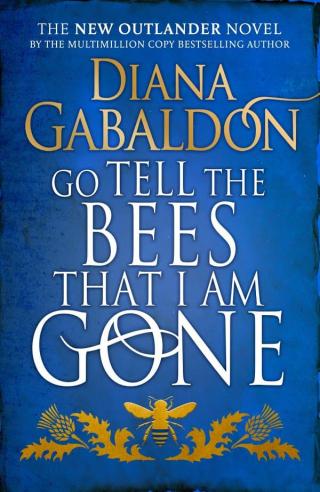
Go Tell the Bees That I Am Gone
- Автор: Гэблдон Диана
- Серия: Outlander #9
- Год: 2021
- Язык: английский
- Год: Delacorte Press
- ISBN: 978-1-473-51900-8
- Жанр: Исторические приключения

Электронная книга - «Go Tell the Bees That I Am Gone». Краткое содержание книги:
The past may seem the safest place to be . . . but it is the most dangerous time to be alive. . . .
Jamie Fraser and Claire Randall were torn apart by the Jacobite Rising in 1746, and it took them twenty years to find each other again. Now the American Revolution threatens to do the same. It is 1779 and Claire and Jamie are at last reunited with their daughter, Brianna, her husband, Roger, and their children on Fraser’s Ridge. Having the family together is a dream the Frasers had thought impossible. Yet even in the North Carolina backcountry, the effects of war are being felt. Tensions in the Colonies are great and local feelings run hot enough to boil Hell’s teakettle. Jamie knows loyalties among his tenants are split and it won’t be long until the war is on his doorstep. Brianna and Roger have their own worry: that the dangers that provoked their escape from the twentieth century might catch up to them. Sometimes they question whether risking the perils of the 1700s—among them disease, starvation, and an impending war—was indeed the safer choice for their family. Not so far away, young William Ransom is still coming to terms with the discovery of his true father’s identity—and thus his own—and Lord John Grey has reconciliations to make, and dangers to meet . . . on his son’s behalf, and his own. Meanwhile, the Revolutionary War creeps ever closer to Fraser’s Ridge. And with the family finally together, Jamie and Claire have more at stake than ever before.
“Does Bobby own his cabin?” Moira Talbert was asking, her eyes fixed speculatively on the little knot of people surrounding Bobby Higgins. “Himself built it, and I ken his lass and her man dwelt there for a time, but Joseph Wemyss told Andrew Baldwin as how Himself had given Bobby and Amy the place, but he didna say was it the house and land by deed, or only the use of it.”
“Dinna ken,” Peggy Chisholm replied, her own eyes narrowing in speculation. She glanced toward the far side of the room, where her two daughters were helping to cut and lay out slices of a vast fruitcake soaked in whisky that Mandaidh MacLeod had brought down. “D’ye think maybe that Himself has it in mind to wed his wee orphan lass to Bobby, though? If it was her, he’d see Bobby right for the cabin, sure …”
“Too young,” said Sophia MacMillan, shaking her head. “She’s but a maid yet.”
“Aye, and he needs a mother for his wee lads,” Annie Babcock put in dismissively. “That one couldn’t say boo to a goose. Now, there’s my cousin Martina, she’s seventeen, and—”
“Even so, the man’s a murderer,” Peggy interrupted. “I dinna think I want him for a son-in-law, even with a good hoose.”
Brianna, stifled by amazement, found her voice at this.
“Bobby’s not a murderer,” she said, and was surprised to hear how hoarse she was. She cleared her throat hard and repeated, “He’s not a murderer. He was a soldier, and he shot someone during a riot. In Boston.”
A small jolt ran through her at the word “Boston.” The Old State House behind her and the smell of traffic, with the big round bronze plaque set into the asphalt at her feet. Her fifth-grade classmates clustered around it, all shivering in the wind off the harbor. The Boston Massacre, the plate read.
“A riot,” she said, more firmly. “A big group of people attacked a small group of soldiers. Bobby shot someone to save the soldiers’ lives.”
“Oh, aye?” said Sarah MacBowen with a skeptical arch of her brow. “So why is it he’s got yon M on his face, then?”
The scar had faded in the ten years since, but was clearly visible now; Bobby sat by the coffin, and the pale glow of the candle showed the mark of the brand, dark against the whiteness of his face. She saw that he was still gripping the edge of the pine coffin, as though he could keep Amy from going from him, refusing to acknowledge that she was already gone.
Brianna had to go to him. Had to look at Amy. Had to apologize.
“Excuse me,” she said abruptly, and pushed past Moira.
A small group of Bobby’s friends were clustered about him, murmuring gruff words and giving him an occasional consoling squeeze of the shoulder. She hung back, awaiting an opening, her heartbeat thumping in her ears.
“Och, Brianna!” A hand clutched her arm, and Ruthie MacLeod leaned in to peer at her. “Are ye all right, a nighean? They’re sayin’ as how ye were with Amy when the wicked beast took her—is it so?”
“Yes,” she said. Her lips felt stiff.
“What happened?” Beathag Moore and another young woman were clustering behind Ruthie, eyes bright with curiosity. “How close were ye to the bear?”
As though the word “bear” had been a signal, heads turned toward Brianna.
“As close as I am to you right now,” she said. She could barely hear her own words; her heart had speeded up and … oh, God. It burst into a violent flutter in her chest, as though a flock of sparrows were trapped inside her, and black spots swam at the edges of her sight. She couldn’t breathe.
“I—I have to—” She made a helpless gesture at the avid faces, turned, and lurched out of the room, half-running for the stairs.
She was pulling at her bodice as she reached the landing, and all but ripped it off as she stumbled into the bedroom and pushed the door closed behind her.
She had to get out of the stays, she couldn’t breathe … She tore the straps off her shoulders and squirmed out of the half-fastened corset, gasping for air. Threw off her skirt and petticoat and leaned against the wall, heart still galloping. Air.
Sweating and trembling, she flung open the door and started up the stairs to the open air of the unfinished attic.
ROGER SAW BRIANNA go white, then turn and stumble out of the kitchen, knocking into the propped-open door so it swung heavily shut behind her.
He made his way through the crowd as fast as he could, but she was gone when he pushed out into the hall. Maybe she’d just needed air—God knew, he did; the night-chilled breeze rushing in from the yard was a huge relief.
“Bree!” he called from the doorstep, but there was no answer—only the shuffle and murmur of visitors making their way up the slope by the flickering of a pine torch.
The surgery, then—she must have gone to look at the children …
He found her, finally, in the house. High up in the open air, clinging to one of the uprights of the timbers framing the unfinished attic, a white shadow against the night sky.
She must have heard him, though he tried to tread lightly; only a single layer of boards served (for the moment) as both the ceiling of the second floor and the floor of the attic. She didn’t move, though, save for the flow of her hair and her shift, both rippling in the unsettled air. There was a late thunderstorm in the neighborhood; he could see a mass of steely cloud boiling up behind the distant mountain, shot with constant vivid cracks of lightning. The smell of ozone was strong on the wind.
“You look like the figurehead of a ship,” he said, coming close behind her. He put his arms gently round her, covering her from the chill. “Ye feel like one, too—you’re so cold, ye’re hard as wood.”
She made a sound that he took as an indication that she was glad to see him and acknowledged his feeble joke but either was too cold to talk or didn’t know what to say.
“Nobody knows what to say when something like this happens,” he said, and his lips brushed a cold white ear.
“You do. You did.”
“Nah,” he said. “I said something, aye, but God knows—and I mean that, by the way—whether it was the right thing to say, or if anything ever could be, in a situation like that. You were there,” he said, in a softer voice. “Ye got help, ye took care of the bairns. Ye couldn’t have done more.”
“I know.” She turned to him then, and he felt the wetness on her cheek against his own. “That’s what—what’s so terrible. There was nothing to—to fix it, to make things better. One second she was there, and then …” She was shaking. He should have thought to bring a cloak, a blanket … but all he had was his own body, and he held her as close as he could, feeling the solid life of her trembling in his arms, and felt a terrible guilt at his relief that it hadn’t been—
“It could have been me,” she whispered, her voice shaking as much as her body. “She wasn’t ten feet away from me. The bear could have come from the other side, and—and Jem and Mandy would be or-orphans t-tonight.” She let out a small, suffocated sob. “Mandy was right by my feet, five minutes b-before. She—it could have—”
“You’re freezing,” he whispered into her hair. “It’s going to rain. Come down.”
“I can’t do it. We shouldn’t have come,” she said. “We shouldn’t have come here.” And letting go of the upright, she bent her head on his shoulder and cried, pressing hard against him. The cold had seeped from her body into his, and the cold pellets of her words lay like frozen buckshot in his mind. Mandy.