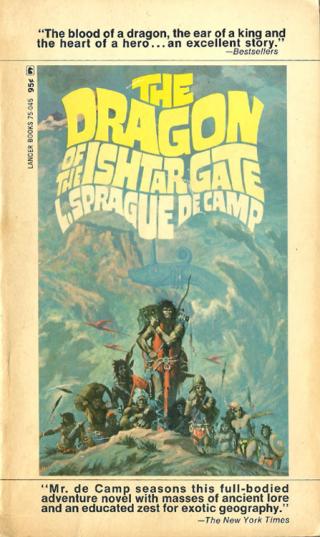
The Dragon of the Ishtar Gate
- Автор: Де Камп Лайон Спрэг
- Год: 1968
- Язык: английский
- Год: Lancer Books
- Жанр: Научная фантастика

Электронная книга - «The Dragon of the Ishtar Gate». Краткое содержание книги:
Dragon is probably closest in mood to de Camp's fantasy novels, while Bronze God and Arrows are closer to his science fiction, with their description of engineering problems, and personality clashes among researchers and engineers. Dragon also reflects de Camp's then-recent acquaintance with the Conan stories and other works of Robert E. Howard. Bessas, the huge Persian nobleman, is not only a close match for Conan in physique, but his mood swings, fixation on his mother, and tendency to toss of verses, seems a reflection of Howard himself. (Fortunately, his poems reflect de Camp's verbal dexterity and wit, not Howard's melancholy.)
But the bloodless siege continued. Glowering over his stockade, Bessas said to Myron the next day:
"By the demons of Mazana, these churls give our folk no rest! I meant to stop here for them to gather strength for the next march, but they look wearier than ever. Look at that son of a toad! He has been at it for hours."
He pointed to a muscular Andera, who stood twenty paces away, shouting demands. Nearby, Salimat said softly:
"Good Captain Bessas, if you let that mighty mendicant in, methinks I can use him."
The man was Nyakong, from one of the more distant villages. After Salimat had spoken with him through Merqetek for an hour, he departed, scowling and muttering. Bessas asked:
"What said you to that lout, my lady?"
Salimat smiled enigmatically. "We spoke of the leading men of the villages of the Anderae: which would do us good and which ill."
Late the same day, Gwek returned, shouting angrily. At Salimat's request, he was admitted. Soon he, too, departed, frowning and growling.
The following day, small parties of the Anderae were seen from the camp, hurrying hither and thither across the savanna. Fighting broke out among them. Smoke rose from burning villages. Men, tiny in the distance, were seen pursuing and slaying other men. But the Anderae let the encampment alone. Bessas sought out Salimat and said:
"By the flames of Atar, lass, you've worked a magic as strong as Kothar's! Tell me what you did."
"It was simple. First I told Nyakong that we could give him no gifts, because gifts were only for the brave, and Gwek had told us that Nyakong was the greatest coward of his village, whose men were the worst cravens among the Anderae.
"Then Gwek came, demanding to know what we had said to Nyakong to cause him to shout taunts at Gwek. And I told a similar tale, but with the roles reversed. So now another feud has burst amongst the villages, half siding with Gwek and half with Nyakong. By the time they come to their senses, I trust that we shall be far away."
Bessas looked sharply at the shaykh's daughter. "My dear Salimat," he said, "you belong, not in the clean, simple desert, but at the Achaemenid Court, where the threads of intrigue spread as thickly as cobwebs in a haunted house!"
XIV – The Pestilential Plain
King Akol, who ruled the southern Nubae from his thatched-hut palace in Tenupsis, proved friendly although possessed of a voracious appetite for gifts. He sold the travelers food, rented them women, and gave them advice.
They could not follow the river farther south, he said, because of the swamp that spread for many leagues in every direction. As the rains were now at their height, the river overflowed and flooded the plain, making it impassable. Nor was it practicable to go up the stream by boat, because the river lost itself in many channels, often blocked by floating masses of weed. Moreover, one would need the help of the fierce and hostile Syrbotae, who lived in the swamp.
Therefore one had to make a wide swing away from the Astasobas, around the swamp, returning to the river farther south. Somewhere in the misty distances of the unknown southland, Akol understood, lay the town of Boron, capital of the Alabi.
So Bessas' company darned their garments, sharpened their blades, tested their harness straps, laid in food, and prepared to march once more.
As the camels and mules were being loaded, Shaykh Zayd plucked at Bessas' sleeve. "The blacks come!"
"Plague!" Bessas ran to the edge of the stockade and peered over. Several furlongs off on the grassy plain, an irregular dark mass flickered and pulsated, flowing ever closer. Bessas blew his whistle. "Stand to arms!"
By the time the Anderae came within bowshot, the loaded camels had been unloaded. Every man, grasping a spear, was mounted on horse, mule, or camel. As the Anderae neared, looking ghostly with their hides smeared with cow-dung ash, they shouted and screamed in a frenzy of belligerence. Bessas asked:
"What say they?"
"They say we shall not go," replied Merqetek. "They will slay us and take all our nice things: our weapons, our ornaments, and our women. Their rain maker has given them a charm that protects them from our weapons."
"Follow me in column!" cried Bessas. He spurred at a canter out the gate. When the last camel cleared the gate, he commanded:
"By the left flank, turn!"
As a result of the differences in mounts and languages, and the lack of practice, the maneuver was raggedly carried out. Bessas pulled back to a walk while he bellowed curses and commands at his straggling troop. At last they were gotten into some sort of line.
"We are vastly outnumbered!" wailed an Arab. "What can twelve men do against hundreds?"
"By Mithra, you whoresons shall see!" said Bessas. "Many they may be, but they have never faced a mounted charge. Forward, walk! ... Canter! ... Charge! And Verethraghna aid us!"
His heart beating painfully, Myron charged with the rest, sighting on the foe over the point of his spear. The Anderae were scattered loosely about the plain. They ran towards the stockade, shaking their crude weapons and screaming war cries.
As the handful of mounted men bore down upon them, many of them threw spears. But these horn-tipped weapons had no great penetrating power. Most of them either missed or glanced harmlessly off leathern corselets.
When the mounts of their foes loomed over them, most of the Anderae broke and scattered. Of the few who struck or thrust at the mounted men, most were speared or ridden down. Bessas' horse Vayu, eyes rolling and teeth bared, assailed any foe who strove to stand before him, snorting and trampling like a four-legged demon.
Myron's horse knocked over one Andera. Myron, with a small prayer to Ares, couched his spear towards the ash-smeared chest of another black giant, who threw himself forward with upraised club. The club struck the horse's off shoulder with a thump, causing the animal to shy and almost unseat his rider. But Myron's spearhead went home. As the Andera fell, he dragged down the spearhead; the weapon was twisted out of Myron's grasp. Myron tugged out his bronze-headed mace and looked for another foe.
The Anderae were running in all directions, colliding and falling over one another in their haste. A widening gap formed in the center of their array as the troop galloped through. Here and there a man shrieked as the point of a spear found his back. Before he could come within reach of another antagonist, Myron had ridden completely through the hostile host. He drew rein.
Between him and the stockade the mass of Negroes still milled, split by the charge into two separate crowds. Some were running away, some were hopping and screaming defiance, some were shouting advice to the others, and some were stolidly standing about as if wondering what to do next. They seemed to have no organization whatever.
"Form your line!" roared Bessas.
He led them in another charge. The Anderae scattered even faster than before. From the outer parts of their host, men began to stream away across the plain.
"Another charge; form your line!"
Myron pulled up beside Bessas, whose spear ran blood a yard back from the tip. "They are breaking; why kill more of them?"
"We must harry them from the field, lest they rally. Forward, walk! ..."
Myron rode with the rest. With his mace he smote a black woolly head that bobbed into sight near his right knee.
Then there were no more Anderae within reach. The tribesmen were streaming away in all directions, bounding through the grass on their long legs almost as fast as a horse's canter. A score lay about the field, half hidden by the grass.