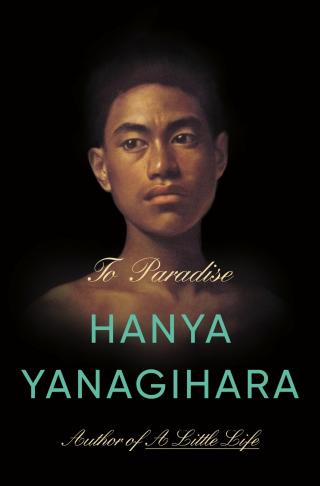
To Paradise
- Автор: Yanagihara Hanya
- Год: 2022
- Язык: английский
- Год: Knopf Doubleday Publishing Group
- Жанр: Современная русская и зарубежная проза

Электронная книга - «To Paradise». Краткое содержание книги:
In an alternate version of 1893 America, New York is part of the Free States, where people may live and love whomever they please (or so it seems). The fragile young scion of a distinguished family resists betrothal to a worthy suitor, drawn to a charming music teacher of no means. In a 1993 Manhattan besieged by the AIDS epidemic, a young Hawaiian man lives with his much older, wealthier partner, hiding his troubled childhood and the fate of his father. And in 2093, in a world riven by plagues and governed by totalitarian rule, a powerful scientist's damaged granddaughter tries to navigate life without him--and solve the mystery of her husband's disappearances.
These three sections are joined in an enthralling and...
It was still early, but people were already preparing to leave. “He’s tired,” they said of Peter to one another, and, to him, “Are you tired?,” to which Peter replied, time after time, “Yes, a little,” until a certain weariness entered his voice, one that could have been from his patience finally depleting or from genuine fatigue. He spent most of his days sleeping, he had told Charles, and in the evenings he would doze until midnight and then wake and “take care of things.”
Like what? he had asked at a lunch about six months ago, shortly after Peter had decided on his Switzerland plan.
“Gathering my papers. Burning letters I don’t want getting into the wrong hands. Finalizing the gift list appended to my will—deciding who gets what. Making a list of people I want to say goodbye to. Making a list of people I don’t want invited to my funeral. I had no idea how much of dying involves list-making: You make lists of people you like and people you hate. You make lists of people you want to say thanks to, and people you want to ask forgiveness from. You make lists of people you want to see and people you don’t. You make lists of songs you want played at your memorial service, and poems you might want read, and who you might want to invite.
“Of course, this is if you’ve been lucky enough to keep your mind. Though lately I’ve been wondering if it’s so lucky at all, being so conscious, being so aware that, from now on, you’ll never progress. You’ll never become more educated or learned or interesting than you are right now—everything you do, and experience, from the moment you begin actively dying is useless, a futile attempt to change the end of the story. And yet you keep trying to do it anyway—read what you haven’t read and see what you haven’t seen. But it isn’t for anything, you see. You just do it out of practice—because that’s what a human does.”
But does it have to be for anything? he had asked, tentatively. He was always nervous about addressing Peter directly, but he hadn’t been able to stop himself—he had been thinking about his father.
“No, of course not. But we’ve been taught that it must, that experience, that learning, is a pathway to salvation; that it’s the point of life. But it isn’t. The ignorant person dies the same way as the educated one. It makes no difference in the end.”
“Well, but what about pleasure?” Charles had asked. “That’s a reason to do it.”
“Certainly, pleasure. But pleasure doesn’t change anything, really. Not that one should do or not do things because they make no difference in the end.”
Are you scared? he had asked.
Peter had been quiet, and David had worried he had been rude. But then Peter spoke. “I’m not scared because I’m worried it’s going to hurt,” he said, slowly, and when he looked up, his large, light eyes looked even larger and lighter than usual. “I’m scared because I know my last thoughts are going to be about how much time I wasted—how much life I wasted. I’m scared because I’m going to die not being proud of how I lived.”
There had been a silence after that, and then the conversation had somehow changed. He wondered if Peter still felt that way; he wondered if he was thinking even now that he had wasted his life. He wondered if that was why Peter had tried chemotherapy after all, if he had decided he was going to try once more, if he was hoping he could change his mind, hoping he could feel differently. David hoped he did feel differently; he hoped Peter didn’t still feel as he had. It was an impossible thing to ask—Do you still feel you’ve wasted your life?—and so he didn’t, though later he would wish he had been able to find a way to do so. He thought, as he always did, of his father, of how he had willed his life away—or was it that he had willed himself away from it? It was his sole act of disobedience, and David hated him for it.
In the living room, the Three Sisters were putting on their coats, winding scarves around their throats, kissing Peter and then Charles goodbye. “You’ll be okay?” he heard Charles ask Percival. “I’ll see you next week, all right?” And Percival’s response: “Yes, I’m fine. Thanks, Charlie—for everything.” David was always moved by this side of Charles: his motherliness, his care. He had a sudden vision of one of the mothers in the picture books he and his father used to read together, babushkaed and aproned and pleasantly fat and living in a stone house in some unnamed village in some unnamed European country, slipping into her children’s pockets pebbles that she had heated in the oven so their fingers would stay warm on their walk to school.
He knew Charles had asked Adams to instruct the caterers to pack up all the leftover food so any of their guests could take some, though he knew Charles meant for the majority of it to go to John and Timothy. In the kitchen, he found some of the waitstaff placing the last of the cookies and cakes into cardboard containers, and the containers into paper bags, and others hefting large crates of dirty dishes out to their van, which was parked behind the house, in the courtyard that had once separated the main building from the carriage house, which was now a garage. James, he was disappointed and relieved to discover, was nowhere in sight, and for a moment he watched, mesmerized, at the tenderness with which one young woman lowered the remaining quarter of the cheesecake into a plastic tub, settling it as if it were a baby she was tucking into its cradle.
The only thing not put away was the misshapen brick of dark chocolate, scarred and dusty in parts like an oversize car battery. This, like the double-chocolate cake, was a signature of Charles’s parties, and the first time David had seen it, seen how one of the waiters had taken an awl and stuck it in its side, tapping it with a small hammer as another waiter held aloft a plate to catch the splinters that fell from it, he was enraptured. It seemed both improbable and ridiculous that people should order a cube of chocolate so big that they had to actually carve it with a hammer and chisel until its sides appeared to have been gnawed on by mice, and even more unlikely that he should be dating someone who thought this was unexceptional. He had described it later to Eden, who had scoffed and said unhelpful things like “This is why the revolution is coming” and “You better than anyone should know that eating sugar is an act of hostile colonialism,” but he could tell she was entranced as well by something that seemed like a child’s fantasy brought to life—after this, why shouldn’t one expect to find the house made of gingerbread, the clouds made of cotton candy, the trees in the Square made of peppermint bark? It became a running joke of theirs: The omelet she made was good, he said, but not chocolate-mountain good. The girl she’d had sex with the night before had been fine, she said, but she was no chocolate mountain. “The next party, you have to take a picture and prove to me the depth of Charles’s capitalist depravity,” she told him. She was always asking him when the next gathering would be, when she would finally get to see the evidence.
And so he had been excited to invite Eden to Charles’s next party, his annual pre-Christmas gathering. This had been last year, shortly after he’d moved in, and he had been nervous to ask, but Charles had been enthusiastic. “Of course you should bring her,” he said. “I’m looking forward to meeting this spitfire of yours.” Come, he had told Eden. Come hungry.
She had rolled her eyes. “I’m only coming for the chocolate mountain,” she said, and although she had tried to sound blasé, David had known she was excited as well.