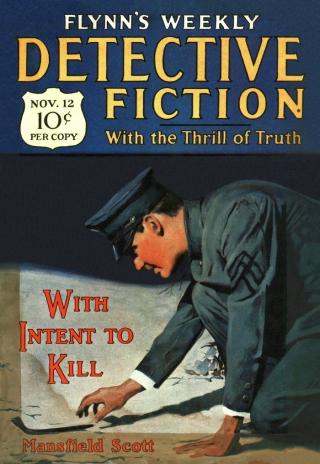
Flynn’s Weekly Detective Fiction. Vol. 28, No. 3, November 12, 1927
- Автор: Alexander R. W., Ames John
- Год: 1927
- Язык: английский
- Год: The Red Star News Company
- Жанр: Другие детективы

Электронная книга - «Flynn’s Weekly Detective Fiction. Vol. 28, No. 3, November 12, 1927». Краткое содержание книги:
But when Henri Henry reached the description of Brancion’s house, explained precisely where it was, and what took place there, Martin du Pont’s face lighted up with understanding.
“I know that house well,” he exclaimed, “and I’m giving it a prominent place in the book I’m preparing for the printer now!
“It was built in the year 1464 for a certain Lord Crespinoy, who had lived for a long time among the Turks, and had established a harem for himself at a time when polygamy was a hanging offense. This harem was concealed in a mysterious part of the building, which was large and ingeniously protected.
“I even have a manuscript, written in Latin by Lord Crespinoy himself, in which his harem’s quarters are described in detail, as well as the mechanism which works the entrance to this subterranean part of his house. I’ll read you the translation I’ve made of it. It’s somewhere in this pile of papers.”
With these words he pointed to a mountain of documents on a stand in the corner. Then he arose, upset the mountain with a single push of his hand and, after looking through the debris for a few moments, extracted a large sheet of school paper, covered with scribblings in a mousetrack handwriting, which was that of Martin du Pont himself.
He cleared his throat with a cough and began:
“This is a letter which Lord Crespinoy wrote to a friend in the provinces, who had formerly lived at the Turkish Court with him.
“Lord Crespinoy wrote half jokingly:
I have great fear that the elaborate precautions I have taken to avoid the punishment meted out to the polygamous may expose me to the persecution visited on those wretches who practice magic. The danger lies in the cleverness of the device I learned in the Orient, which has made it possible for me to fit out a secret apartment, underneath my house, between the ground floor and the cellars, somewhat like the boxes with false bottoms that jugglers use to deceive their public.
There is no apparent communication between this apartment and the rest of the house, and nothing to betray its existence to any one outside. The barred windows, which give it light and air, opening on the rear, look like vent holes, and do not attract any curiosity.
The only thing that might seem strange to an observant visitor is the length of the stairway leading from the ground floor into the cellar, which is not in proportion to the height of the cellar itself. But, aside from the fact that I receive few visitors anyway, those who do come have no reason to go down into the cellar. As for my servants, I brought them back from the East, as you know, and their faithfulness has been proved.
Nevertheless, the great ingenuity of the construction has almost got me the reputation of having dealings with the devil. The engineer who worked the thing out for me included a great interior vestibule, before coming into the secret apartment itself, large enough so that I can drive in with a carriage and four!
It’s done as follows: The marble landing by which you reach the main entrance to the house, is very high and hollow. It opens in the middle, with one of those complicated systems of pivots they have in Oriental palaces, revealing a passage, wide enough for the carriage to enter, down a gentle slope.
As the carriage goes down, the marble steps swing silently back into place behind it, so that the visitors — and some of them are charming! — have got out of the carriage before they realize that they are my prisoners.
But there they are, and if they don’t know the secret of the mechanism, it’s as impossible for them to get out as it would be for them to fly to the moon. Now, the machinery that opens and shuts the entrance makes use of that strange substance recently brought back from Germany which has spread terror on the battle-fields. It is a blackish stuff called powder, which when it is ignited, causes a sudden expansion of gases.
The use my engineer made of this expansive property is especially clever. The door is so delicately balanced on its pivots that a push with the little finger, from within and at the right point, is enough to open it. But without this push, it is impossible to open it. There is nothing you can do from the outside which will take the place of that push, even if you know the secret.
On the inside, however, running along the upper interior partition, is a narrow tube of stone, which leads to the movable part of the stonework. In this tube a charge of powder can be set off, not strong enough to destroy the tube, but with enough power to drive gases down it with considerable force of expansion. The pressure of these gases, when the powder has been ignited, is the only thing which will open the door on its pivots.
The door, as it closes by its own weight, works a mechanism, which drops into the tube a fresh charge of powder, exactly the same size as before. Consequently at each opening of the door there is an explosion and a cloud of smoke, which has aroused great curiosity among the peasants of the neighborhood.
At this point Mr. Martin du Pont looked up from his manuscript. “I don’t need to remind you, Mr. Henry,” he interjected, “that at the time this letter was written the house you are interested in, and which now stands in the midst of Paris, was surrounded by open fields, and that the city limits were still some distance away.”
After this commentary, the historian continued his reading:
As a result of this the peasants have already accused me of diabolical practices, and if weren’t for certain friends I have at the court, I should probably have suffered persecution.
At any rate, in, case anything should happen to me, I don’t want my secret to die with me and the treasures hidden under my house to be lost. That is why I am confiding to you in this letter, which I shall send by a trustworthy messenger, how it is possible to enter my secret apartment. Read what follows and learn it by heart, for you must burn this when you have read it.
“Fortunately for us,” added Martin du Pont, “Lord Crespinoy’s friend did not burn the letter, for its contents are as thrilling as the most marvelous of the ‘Thousand and One Nights.’ I intend, moreover, to read it at one of the approaching sessions of the Academy.”
Henri Henry nodded. His throat drawn, his eyes dilated, he listened eagerly to this revelation, the author of which had been dead for more than four centuries, but who now, with magnificent poetic justice, was supplying a powerful weapon against the scoundrel who was using — to carry out his crimes — the very chamber where Lord Crespinoy had concealed his pleasures.
After a moment’s pause the academician began again:
At each side of the main entrance, on the marble landing, are two small dogs carved in stone, which seem to be merely ornaments. To open the passage in the stonework, you take hold of the right-hand side dog’s left ear and turn it from left to right until the explosion occurs.
This ear is attached to a wire, which operates a flint lighter, placed so as to ignite the charge of powder in the stone tube. The passage will open, and you can enter. To get out, you merely have to apply a lighted torch to the powder.
Mr. Martin du Pont stopped once more, and looked up.
“After that,” he said, “there are various protestations of friendship that don’t interest either you or me. But what do you think of this amazing manuscript? I had neglected it a little until now, because it seemed so far fetched; the story you have just told me of the house located precisely where Lord Crespinoy’s was reminded me of it.”
“And I’m glad it did,” said Henry, “for now there can be no doubt of the guilt of the man I’m after, and you have shown me how to get into the room he thinks is impenetrable. Once there, I hope I shall uncover his other secret, which is even more terrifying than the first: that of the ‘object with a rectangular base.’ ”