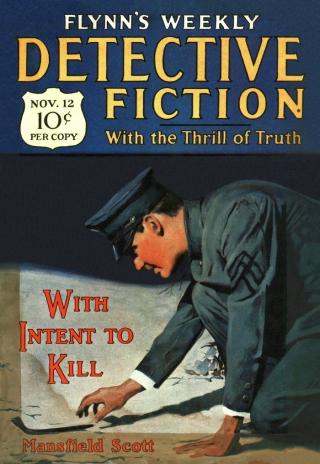
Flynn’s Weekly Detective Fiction. Vol. 28, No. 3, November 12, 1927
- Автор: Alexander R. W., Ames John
- Год: 1927
- Язык: английский
- Год: The Red Star News Company
- Жанр: Другие детективы

Электронная книга - «Flynn’s Weekly Detective Fiction. Vol. 28, No. 3, November 12, 1927». Краткое содержание книги:
And when my friend of the Secret Service finished his recital, I felt, despite a desire not to, a sort of sympathy for this pathetic old man who found it necessary to stick up a train single-handed after he had turned seventy.
The Bus That Vanished[3]
by Leon Groc
A commonplace omnibus becomes the vehicle of intrigue and mystery, as eight citizens disappear in the maw of Paris.
Chapter XXX
The Past Grips the Present
The attitude adopted by the escaped victims of Bus 519 left Henri Henry without any theory. His clear intelligence and rare faculties of intuition were, for the first time perhaps, utterly helpless before a problem. He did not know what to believe, and dared not let his imagination take flight.
A single gleam of hope shone through this mystery; a single clew which promised some day to uncover the truth he so ardently sought. Hence, abandoning all the other aspects of the situation, he came back time after time to the question which had so deeply moved Gilbert and Muret: “What was the object with the rectangular base stolen from the Villa Cécile?”
He felt sure that the answer to that question would of itself give him the key to the enigma, but he found no hypothesis which could explain the relation between this theft and the impudent security which the thief seemed to enjoy.
“This ‘object with a rectangular base,’ ” he remarked to Brunnel, “is evidently in Brancion’s hands. The visit to his house, which we are going to make tomorrow, with the help of our negro, is therefore more important than ever. It may not only give us the secret to the prison where that scoundrel held his captives, but also reveal the nature of this object which is the source of his power.
“On the success of this expedition depends the success of our investigation. Consequently we must leave nothing to chance, and take every possible precaution. We both of us know the man we have to deal with, and that he holds human life cheap.
“The more advance information we can get about the lair we are going to explore, the more chance we will have of escaping any traps he may set for us.”
“That is no doubt true,” agreed Brunnel, “but what are the precautions you speak of, and where can you expect to get any advance information?”
“From the one man who knows more than anybody else about the secrets of the old buildings of Paris. The house where Brancion has his headquarters is far from being modem; certain parts of it, at any rate, date from the fifteenth century.
“I happen to be acquainted with a learned decipherer of old manuscripts, who may not know anything about contemporary life, but certainly knows a great deal about Paris as it was during the Middle Ages and the Renaissance. I’ve had the honor and the pleasure of interviewing him several times — for it is an honor and a pleasure to talk with him.
“He is a member of the Academy of Inscriptions and Belles-Lettres, and is publishing a series of volumes on ‘Parisians in the Fifteenth Century.’ Last year he brought out a volume on ‘their costumes;’ this year it is to be ‘their houses.’ ”
“You mean Mr. Martin du Pont,” interrupted Brunnel, who prided himself on keeping up with the current books as they appeared.
“Exactly. And if, as certain indications lead me to believe, the secret part of Brancion’s house was constructed at the same time as the building itself, our friend the academician will certainly know all about it.”
“But will he be willing to share the results of his studies with us?”
The reporter smiled and answered:
“Your point is well taken, for any one who knows that Martin du Pont has no liking for reporters and hates to tell them all about his affairs. Generally speaking, he never even receives them.
“But he makes an exception for me, since I undertook a campaign one time — and carried it through successfully — after one of his communications to the Academy, to preserve one of the oldest corners in Paris.
“In spite of the fact that he never reads the papers, he knew how much help my articles had been in getting the old buildings that were precious to him, classed as historical monuments. And at present his door is always open to me. Now I will wager that he knows Brancion’s house as well as its owner, at least so far as the parts which date from past centuries are concerned.”
Strong in this conviction, the journalist presented himself, a few hours after his talk with Brunnel, at the learned academician’s house.
As he had foreseen, he was received at once in the scholar’s study.
Martin du Pont was about sixty years old; the front part of his head was bald and lined with deep wrinkles, while a bushy little beard flourished on his chin and cheeks. His blinking eyes were sheltered behind spectacles tinted a faint yellow, which gave his face a strange expression.
He was so careless of his clothes that his old valet, who had been his only servant for thirty years, had to drive him at intervals to have a new suit made. The bow-knot of the Legion of Honor, which he wore in his buttonhole, had grown faded and dingy. His coat pockets had been stretched out of shape by the many books he had stuffed into them, and he had even been known to attend meetings of the Academy without a tie.
His absent-mindedness was proverbial, and there were many anecdotes about it. It was he who came home soaked to the skin one rainy day, holding his umbrella carefully rolled up in its case. His faithful servant exclaimed: “Why didn’t you open it up?” And Mr. du Pont answered: “You’re right! I never thought of it.”
His study was as curious as himself. Piles of dusty papers stood about in a picturesque disorder. The scholar had given strict orders that they should never be disturbed.
“If you straighten things up,” he explained, “I’ll never be able to find anything.” And in fact, thanks to a sort of intuition, he could put his hand at once on any document he needed, among the hundreds which were stacked on the tables, the chairs, and even the floor.
When Henri Henry reached this sanctuary, Martin du Pont quickly cleared a chair of the folios which covered it, and said as hospitably as he knew how:
“Sit down, young man, sit down and tell me what brings you here. I don’t suppose you have come into my den just for the pleasure of seeing me?”
“Your time is too valuable, sir, for me to disturb you without a serious reason. I have come to ask the aid of your learning in a most important matter.”
“What!” exclaimed Martin du Pont. “Are the few vestiges of old Paris threatened again by vandals?”
The reporter smiled and hastened to reassure him.
“This time it is a very different sort of question,” he said. “You probably have not heard, since you don’t read the papers—”
“I haven’t time for it,” interrupted Martin du Pont, as if to excuse himself.
“Oh, I am not reproaching you, sir,” answered Henry. “But in order to explain the cause of my visit I must tell you about a certain affair which at present is very much in the public mind.”
And he told the story of the misadventures of Bus 519, to which the historian listened with a noticeable politeness and with a lack of interest that was equally noticeable. “How can this business,” he seemed to be thinking, “possibly have anything to do with my work?”
3
This story began in Flynn’s Weekly Detective Fiction for October 22.