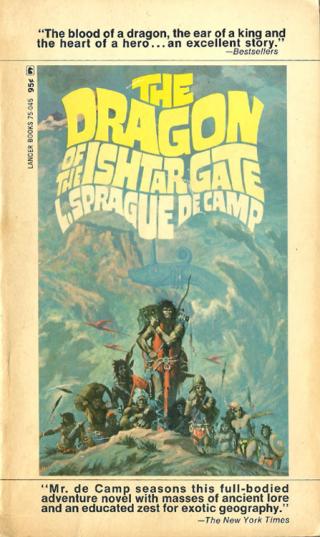
The Dragon of the Ishtar Gate
- Автор: Де Камп Лайон Спрэг
- Год: 1968
- Язык: английский
- Год: Lancer Books
- Жанр: Научная фантастика

Электронная книга - «The Dragon of the Ishtar Gate». Краткое содержание книги:
Dragon is probably closest in mood to de Camp's fantasy novels, while Bronze God and Arrows are closer to his science fiction, with their description of engineering problems, and personality clashes among researchers and engineers. Dragon also reflects de Camp's then-recent acquaintance with the Conan stories and other works of Robert E. Howard. Bessas, the huge Persian nobleman, is not only a close match for Conan in physique, but his mood swings, fixation on his mother, and tendency to toss of verses, seems a reflection of Howard himself. (Fortunately, his poems reflect de Camp's verbal dexterity and wit, not Howard's melancholy.)
"Really, old boy, I am no braver than most."
Bessas said: "You are brave enough for me. Belike the shortness of our tempers is the result of too much virtue for the past fortnight. Let's celebrate!"
"Celebrate what?" said Kothar.
"Just celebrate. I make merry when I feel like it, not when some priestly calendar says I should. We'll make a night of it!"
That evening, while Bessas, Myron, Shimri, and Skhâ reveled at the inn, Kothar bar-Malko sat quietly in an anteroom of the temple of Wepwawet, the wolf god of Siout. He wrote:
KOTHAR OF QADESH GREETS THE HOLY BELKISHIR, HIGH PRIEST OF MARDUK OF BABYLON
Mindful of your charge, your servant has guided those mortals committed to his care as far as this city of Siout in Egypt. Deadly perils have threatened us, and more than once we have been saved only by my occult insight and presence of mind. Today I averted a breakup of the company resulting from a quarrel between the leaders, Bessas of Zariaspa and his lieutenant, Myron of Miletos. For I agree with Your Holiness that the expedition must come to its appointed end, not in this teeming land where Persian officials watch the fall of every sparrow, but in the unknown territories beyond Kush where their fate can never be traced. Tomorrow, if my fellow travelers be not palsied from the effects of their disgusting dissipation, we shall resume our journey.
Kothar long studied the letter. Then he knelt and raised his arms in prayer. Long and fervently he prayed, with sweat bedewing his brow. He muttered:
"Seteh, patron of wizards and guardian of foreigners in the land of Khem, help me to decide!"
Fifty leagues south of Siout lay the second city of Egypt, a city of many names. To the most ancient Egyptians it was Weset; to those of more recent date, Opet. Those who now dwelt there more often called it the City of Amon, or simply the City. To the Greeks it was the City of Zeus, or Thebes of the Hundred Gates.
"I see no hundred gates," said Myron, as they neared the sprawling suburbs on the east bank of the Nile. "In fact, I see no wall at all. What sort of city is this, to have no wall?"
Kothar said: "There is none; or, if there ever was, it was outgrown in ancient times, and demolished and never rebuilt. For sieges, the temple inclosures provide space and security for the people. I believe the term 'hundred gates' refers to the pylons of these temples, of which there are ten pairs in the temple of Amon alone."
"I see what you mean," said Myron, staring in amazement at the vast lion-colored brick wall that inclosed the temenos of this temple, ahead and to their left.
Farther away on the left stood the smaller inclosure of the temple of Mont. Other temple walls, thirty to forty cubits high, could be seen across the river, in the City of the Dead on the west bank. Over the tops of these walls Myron glimpsed the roofs of temples, upheld by lotus-topped columns of enormous girth.
Nowhere in all his travels, not even in mighty Babylon, had Myron seen anything to compare with this amazing mass of sacerdotal stonework. Although Opet was a large and flourishing city, the private houses and the people seemed dwarfed. The sheer size and number of the temples rendered ordinary folk insignificant.
"If this be the Great Temple of Amon," said Myron, "It is our present destination. I have a letter of introduction to"—he fumbled in his scrip—"the priest Jed-hor, Second Prophet of Amon."
They dismounted and walked along an avenue, flanked by two rows of stone rams, to the gate in the outer wall. Kothar spoke to a temple guard, who bore a large wicker shield and a copper-headed spear and wore a helmet of crocodile skin. Kothar turned back to Myron.
"Our luck holds," he said. "Your man is now First Prophet of Amon. This means that he is the most powerful Egyptian in the land of Khem."
The guard whistled up another guard, who led the party through the gate. The outer wall of the temenos was a rough square, more than six hundred paces on a side. Inside lay the main temple. This was in the form of a long rectangle, four hundred and fifty by one hundred and fifty paces.
However, the symmetry of this rectangle had long ago been spoilt by kings who haphazardly added more buildings and monuments, until the vast temenos had become a chaos of walls, columns, pylons, courts, temples, statues, obelisks, and shrines. The temple compound was like a city in itself. Small detached temples stood here and there outside the main mass and in the courts of the larger temples. Most of the walls were covered with painted carvings, which showed forgotten kings dispatching their foes and adoring their gods.
The soldier led them through a vast unfinished pylon inside the wall, through a colonnaded court above a hundred paces on a side, and into an immense roofed hall. At the entrance they gave up their cloaks, boots, and other garments of animal origin to the doorkeeper.
Here a forest of more than a hundred carven columns upheld the roof. The twelve central columns were so huge that six tall men, with arms outstretched, could scarcely close a ring about one of them. Bessas remarked:
"No artist, I, but I like the audience halls at Persepolis better. There the columns are not so thick that a man can see nought."
Myron said to Kothar: "I wonder they let us in here; we are not purified initiates."
"Fear not; this part is open to the public. It is a long way yet to the sacred areas."
They passed through a bewildering series of pylons, courts, and passages. Bessas said: "It must take a new priest a year just to learn his way around this barrack."
They were made to sit in an open court on a bench of tawny brick while the First Prophet, the high priest of Amon, completed his devotions. Shaven-headed priests hurried by. Egyptian laymen wandered past in low-voiced groups, sometimes staring at the travelers. There was no open hostility, because Myron and Bessas now wore kilts instead of their telltale Persian trousers. They were obviously foreigners, but in their nondescript garb they might have been from anywhere.
Myron waited with keen anticipation, his heart pounding. All his life he had heard of the ancient wisdom of Egyptian priests. Having, by this unexpected stroke of luck, gained access to the highest priest in Egypt, Myron thought that surely he should be able to pry out some of this hoarded wisdom. If anyone knew the answers to the riddles of the cosmos, it should be the First Prophet of Amon.
As the sun sank, they were led through more passages into a room in a subsidiary building, where a small, slight, shaven-headed man in a voluminous and elaborately pleated white linen vestment sat on an ivory chair. Myron first guessed the man to be about his own age. But when the man smiled, his face, previously smooth, sprang into a multitude of wrinkles that showed him to be much older.
"Peace," said the small man in good Aramaic. "I am pleased to welcome friends of my old friend Uni, whose career I have long followed. I was a mere officiant when he entered the priesthood. Had he remained here he might have risen far in the hierarchy, but duty called him to the foreign field. I hope some day he will come back; who drinks the water of the Nile will surely return thereto. Tell me more about him."
Myron told about Uni. Then Jed-hor said: "I thank you, my son. As one ages, the doings of friends of one's youth become of increasing interest. When did you leave Persepolis?"
"On the fourth of Nisanu, Your Holiness."
Jed-hor frowned in the effort to translate the date into the Egyptian calendar. "By the horns of Hat-hor, that is good time! Two months and a few days over."