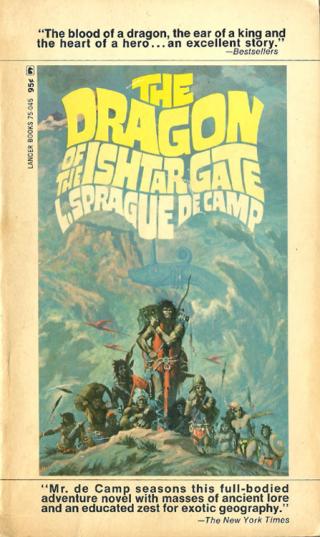
The Dragon of the Ishtar Gate
- Автор: Де Камп Лайон Спрэг
- Год: 1968
- Язык: английский
- Год: Lancer Books
- Жанр: Научная фантастика

Электронная книга - «The Dragon of the Ishtar Gate». Краткое содержание книги:
Dragon is probably closest in mood to de Camp's fantasy novels, while Bronze God and Arrows are closer to his science fiction, with their description of engineering problems, and personality clashes among researchers and engineers. Dragon also reflects de Camp's then-recent acquaintance with the Conan stories and other works of Robert E. Howard. Bessas, the huge Persian nobleman, is not only a close match for Conan in physique, but his mood swings, fixation on his mother, and tendency to toss of verses, seems a reflection of Howard himself. (Fortunately, his poems reflect de Camp's verbal dexterity and wit, not Howard's melancholy.)
"Maybe so," said Bessas. "But Cyrus and Darius continued to rule ably into eld. And Masistes would have done the like, had he gained the throne. Withal my father, who knew Cambyses, averred that those tales of Cambyses' madness were but lies sent abroad by Egyptian scribes, in revenge for his conquest of their country."
"Ah, but how can one determine in advance how the king will turn out? That's why in Hellenic cities we elect our chief men to office for limited times only."
"All very well for those lousy little walled villages you call cities, but it were absurd to apply such methods to a great empire."
Myron smiled wryly. "As the wise Solon wrote":
The people in their ignorance have bowed
In slavery to a monarch's single rule.
Bessas continued: "Masistes, now—ah, there was a man for you! Had the gods willed otherwise ..." The giant sighed and wiped away a tear.
"What about Masistes?" asked Skhâ. "Was that not a brother of the king, who died when I was a boy?"
"Aye," said Bessas somberly. "As I know the story better than most, since my father was a follower of Masistes, I shall tell the tale.
"Masistes was a brother of King Xerxes, satrap of Bactria, and commander of one of the six army corps. He had a wife, with whom he lived in such happiness as is possible to those in the married state, and several sons and daughters.
"After failure of the expedition against Hellas, Xerxes returned to Shushan. There he fell in love with Maisistes' wife, who however refused his suit. Not wishing to drag her to his couch by force, because of the standing of his brother, Xerxes thought to bring suasion to bear upon Masistes' wife by marrying her daughter Artaynta to his son Darius. Then, losing his passion for Masistes' wife, he conceived one equally hot for his daughter-in-law Artaynta, who did not deny him.
"You may judge the wisdom of promising to any mortal, let alone a woman, that one will give her anything she asks. Yet Xerxes, assotted with Artaynta, made this promise. And she demanded, of all things, the royal robe that Queen Amestris herself had woven for her husband the king.
"Fearing that his intrigue would be discovered, Xerxes tried by extravagant offers to persuade the foolish and reckless girl to change her demand. He offered her cities, treasures, and even a private army; but no, she would have the robe and nought else. At length Xerxes yielded and gave her the garment, which she wore. And, of course, Amestris heard of this gift.
"Now, whatever the virtues and faults of the Achaemenids, I had ten times rather be in the bad graces of one of them than of their women. This bloodthirty bitch of a queen decided, by some strange womanish process of thought, that Masistes' wife was the cause of Xerxes' intrigue with Artaynta. So, at the king's birthday party, she demanded Masistes' wife to do with as she listed. Custom requires that the king deny no request made to him at this banquet. Again the king sought to refuse. But Amestris persisted until, wearied of her demands and loath to break the law of the feast, he again gave in.
"Xerxes summoned his brother Masistes and ordered him to divorce his wife and wed one of Xerxes' daughters. But Masistes, who loved his wife, refused with such firmness as he dared to show. Meanwhile Amestris had sent soldiers to Masistes' quarters to mutilate Masistes' wife. They cut off her breasts, nose, ears, and lips, and they tore out her tongue.
"When Masistes returned to his house and found his wife so horribly used, he gathered his sons and partisans. Mad with fury, all set out for Bactria, where Masistes was much beloved and where he meant to raise a revolt against Xerxes. But Xerxes sent cavalry after them, and these overtook them on the road and slew them all."
"How t-terrible!" said Shimri, who was changing the padding inside Skhâ's helmet to make it fit better. "Had I been there, I should have saved Masistes."
"Forsooth? I think not. Anyway, it is said that Xerxes moaned and wept over the loss of his brother, who had been his ablest and most loyal supporter. And it is whispered that Xerxes has not slept with Amestris from that day to this. But of course all that did not bring back the noble Masistes."
"Ha!" said Shimri. "If—if the king's women misbehave, why does he not have them simply drowned or strangled?"
Myron: "With a mere slave or concubine he could, but not with his official wives. Know that Darius, when he acceded to the throne, agreed to take wives only from the families of the six conspirators who assisted him, and Xerxes follows the precedent. These families, the Daduchids and the rest, are the mightiest lords in the Empire. While they hold together and support the king, his throne is secure; but let him antagonize them and it would soon be rocking under his fundament. Oh, well, that's monarchy for you."
"It is not merely monarchy," said Kothar. "All government by common mortals falls into such disorder. Men will never be governed justly until they give all power into the hands of those who possess true occult wisdom—that is, persons like my unworthy self."
At Siout, Myron and Bessas quarreled. The cause of their quarrel was this: At Memphis, Bessas, claiming the need for haste, refused to grant Myron an extra day in which to visit the Sphinx and the pyramids of kings Khufu and Khafra three leagues north of the city. Then, when Bessas learnt that the men of Siout practiced a peculiar technique of fighting with quarterstaves, he took a day off to seek out experts at this form of combat and hire these men to teach him their tricks. At this, Myron bitterly complained of the loss of his chance to add to his store of knowledge.
"You may sneer at my mastery of different kinds of fighting," growled Bessas, "but 'twere better if you spent more time in weapon practice yourself. Whither we are going, such skills are all that will stand between us and the Bridge of Judgment."
"All I said," snapped Myron, "was that knowledge of other kinds is equally important—"
"Plague take you!" roared Bessas, his pock-marked face dark with rage. "If you like not how I run this venture, take yourself off! I release you from your oath I Get out of my sight, you lying, cowardly, boy-loving Greek-ling!"
Myron rose, pale. "For that I'll fight you. Get your weapons—anything but your bow—and I will get mine."
"Do you mean that?"
"You shall see when you feel my steel." Myron undid his baggage and pulled on his helmet. Bessas began to arm himself likewise.
"Mortals!" said a low but penetrating voice. It was Kothar, sitting quietly on a palm log. "Ere you shed each other's blood, I have that to say which may interest you."
"Forsooth?" said Bessas.
"Knowing the dangers of our journey, I have sought advice from the higher powers. I have watched the flight of birds; I have observed the wheeling stars; I have listened in the stillness of the night to the voices of my familiars. And I tell you this: disembodied spirits of evil, sent by your ill-wishers, menace you at this very moment. Unable to strike directly at you, because of my counterspells, they seek by sowing discord to incite you to destroy yourselves.
"Perils encompass you round, which united you may overcome. But, if you break up in a quarrel now, or ever the course be run, disaster will surely strike you all—those who go on and those who go back. So say the divine powers."
"Well—" said Bessas.
"Well—" said Myron.
"Oh, to demon land with it!" growled Bessas. He threw down his sword and buckler, caught Myron in a bear hug, and loudly kissed the smaller man on both cheeks. "Will you forgive my insult to your courage, old friend? By the Seven Guardian Stars, had you been a craven, you would never have stood up to me."
Myron had been, a moment before, fully expecting to die. Hence he was vastly relieved by the reconciliation, although he did not think it prudent to make much of this. He said: