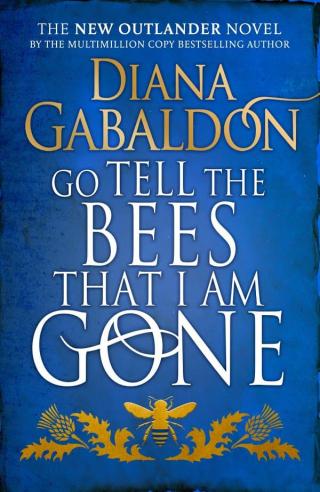
Go Tell the Bees That I Am Gone
- Автор: Гэблдон Диана
- Серия: Outlander #9
- Год: 2021
- Язык: английский
- Год: Delacorte Press
- ISBN: 978-1-473-51900-8
- Жанр: Исторические приключения

Электронная книга - «Go Tell the Bees That I Am Gone». Краткое содержание книги:
The past may seem the safest place to be . . . but it is the most dangerous time to be alive. . . .
Jamie Fraser and Claire Randall were torn apart by the Jacobite Rising in 1746, and it took them twenty years to find each other again. Now the American Revolution threatens to do the same. It is 1779 and Claire and Jamie are at last reunited with their daughter, Brianna, her husband, Roger, and their children on Fraser’s Ridge. Having the family together is a dream the Frasers had thought impossible. Yet even in the North Carolina backcountry, the effects of war are being felt. Tensions in the Colonies are great and local feelings run hot enough to boil Hell’s teakettle. Jamie knows loyalties among his tenants are split and it won’t be long until the war is on his doorstep. Brianna and Roger have their own worry: that the dangers that provoked their escape from the twentieth century might catch up to them. Sometimes they question whether risking the perils of the 1700s—among them disease, starvation, and an impending war—was indeed the safer choice for their family. Not so far away, young William Ransom is still coming to terms with the discovery of his true father’s identity—and thus his own—and Lord John Grey has reconciliations to make, and dangers to meet . . . on his son’s behalf, and his own. Meanwhile, the Revolutionary War creeps ever closer to Fraser’s Ridge. And with the family finally together, Jamie and Claire have more at stake than ever before.
“And you’re the church,” she said. “I’m proud of you.” Letting go then, she turned back and waved a hand toward the ghostly door.
“Well, if Mama and Da can rebuild from ashes, so can we. Will we rebuild here, or do you want to choose another place? I mean, I don’t know whether people would be superstitious about it being destroyed by lightning.”
He shrugged, feeling warm from her words.
“It’s not supposed to strike twice in the same place, is it? What could be safer? Come on, then; Lizzie and her ménage will be waiting.”
“Surely you mean her menagerie,” Bree said, kilting up her skirts for the hike to the Beardsley cabin. “Lizzie, Jo and Kezzie, and … I’ve forgotten how many children Mama said they have now.”
“So have I,” Roger admitted. “But we can count them when we get there.”
It wasn’t until the forest closed behind them and the path rose before them that he thought to ask. She hadn’t wanted to look beyond day-to-day survival during the worst of their journey, but he was sure that her vision of the present wasn’t limited to washing clothes and shooting turkeys.
“What do you think your own job might be? Here.”
He was following her; she turned her head briefly toward him and the sun touched her hair with flames.
“Oh, me?” she said. “I think maybe I’m the armorer.” She smiled, but the look in her eyes was serious. “We’re going to need one.”
12
Erstwhile Companions
WILLIAM SMELLED SMOKE. NOT hearth fire or wildfire; just an ashy tang on the wind, tinged with charcoal, grease—and fish. It wasn’t coming from the dilapidated house; the chimney had collapsed, taking part of the roof with it, and a big red-tinged creeper shrouded the scatter of stones and shingles.
There were poplar saplings growing up through the buckled boards of the small porch, too; the forest had begun its stealthy work of reclamation. But the forest didn’t smoke its meat. Someone was here.
He dismounted and tethered Bart to a sapling, primed his pistol, and made his way toward the house. It could be Indians on a hunt, smoking their game before carrying it back to wherever they’d come from. He’d no quarrel with hunters, but if it was squatters who’d thought to take over the property, they could think again. This was his place.
It was Indians—or one, at least. A half-naked man squatted in the shade of a huge beech tree, tending a small firepit covered with damp burlap; William could smell fresh-cut hickory logs, mingled with the thick smell of blood, fresh meat, smoke, and the pungent reek of drying fish—a small rack of split trout stood beside an open fire. His belly rumbled.
The Indian—he looked young, though large and very muscular—had his back to William and was deftly dressing out the carcass of a small hog that lay on a flattened burlap sack beside the firepit.
“Hallo, there,” William said, raising his voice. The man looked round, blinking against the smoke and waving it out of his face. He rose slowly, the knife he’d been using still in his hand, but William had spoken pleasantly enough, and the stranger wasn’t menacing. He also wasn’t a stranger. He stepped out of the tree’s shadow, the sunlight hit his hair, and William felt a jolt of astonished recognition.
So did the young man, by the look on his face.
“Lieutenant?” he said, disbelieving. He looked William quickly up and down, registering the lack of uniform, and his big dark eyes fixed on William’s face. “Lieutenant … Lord Ellesmere?”
“I used to be. Mr. Cinnamon, isn’t it?” He couldn’t help smiling as he spoke the name. The young man’s hair was now little more than an inch long, but only shaving it off entirely would have disguised either its distinctive deep reddish-brown color or its exuberant curliness. A French mission orphan, he owed his name to it.
“John Cinnamon, yes. Your servant … sir.” The erstwhile scout gave him a presentable half bow, though the “sir” was spoken with something of a question.
“William Ransom. Yours, sir,” William said, smiling, and thrust out his hand. John Cinnamon was a couple of inches shorter than himself, and a couple of inches broader; the scout had grown into himself in the last two years and possessed a very solid handshake.
“I trust you’ll pardon my curiosity, Mr. Cinnamon—but how the devil do you come to be here?” William asked, letting go. He’d last seen John Cinnamon three years before, in Quebec, where he’d spent much of a long, cold winter hunting and trapping in company with the half-Indian scout, who was near his own age.
He wondered briefly if Cinnamon had come in search of him, but that was absurd. He didn’t think he’d ever mentioned Mount Josiah to the man—and even if he had, Cinnamon couldn’t possibly have expected to find him here. He’d not been here since he was sixteen.
“Ah.” To William’s surprise, a slow flush washed Cinnamon’s broad cheekbones. “I—er—I … well, I’m on my way south.” The flush grew deeper.
William cocked an eyebrow. While it was true that Virginia was south of Quebec and that there was a good deal of country souther still, Mount Josiah wasn’t on the way to anywhere. No roads led here. He had himself come upriver with his horse on a barge to the Breaks, that stretch of falls and turbulent water on the James River where the land suddenly collapsed upon itself and put a stop to water travel. He’d seen only three people as he rode on above the Breaks—all of them headed the other way.
Suddenly, though, Cinnamon’s wide shoulders relaxed and the look of wariness was erased by relief.
“In fact, I came to see my friend,” he said, and nodded toward the house. William turned quickly, to see another Indian picking his way through the raspberry brambles littering what used to be a small croquet lawn.
“Manoke!” he said. Then shouted, “Manoke!” making the older man look up. The older Indian’s face lighted with joy, and a sudden uncomplicated happiness washed through William’s heart, cleansing as spring rain.
The Indian was lithe and spare as he’d always been, his face a little more lined. His hair smelled of woodsmoke when William embraced him, and the gray in it was the same soft color as smoke, but it was still thick and coarse as ever—he could see that easily; he was looking down on it from above, Manoke’s cheek pressed into his shoulder.
“What did you say?” he asked, releasing Manoke.
“I said, ‘My, how you have grown, boy,’” Manoke said, grinning up at him. “Do you need food?”
MANOKE WAS HIS father’s friend; Lord John had never called him anything else. The Indian came and went as he pleased, generally without notice, though he was at Mount Josiah more often than not. He wasn’t a servant or a hired man, but he did the cooking and washing-up when he was there, kept the chickens—yes, there were still chickens; William could hear them clucking and rustling as they settled in the trees near the ruined house—and helped when there was game to be cleaned and butchered.
“Your hog?” William asked Cinnamon, with a brief jerk of the head toward the covered firepit. He’d seen to Bart, then joined the Indians for supper on the crumbling porch, the men enjoying the soft evening air and keeping an eye on the drying fish, in case of marauding raccoons, foxes, or other hungry vermin.
“Oui. Up there,” Cinnamon said, waving a big hand toward the north. “Two hours’ walk. A few pigs in the wood there, not many.”
William nodded. “Do you have a horse?” he asked. It was a small hog, maybe sixty pounds, but heavy to carry for two hours—especially as Cinnamon presumably hadn’t known how far he’d have to go. He’d already told William that he’d never visited Mount Josiah before.