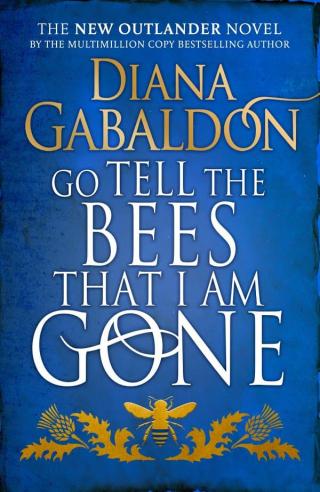
Go Tell the Bees That I Am Gone
- Автор: Гэблдон Диана
- Серия: Outlander #9
- Год: 2021
- Язык: английский
- Год: Delacorte Press
- ISBN: 978-1-473-51900-8
- Жанр: Исторические приключения

Электронная книга - «Go Tell the Bees That I Am Gone». Краткое содержание книги:
The past may seem the safest place to be . . . but it is the most dangerous time to be alive. . . .
Jamie Fraser and Claire Randall were torn apart by the Jacobite Rising in 1746, and it took them twenty years to find each other again. Now the American Revolution threatens to do the same. It is 1779 and Claire and Jamie are at last reunited with their daughter, Brianna, her husband, Roger, and their children on Fraser’s Ridge. Having the family together is a dream the Frasers had thought impossible. Yet even in the North Carolina backcountry, the effects of war are being felt. Tensions in the Colonies are great and local feelings run hot enough to boil Hell’s teakettle. Jamie knows loyalties among his tenants are split and it won’t be long until the war is on his doorstep. Brianna and Roger have their own worry: that the dangers that provoked their escape from the twentieth century might catch up to them. Sometimes they question whether risking the perils of the 1700s—among them disease, starvation, and an impending war—was indeed the safer choice for their family. Not so far away, young William Ransom is still coming to terms with the discovery of his true father’s identity—and thus his own—and Lord John Grey has reconciliations to make, and dangers to meet . . . on his son’s behalf, and his own. Meanwhile, the Revolutionary War creeps ever closer to Fraser’s Ridge. And with the family finally together, Jamie and Claire have more at stake than ever before.
Someone had put a stranger with no ears in the grave marked Benjamin Grey, and whomever it was almost certainly knew what had happened to Ben. He’d talked to—at latest count—twenty-three militiamen who’d been in the Watchung Mountains with Washington during the time when Ben had theoretically died. Four of them had heard of Ben and heard that he was dead, but none of them had seen the body or the grave, and he’d swear that none of them were lying.
But. Uncle Hal had received a letter telling him of Ben’s death. It had been passed to him by an aide to General Clinton, who had received the letter from some officer on the American side. Who had written that letter?
“Why the bloody hell didn’t you ask to see it?” he muttered to himself. Because you were too busy being on your high horse about your damned dignity, his mind replied.
That was the logical next thing to do, though. Find out the name of the American officer who wrote the letter and then … find the officer, if he hadn’t been shot, been captured, or died of syphilis in the meantime.
The next step was logical, too: Uncle Hal would certainly have kept the letter—and Uncle Hal (and Papa …) had the sorts of army connections that might allow them to make inquiries about the whereabouts of a specific American officer.
He’d have to go to Savannah, then, and hope that the British army was still holding the city. And that his father and Uncle Hal were still with said army.
MANOKE AND CINNAMON were smoking tobacco on the porch when he came back. The smoke mingled with the rising ground mist, a sweet, cool vapor, smelling of plants.
Evidently they’d been discussing things while he was gone, for Manoke removed his pipe when William sat down.
“Do you know where he is?” he asked directly. “Our Englishman?”
Our Englishman, forsooth, William thought, and glanced at Cinnamon. The Indian’s head was bent, absorbed in stuffing his pipe, but William thought he could see a certain stiffening of the big shoulders.
“No,” William said, but honesty compelled him to add, “The last time I saw him, he was with the army in Savannah. That’s in Georgia.” Manoke nodded, but with a certain blankness of expression that betokened complete ignorance of what or where Georgia might be. Wherever Manoke’s private paths might take him, it evidently wasn’t south.
“How far is that?” Cinnamon asked, his voice casual.
“Maybe four hundred miles?” William hazarded. It had taken him nearly two months to make the journey to Virginia, but he hadn’t been moving with any real sense of intent; he asked questions about Ben as he went, but in reality he was just drifting uncertainly toward the only place where he’d always felt happy and at home since leaving Helwater, his home in the Lake District of England.
If he said no more, presumably Cinnamon would set off for Georgia, leaving William to what peace he could find here. William wiped his face with his sleeve; the smell of smoked meat, fish, and tobacco hung heavy in his clothes; Mount Josiah would travel with him for some time.
He could send a letter with Cinnamon, asking Uncle Hal to make inquiries for the American officer who’d sent the notification of Ben’s death. He could do what he’d come to do: sit and think.
And let Papa meet this fellow without warning? He was honest enough to admit that his disinclination to allow this had nothing to do with the potential embarrassment to Lord John or inconvenience to Cinnamon, but with a mixture of curiosity and … well, simple jealousy. If Lord John was going to meet his natural son as a grown man, he, William, wanted to be there to witness the meeting.
“The army moves a lot, you know,” he said at last, and Manoke smiled at him.
Cinnamon made a soft sound of acknowledgment and bobbed his head, though he kept his eyes fixed on the beaded tobacco pouch on his knee.
“Do you want me to take you to him?” William asked, his voice a little louder than he’d intended it to be. “To Lord John?”
Cinnamon lifted his head, startled, and looked at William for a long, inscrutable moment.
“Yes,” he said at last, softly, and then bending his head again said more softly still, “Thank you.”
Well, what the devil, William thought, taking the pipe Manoke offered him. I can think on the way.
13
“What Is Not Good for the Swarm Is Not Good for the Bee” (Marcus Aurelius)
THE FIRST FLOOR HAD now been walled in from the outside, though much of the inside was still just timber studs, which gave the place rather a nice sense of informality as we walked cheerfully through the skeletal walls.
My surgery had no coverings for its two large windows, nor did it have a door—but it did have complete walls (as yet unplastered), a long counter with a couple of shelves over it for my bottles and instruments, a high, wide table of smooth pine (I had sanded it myself, taking great pains to protect my future patients from splinters in their bottoms) on which to conduct examinations and surgical treatment, and a high stool on which I could sit while administering these.
Jamie and Roger had begun the ceiling, but there were for the moment only joists running overhead, with patches of faded brown and grimy gray canvas (salvaged from a pile of decrepit military tents found in a warehouse in Cross Creek) providing actual shelter from the elements.
Jamie had promised me that the second floor—and my ceiling—would be laid within the week, but for the moment I had a large bowl, a dented tin chamber pot, and the unlit brazier strategically arranged to catch leaks. It had rained the day before, and I glanced upward to be sure there were no sagging bits holding water in the damp canvas overhead before I took my casebook out of its waxed-cloth bag.
“What ith—is that?” Fanny asked, catching sight of it. I had put her to work picking off and collecting the papery skins from a huge basket of onions for steeping to make yellow dye, and she craned her neck to see, keeping her onion-scented fingers carefully away.
“This is my casebook,” I said, with a sense of satisfaction at its weight. “I write down the names of the people who come to me with medical difficulties, and describe each one’s condition, and then I put down what it was that I did or prescribed for them, and whether it worked or not.”
She eyed the book with respect—and interest.
“Do they always get better?”
“No,” I admitted. “I’m afraid they don’t always—but very often they do. ‘I’m a doctor, not an escalator,’” I quoted, and laughed before remembering that it wasn’t Brianna I was talking to.
Fanny merely nodded seriously, evidently filing away this piece of information.
I coughed.
“Um. That was a quote from a, er, doctor friend of mine named McCoy. I think the general notion is that no matter how skilled a person might be, every skill has its limits and one is well advised to stick to what one’s good at.”
She nodded again, eyes still fixed in interest on the book.
“Do you … think I might read it?” she asked shyly. “Only a page or two,” she added hastily.
I hesitated for a moment, but then laid the book on the table, opened it, and paged through to the spot where I had made a note about using gallberry ointment for Lizzie Wemyss’s malaria, as I hadn’t any Jesuit bark. Fanny had heard me talk about the situation to Jamie, and Lizzie’s recurrent ague was common knowledge on the Ridge.