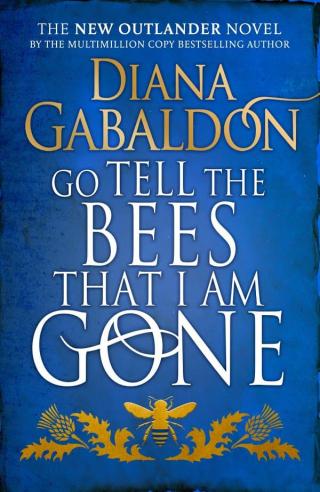
Go Tell the Bees That I Am Gone
- Автор: Гэблдон Диана
- Серия: Outlander #9
- Год: 2021
- Язык: английский
- Год: Delacorte Press
- ISBN: 978-1-473-51900-8
- Жанр: Исторические приключения

Электронная книга - «Go Tell the Bees That I Am Gone». Краткое содержание книги:
The past may seem the safest place to be . . . but it is the most dangerous time to be alive. . . .
Jamie Fraser and Claire Randall were torn apart by the Jacobite Rising in 1746, and it took them twenty years to find each other again. Now the American Revolution threatens to do the same. It is 1779 and Claire and Jamie are at last reunited with their daughter, Brianna, her husband, Roger, and their children on Fraser’s Ridge. Having the family together is a dream the Frasers had thought impossible. Yet even in the North Carolina backcountry, the effects of war are being felt. Tensions in the Colonies are great and local feelings run hot enough to boil Hell’s teakettle. Jamie knows loyalties among his tenants are split and it won’t be long until the war is on his doorstep. Brianna and Roger have their own worry: that the dangers that provoked their escape from the twentieth century might catch up to them. Sometimes they question whether risking the perils of the 1700s—among them disease, starvation, and an impending war—was indeed the safer choice for their family. Not so far away, young William Ransom is still coming to terms with the discovery of his true father’s identity—and thus his own—and Lord John Grey has reconciliations to make, and dangers to meet . . . on his son’s behalf, and his own. Meanwhile, the Revolutionary War creeps ever closer to Fraser’s Ridge. And with the family finally together, Jamie and Claire have more at stake than ever before.
I nodded, and he closed the book gently and handed it back. I clasped it to my bosom, overwhelmed with anticipation. Thirteenth edition—from 1977!
Roger coughed, and when Brianna looked at him, he tilted his head toward the bag.
“And …” she said, smiling at Jamie. “For you, Da.” She pulled out a small, thick paperback and handed it to him. “And for you …” A second book followed the first. “And this one’s for you, too.” The third.
“They all go together,” Roger said gruffly. “It’s all one story, I mean, but printed in three volumes.”
“Oh, aye?” Jamie turned over one of the books gingerly, as though afraid it might disintegrate in his hands.
“It’s glued, is it? The binding?”
“Aye,” Roger said, smiling. “It’s called a paperback, that sort of wee book. They’re cheap and light.”
Jamie weighed the book on his hand and nodded, but he was already reading the back cover.
“Frodo Baggins,” he read aloud, and looked up, baffled. “A Welshman?”
“Not exactly. Brianna thought the tale might speak to ye,” Roger said, his smile deepening as he looked at her. “I think she’s right.”
“Mmphm.” Jamie gathered the trio of books together and—with a thoughtful look at the sticky fingerprints Mandy had left on her cup—put them on the top of my simples closet. He kissed Bree and nodded toward her bag.
“Thank ye kindly—I ken they’ll be braw. What did ye bring for yourself, lass?”
“Well … mostly small tools,” she said. “Mostly things that exist now, but of a better quality, or that I couldn’t get here without a lot of trouble and expense.”
“What, nay books at all?” Jamie asked, smiling. “Ye’ll be the only illiterate of the family?”
Bree was already flushed with pleasure and excitement, but grew noticeably pinker at this question.
“Um. Well … just the one.” She glanced at me, cleared her throat, and reached into the almost-empty bag.
“Oh,” I said, and the tone of my voice made Jamie look at me, rather than at the hardbound book in its plastic-covered dust jacket. The Soul of a Rebel, it said. The Scottish Roots of the American Revolution. By Franklin W. Randall, PhD.
Bree was looking at Jamie, a small anxious frown between her brows, but at this, she turned to me.
“I haven’t read it yet,” she said. “But you—either of you,” she added, glancing between me and Jamie, “are welcome to read it anytime. If you want to.”
I met Jamie’s eyes. His brows lifted briefly and he looked away.
BRIANNA AND ROGER took the sticky cups, mixing bowl, spoon, and milk pitcher outside to rinse, and I sat down beside Jamie on a large sack of dried beans to gloat over my Merck Manual for a few minutes. He was turning Frank’s book over in his hands with a ginger air indicating that he thought it might explode, but put it aside and smiled when he saw me fondling the blue pebbled cover of my new baby.
“D’ye mean to read it through from beginning to end, like the Bible?” he asked. “Or will ye just wait ’til someone comes to ye with blue spots and look that up?”
“Oh, both,” I assured him, weighing the chunky little book in my hand. “It may have new treatments to suggest for things I recognize—but it undoubtedly describes things I’ve never seen or heard of, too.”
“May I see it again?” He held out a hand, and I carefully laid the book in it. He opened it at random, read … “Trypanosomiasis.” His eyebrows rose. “Can ye do anything about trypanosomiasis, Sassenach?”
“Well, no,” I admitted. “But—on the off chance that I should encounter trypanosomiasis, at least I’d know what it was, and that might save the patient from being subjected to an ineffective or dangerous treatment.”
“Aye, and give him time to write his will and summon a priest, too,” he said, closing the book and handing it back.
“Mm,” I said, not really wanting to dwell on the possibility—well, the dead certainty, in fact—of diagnosing fatal conditions I couldn’t treat. “What about your books? Do they look interesting?” I nodded toward the stack of thick paperbacks, and his face lit up. He picked up the first volume and riffled the pages, slowly, then turned back to the first page and read in a husky voice:
“Concerning Hobbits. This book is largely concerned with Hobbits, and from its pages a reader may discover much of their character and a little of their history.”
“That’s just the Prologue,” I assured him. “You could skip that, if you like.”
He shook his head, eyes fixed on the page, smiling.
“If the author thought it was worth his writing it down, then it’s worth my reading it. I dinna mean to miss a single word.”
A sharp pang struck me then, seeing the reverential way in which he handled the book, turning over pages with a delicate forefinger. A book—any book—had a meaning well beyond its contents for a man who’d lived years at a time with little or no access to the printed word, and only the memory of stories to provide him and his companions escape from desperate circumstances.
“Have ye read these, Sassenach?” he asked, looking up.
“No, though I’ve read The Hobbit, by the same author. Bree and I read that one together when she was in the sixth grade—about twelve years old, I mean.”
“Ah. So ye wouldna say these are lewd books?”
“What? No, not at all,” I said, laughing. “Whatever gave you that idea?”
“Nothing, from the cover—I’ve never seen so much printing on the outside of a book—but ye canna tell, can ye?” He closed the book with obvious reluctance. “I was thinking, we might read these in the evenings, maybe everyone taking it in turn to read a chapter. Jem and Germain are old enough to manage it. D’ye think Frances can read?”
“I know she can. Her sister taught her, she said.” I rose and came over to him, leaning against his shoulder to look at The Fellowship of the Ring. “That’s a wonderful idea.” We had done that with Jenny and Ian during the brief months of our early marriage spent at Lallybroch: passed firelit hours of peace and happiness in the evenings while one person or another read aloud and the others knitted stockings or mended clothes or small bits of furniture. The rosy vision of such evenings here, our own family in our own home, made my heart glow in my chest.
He made a low Scottish noise indicating content and set the book down, next to the hardcover book Bree had brought for herself. Frank’s book. My already tenderized heart squeezed a little, at once happy and sad that she had brought it to remember him, to bring him with her into this new life.
Jamie saw me looking at the book and made another Scottish noise, this one indicating cautious interest. I nodded at The Soul of a Rebel. “Are you going to read that one?”
“I dinna ken,” he admitted, glancing at it. “Have you read it, Sassenach?”
“No.” I felt a small qualm at the admission. The fact was that while I’d read all of Frank’s articles, books, and essays during what I thought of as our first marriage, I hadn’t been able to bring myself to read any of the books he’d written during our second go, save a brief look at one that dealt with the aftermath of Culloden, when I began to search for the men of Lallybroch.
“This one was published after I … came back,” I said, my throat tight. “It was the last book he wrote. I’ve not even seen it before.” I wondered, for an instant, whether Bree had picked that one because the photograph of Frank on it was what he’d looked like the last time she saw him, or whether she’d chosen it mostly because of the title.