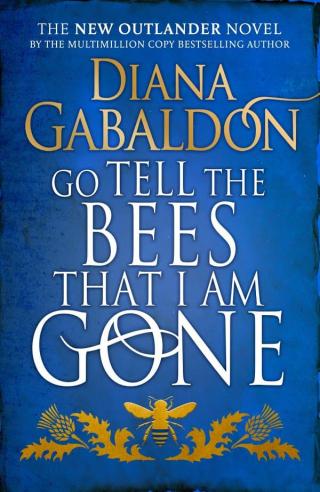
Go Tell the Bees That I Am Gone
- Автор: Гэблдон Диана
- Серия: Outlander #9
- Год: 2021
- Язык: английский
- Год: Delacorte Press
- ISBN: 978-1-473-51900-8
- Жанр: Исторические приключения

Электронная книга - «Go Tell the Bees That I Am Gone». Краткое содержание книги:
The past may seem the safest place to be . . . but it is the most dangerous time to be alive. . . .
Jamie Fraser and Claire Randall were torn apart by the Jacobite Rising in 1746, and it took them twenty years to find each other again. Now the American Revolution threatens to do the same. It is 1779 and Claire and Jamie are at last reunited with their daughter, Brianna, her husband, Roger, and their children on Fraser’s Ridge. Having the family together is a dream the Frasers had thought impossible. Yet even in the North Carolina backcountry, the effects of war are being felt. Tensions in the Colonies are great and local feelings run hot enough to boil Hell’s teakettle. Jamie knows loyalties among his tenants are split and it won’t be long until the war is on his doorstep. Brianna and Roger have their own worry: that the dangers that provoked their escape from the twentieth century might catch up to them. Sometimes they question whether risking the perils of the 1700s—among them disease, starvation, and an impending war—was indeed the safer choice for their family. Not so far away, young William Ransom is still coming to terms with the discovery of his true father’s identity—and thus his own—and Lord John Grey has reconciliations to make, and dangers to meet . . . on his son’s behalf, and his own. Meanwhile, the Revolutionary War creeps ever closer to Fraser’s Ridge. And with the family finally together, Jamie and Claire have more at stake than ever before.
“From your point of view, a floating plank on the trout pond would be just as bad as the Queen Mary—that’s a really big ship.”
“Aye, well, I expect the food would be better on the latter,” he said, unperturbed by my teasing. “And as long as I had your wee stabbers in my face, I could choose on that basis. So, did ye ken the weather changed a great deal in forty years?” he asked, returning the conversation to Bree, who shook her head.
“Not the storms and wind-type weather—I mean, it might have, but we’d have no way of knowing that. What we did know, though, was the political weather.”
“The war,” Roger said, correctly interpreting my blank look. “The British were—I mean, they are—blockading and interrupting trade and seizing American ships right and left these days. What if we chose the wrong ship and ended up being sunk or captured, or me being pressed into the British navy, leaving Bree and the kids to decide whether to go through the stones by themselves, or stay in Jamaica or wherever and try to find me?”
“That’s sensible,” Jamie said. “So ye took ship in 1739, then. How was it?”
“Horrible,” Bree said promptly, just as Roger said, “Terrible!” They looked at each other and laughed, though with an undertone that belied their mirth; it was the slightly nervous laughter of survivors who weren’t yet entirely sure they’d made it.
They’d traveled on a brig called the Kermanagh, out of Inverness, to Edinburgh, where they’d found passage on the Constance, a small merchant ship, headed for Charles Town.
“No staterooms,” Roger said. “Just a wee nook in the hold, between the water barrels and stacks of chests full of cloth: linen, muslin, woolens, and silks. The smell was pretty strong—fuller’s earth and sizing and dyes and urine, ken?—but it could have been worse. The people at the other end of the hold were squashed between crates of salt fish and barrels of gin. With the fumes, they were mostly comatose, so far as we could tell in the dark.”
“They were lucky, if so,” Brianna said ruefully. “We hit four—not one, not two, not three, but four—storms along the way. Between being sure we were going to the bottom any minute and caroming off the cargo every other minute—except for Mandy, we were all bruised everywhere. I kept her in my lap pretty much the whole trip, with my cloak wrapped around us both, for warmth.”
Jamie looked slightly green, merely listening to this, and I had to admit to feeling a sympathetic lurch of the insides myself.
“What did you eat?” I asked, in hopes of stabilizing myself and the conversation.
“Cold parritch,” Roger said with a shrug. “Mostly. Some cold bacon, too. And neeps. Lots of neeps.”
“Raw neeps?” I asked.
“Oh, come on,” Bree protested. “They’re just like apples, except not sweet. And I brought apples and raisins, too, and carrots, and a jar of boiled spinach and one of pickles—and we got one of the casks of salt fish …”
“Oh, my God,” said Roger, with feeling. “I thought I was going to die of thirst after eating one of them …”
“No one told ye to soak them?” Jamie said, grinning.
“We had cheese, too,” Bree said, but it was clear she was fighting a losing battle.
“Well, the cheese wasn’t that bad, if you washed it down with gin … you ever seen a cheese mite, up close?”
“Could ye see them?” Jamie asked, interested. “I’ve been in a ship’s hold more than once and I couldna see my hand in front of my face.”
“Aye,” Roger said. “We couldn’t have an open light in the hold, of course, so the only time we had light was when they opened the hatch cover. Which they did whenever the weather was fine,” he added, with an attempt at fairness.
“That doesna sound sae bad,” Jamie said. “Ye dinna even notice cheese mites, if ye’re hungry. And raw neeps are very filling …”
Bree made a small noise of amusement; I didn’t. He was teasing, but not joking. I recognized the vivid memory of long years of near-starvation in the Highlands after Culloden, and something not far from it in Ardsmuir Prison.
“How long were you at sea?” I asked.
“Seven weeks, four days, and thirteen and a half hours,” Brianna said. “It was a pretty quick trip, thank God.”
“Aye, it was,” Roger agreed. “The last storm hit us near the coast, though, and we had to come ashore at Savannah. I didn’t think I’d get this lot onto another boat”—he waved casually at his wife and children—“but then we asked just how far it was, and faced with the prospect of walking five hundred miles … we found another boat.”
This one was a fishing boat. “An open boat, thank God,” Bree said fervently. “We slept on deck.”
“So ye came to the stones at last, then,” Jamie said. “How was it?”
“We almost didn’t make it,” Roger said quietly. He looked at the children, asleep on the settle. Mandy had fallen over and was sprawled on her face, limp as Esmeralda. “It was Mandy who got us through—and you,” he added, raising his eyes to Jamie with a slight smile.
“Me?”
“You wrote a book,” Bree said softly, looking at him. “A Grandfather’s Tales. And you thought to put a copy in the box with your letters.”
Jamie’s face changed and he looked down at the floor, suddenly abashed.
“Ye … read it?” he asked, and cleared his throat.
“We did.” Roger’s voice was soft. “Over and over.”
“And over,” Bree added, eyes warm with the memory. “Mandy could recite some of her favorite stories word for word.”
“Aye, well …” Jamie rubbed his nose. “But what has that to do wi’ …”
“She found you,” Roger said. “In the stones. We all were thinking as hard as we could, about you and Claire and the Ridge and—and everything we recalled, I suppose. Too much, maybe—too many different things.”
“I can’t begin to describe it,” Bree said, and of course she couldn’t—but the shadow of it lay on her face. “We—couldn’t get out. We stepped through and we were … it’s kind of like exploding, Da,” she said, trying. “But so slowly you can … sort of feel yourself coming apart. When we did it before—it was like that, but it was over pretty fast. This time … it didn’t stop.”
I felt the memory of it, at her words, and everything inside me lurched as though I’d been thrown off a cliff. Bree had gone pale, but she swallowed and went on.
“I—we—you can’t really talk, but you’re sort of aware of who’s with you, who you’re holding on to. But Mandy—and Jem, a little—are … kind of stronger than either Roger or me. And I—we—could hear Mandy, saying, ‘Grandda! Blue pictsie!’ And suddenly, we were … all on the same page, I guess you could say.”
Roger smiled at that, and took up the story.
“We were all thinking of you, and of that specific story; it’s the one with the illustration of a blue pictsie. And … then we were lying on the ground, almost literally in pieces, but … alive. In the right time. And together.”
Jamie made a small sound in his throat—the only inarticulate Scottish noise I’d ever heard from him. I looked away and saw that Jem was awake; he hadn’t moved but his eyes were open. He sat up slowly and leaned forward, elbows on his knees.
“It’s okay, Grandda,” he said, his voice froggy with sleep. “Don’t cry. Ye got us here safe.”