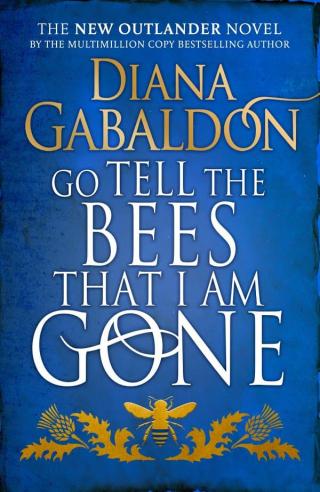
Go Tell the Bees That I Am Gone
- Автор: Гэблдон Диана
- Серия: Outlander #9
- Год: 2021
- Язык: английский
- Год: Delacorte Press
- ISBN: 978-1-473-51900-8
- Жанр: Исторические приключения

Электронная книга - «Go Tell the Bees That I Am Gone». Краткое содержание книги:
The past may seem the safest place to be . . . but it is the most dangerous time to be alive. . . .
Jamie Fraser and Claire Randall were torn apart by the Jacobite Rising in 1746, and it took them twenty years to find each other again. Now the American Revolution threatens to do the same. It is 1779 and Claire and Jamie are at last reunited with their daughter, Brianna, her husband, Roger, and their children on Fraser’s Ridge. Having the family together is a dream the Frasers had thought impossible. Yet even in the North Carolina backcountry, the effects of war are being felt. Tensions in the Colonies are great and local feelings run hot enough to boil Hell’s teakettle. Jamie knows loyalties among his tenants are split and it won’t be long until the war is on his doorstep. Brianna and Roger have their own worry: that the dangers that provoked their escape from the twentieth century might catch up to them. Sometimes they question whether risking the perils of the 1700s—among them disease, starvation, and an impending war—was indeed the safer choice for their family. Not so far away, young William Ransom is still coming to terms with the discovery of his true father’s identity—and thus his own—and Lord John Grey has reconciliations to make, and dangers to meet . . . on his son’s behalf, and his own. Meanwhile, the Revolutionary War creeps ever closer to Fraser’s Ridge. And with the family finally together, Jamie and Claire have more at stake than ever before.
Cinnamon eyed the gifts dubiously, but nodded.
“You suck a pickle if you feel queasy,” William explained. “If that doesn’t work, take six drops of the ether. You can put it in beer if you like,” he added helpfully.
“Thank you.” The wind had restored Cinnamon’s usual ruddy glow. “Thank you,” he said again, and seized William’s hand in a grasp of crushing earnestness. “And tell your sister—how much … how much …” The tide of rising emotion choked him, and he shook his head and wrung William’s hand harder.
“You told her,” William said, easing the hand free and repressing an urge to count his fingers. “She was happy to do it. She’s happy for you. So am I,” he added, patting Cinnamon affectionately on the forearm, as much to avoid being seized again as from the very real affection he felt. “I’ll miss you, you know,” he added diffidently.
He would, and the realization struck him like a blow behind the ear. He felt suddenly hollow, but couldn’t think of anything else to say.
“Moi, aussi,” Cinnamon said, and looked down at his new boots, clearing his throat.
“All aboard!” The naval lieutenant captaining the tender was glaring down at them. “Now, gentlemen!”
William picked up the new portmanteau—a gift from Lord John—and thrust it into Cinnamon’s hand.
“Go,” he said, smiling as hard as he could. “Write to me from London!”
Cinnamon nodded, speechless, then, at another irate shout from the tender, turned and lumbered blindly aboard. The tender’s sails dropped and filled at once, and within a minute, they were in the middle of the river, flying toward the unknown future. William watched the little ship out of sight, then turned back toward Bay Street with a sigh, his sense of loss tinged by envy.
“Au revoir, Michel,” he said, under his breath. “Now who am I going to talk to?”
125
A Woman of the Second Type
ONCE CINNAMON HAD GONE, William moved from the small house they had shared back into Lord John’s house, at his father’s invitation. Amaranthus, Lord John said firmly, needed company.
“She doesn’t accept invitations,” he’d told William, “and only goes out now and then to the shops—”
“She must be in low spirits,” William said. He’d meant it jokingly, but the way in which his father glared at him made him feel ashamed. “Surely you’ve told her that no one knows?”
“Of course I have,” Lord John said impatiently. “So has Hal, with a surprising amount of delicacy. She just hangs her head and says she can’t bear to be seen. ‘On display’ was the rather odd way she put it.”
“Oh,” said William, somewhat enlightened. “Well, that does make more sense.”
“It does?”
“Well,” William said, a little awkwardly, “as a young widow, and the mother of the heir to Uncle Hal’s title … she’d attract—I mean, she did attract a good deal of … interest? At parties and dinners and that sort of thing, I mean.”
“And enjoyed such interest very much, so far as I could see,” his father observed cynically, giving him a sidelong look.
“Quite.” William turned aside, picking up and pretending to examine a Meissen plate from the sideboard. “But now she’s been … er … exposed, so to speak … even if only among us …” He coughed. “I think perhaps she feels she can’t act the part of a beautiful young widow, and, um …”
“She’d feel somewhat conscious, flirting with fatheaded young men, knowing that even if neither Hal nor I was present, we’d likely hear about it. Hmm.” Lord John appeared to find this dubious, but plausible. Then he made the next—inevitable, William supposed—deduction.
“After all, what would she do if one of the bright young sparks she touched caught fire and asked for her hand?” Lord John frowned, the next thing having occurred to him. He looked hastily over his shoulder, then moved closer to William and lowered his voice.
“What would she have done if that happened and we didn’t know the truth?”
William shrugged and spread his hands in an affectation of complete ignorance.
“God knows,” he said, with complete truth. “But it didn’t.”
Lord John looked as though he wanted to say something else, but instead merely shook his head and moved the plate two inches, back into its exact position.
“Perhaps she could go to luncheons, or tea parties, or—or quilting routs?” William hazarded. “Things with just women, I mean.”
His father laughed shortly. “There are two kinds of women in the world,” he said. “Those who enjoy the company of women and those who prefer the company of men. For one reason or another,” he added fairly, “it’s not always to do with lust or marriage.”
“And you imply that Amaranthus is not one of the first type.”
“William, it’s sufficiently obvious that even you will have noticed it, and I assure you the other women have. Women of the first type dislike women of the second type, particularly if the woman of the second type is young, beautiful, and possessed of either charm or money.” He ran a hand through his hair, still thick and blond, though showing traces of white near his face. “I suppose I could beg Mrs. Holmes or Lady Prévost to ask Amaranthus to a hen party of some sort, but I very much doubt that she’d go.”
“And even knowing what you do,” William said, quite gently, “you like her and worry that she’s lonely. After all, the situation’s not her fault.”
His father sighed heavily. He was looking rather disheveled, and a faint smell of spoilt milk hung about him, likely connected to the imperfectly cleaned whitish stain on his charcoal-colored sleeve. Trevor had been weaned but had not yet mastered the mysteries of drinking from a cup.
“You need a nursemaid,” William said.
“Yes, I do,” his father said promptly. “You.”
HE COULDN’T SAY he was sorry to be back in Oglethorpe Street. Bachelor living with John Cinnamon had been pleasant enough, and it was good to have a friend always at hand, to share whatever came along. But he was happy—if a little anxious—for Cinnamon. The small house they’d shared on the edge of the marsh seemed damp and desolate, and his spirits sank when the sun went down, leaving him alone in the shadows with the smell of mud and dead fish. It was good now, to wake in the morning to sunlight and the noises of people in the house below.
And then there was the food. Whatever Moira’s intransigence with regard to grilled tomatoes, the woman was a phoenix with fish, shellfish, and roasted alligator with apricot sauce. She had even—with a little persuasion and the gift of a bottle of good brandy—allowed Lord John to teach her how to make Potatoes Dauphinoise.
And then there was Amaranthus.
He saw at once what Lord John had meant: she was subdued, picking away at her needlework with eyes downcast, only speaking when someone spoke to her. Polite, always—but always distant, as though her thoughts were elsewhere.
Probably in New Jersey, he thought, and was surprised to feel a sort of sympathy for her. It truly wasn’t her fault.
William set himself to bring her back into cordial society and, in the process, found that some parts of his own character that he had set aside over the last year were not in fact dead. He was beginning to dream at night—about England.
They played games in the evening. Chess, draughts, backgammon, dominoes … if Hal or someone else was there for supper, they played whist or brag, and all three men smiled to see Amaranthus light up in the fire of competition; she was a cutthroat cardplayer and played chess like a cat, her changeable eyes fixed on the board as though the chessmen were mice, an imaginary tail gently waving to and fro behind her shoulder, until she pounced and showed her white teeth.