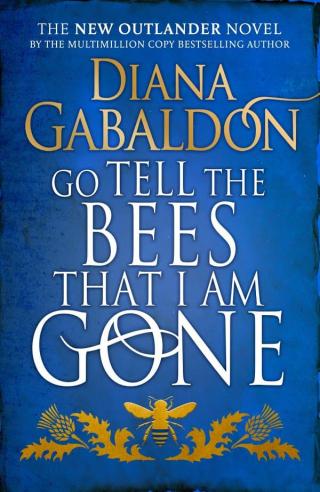
Go Tell the Bees That I Am Gone
- Автор: Гэблдон Диана
- Серия: Outlander #9
- Год: 2021
- Язык: английский
- Год: Delacorte Press
- ISBN: 978-1-473-51900-8
- Жанр: Исторические приключения

Электронная книга - «Go Tell the Bees That I Am Gone». Краткое содержание книги:
The past may seem the safest place to be . . . but it is the most dangerous time to be alive. . . .
Jamie Fraser and Claire Randall were torn apart by the Jacobite Rising in 1746, and it took them twenty years to find each other again. Now the American Revolution threatens to do the same. It is 1779 and Claire and Jamie are at last reunited with their daughter, Brianna, her husband, Roger, and their children on Fraser’s Ridge. Having the family together is a dream the Frasers had thought impossible. Yet even in the North Carolina backcountry, the effects of war are being felt. Tensions in the Colonies are great and local feelings run hot enough to boil Hell’s teakettle. Jamie knows loyalties among his tenants are split and it won’t be long until the war is on his doorstep. Brianna and Roger have their own worry: that the dangers that provoked their escape from the twentieth century might catch up to them. Sometimes they question whether risking the perils of the 1700s—among them disease, starvation, and an impending war—was indeed the safer choice for their family. Not so far away, young William Ransom is still coming to terms with the discovery of his true father’s identity—and thus his own—and Lord John Grey has reconciliations to make, and dangers to meet . . . on his son’s behalf, and his own. Meanwhile, the Revolutionary War creeps ever closer to Fraser’s Ridge. And with the family finally together, Jamie and Claire have more at stake than ever before.
WHEN I WENT upstairs to tie up my hair before starting the soap making, I found Silvia and all four of the girls in my bedroom with Frances, Patience, and Prudence more or less hanging over the sill to watch the militia ride out. They barely noticed me, but Silvia stepped back a little, abashed, and began to apologize.
“Don’t worry at all,” I said, and stepped up behind Patience to peer out. “There’s something about a group of men on horses …”
“With rifles and muskets,” she said, rather dryly. “Yes, there is.”
I thought the girls hadn’t quite grasped the fact that the militia group was drilling and training for the express purpose of killing people, but their mother assuredly had and watched the men forming up, with the usual calling out and crude jokes, with a certain grimness that deepened the lines bracketing her mouth. I touched her arm gently and she turned her head, startled.
“I know that you and your daughters would prefer to die, rather than have other people killed so that you don’t … but you know … you’re our guests. Jamie’s a Highlander, and his laws of hospitality forbid him to let anyone kill his guests. So I’ll have to ask you to stretch your principles a bit and let him protect you.”
Her lips twitched and her eyes met mine with a gleam of humor.
“As a matter of good manners?”
“Exactly,” I said, smiling back.
A squeal from the girls drew us back to the window. Jamie was mounted, passing slowly up and down the line of his men, inspecting their tack and their weapons, pausing to ask questions and make jokes. Steam rose from horses and men, their breaths white in the cold dawn air. Cyrus was at the end of the line, and Young Ian was instructing him on the finer points of mounting a horse, starting with which foot to begin with.
“Oh, doesn’t he look fine?” Prudence said, admiring. I wasn’t sure whether she meant Jamie, Young Ian, or Cyrus, as they were all more or less in the same place, but I made sounds of approval.
It seemed to take a long time for the men to organize themselves, but suddenly they all shuffled and jostled into place in a double column. Jamie took his place at the head of it and lifted his rifle above his head. A sort of jingling rumble reached us, and the militia moved out, with a visible sense of purpose that was quite stirring to watch.
Cyrus, upright as a stalk of uncooked asparagus, rode beside Young Ian, the last pair in line. I crossed myself, then turned to my own troops.
“Well, ladies … it’s a fine day for making soap. Fall in!”
JAMIE AND THE Lindsay brothers, with some help from Tom McHugh and his middle son, Angus, had cut down the trees and brush along one side of the wagon road where the land was flat, so that there was no bank between road and forest. They had left eight big trees standing, spaced about thirty feet apart.
“So,” Jamie said to his gathered troops, and nodded at the trees. “We’re going to weave through those trees—going to one side of the first, then the other side of the next, and so on. And we’re going to do it slowly, one man following the next after a slow count of ten.”
“Why?” said Joe McDonald, squinting at the trees suspiciously.
“Well, first, because I say so, a charaid,” Jamie said, smiling. “Ye always do what your colonel says, because we’ll fight better if we’re all goin’ in the same direction—and for that to happen, somebody has to decide which direction to go … and that’s me, aye?” A ripple of laughter ran through the men.
“Oh. Aye,” McDonald said, uncertainly. Joe was young, only eighteen, and had never fought in a battle, bar fists behind somebody’s barn to settle a grudge.
“But as for why I’m tellin’ ye to do this—” He gestured toward the trees. “This is for the horses. We’re a mounted militia—though we’ll have foot soldiers, too—and the horses must be nimble and you able to guide them through strange ground. Cavalrymen do this sort of drill; it’s called a serpentine—because ye weave like a snake, aye?” Without pausing for further question, he looked at Ian and jerked his head sideways.
Ian nudged his horse and turned slowly out of the group, reined around to face the trees, then leaned forward and with a bloodcurdling scream that made all the other horses snort and stamp, dug in his heels and shot for the first tree as though he and the horse had been fired from a gun. In the instant before collision, they dodged aside and shot toward the next, whipping in and out of the line of trees so fast you could scarcely count the trees as they passed. At the end of the line, they turned on a sixpence and shot back even faster, arriving with a high-pitched Indian yip to shouted applause.
Jamie glanced at Cyrus, who looked at once terrified and excited, the reins clutched up to his chest.
“So now we’ll do it slow,” Jamie said. “Ye want to go first, Joe?”
AT THE END of an hour, both horses and men were warm, limber, and in high spirits, having—for the most part—avoided collision with each other or trees. The sun was well above the horizon now; they’d best head back, so the men could get breakfast and go on to their daily chores. He was about to dismiss them when Ian stood in his stirrups and called over the men’s heads.
“Uncle! Race ye to the bend and back!” There was a general rumble of enthusiasm at this proposal, and Jamie reined round without hesitation, drawing up beside Ian.
“Go!” shouted Kenny Lindsay, and go they did, thundering down the dirt road in a churn of dust and encouraging Highland shrieks from behind. Ian’s horse was a shrewd wee mare named Lucille, who didn’t like being beaten—but neither did Phineas, and it was hell-for-leather all the way and the forest a green blur beside them.
They hit the big bend in the road and shot round it to make the turn. Lucille swerved suddenly, shouldering Phineas with a thump that nearly unseated Jamie, and he caught a glimpse of a wagon in the middle of the road, but no time to look, occupied as he was in staying in the saddle and getting Phin back under control.
There were shouts behind them, thundering hooves and two or three gunshots—the whole militia had let exuberance boil over and joined the race, God damn them. Phin was curvetting and jerking, and while it took no more than seconds to bring him in mind of his duty, the whole boiling of men and horses was down upon them, shouting and laughing. He stood in his stirrups to call out, furious—and then saw the wagon that had startled Lucille, its mules twitching and stamping in their traces, but not so spooked that they meant to run.
The rampage had come to a swirling, mud-churning halt round the wagon, and there was a moment’s silence in the shouting. Bree was holding the mules and doing a fine job of it, he saw. Beside her, Roger raised both hands high.
“Don’t shoot,” he said gravely. “We surrender.”
JAMIE POURED THE last of the JF Special whisky into Roger’s cup, picked up his own, and raised it to the company round the dinner table—and scattered over the kitchen, to boot—this including Young Ian’s family as well as his own, Silvia and her lassies, plus Cyrus Crombie, Murdo Lindsay, and Bobby Higgins, the unwed and widowed men who’d come back with him after the militia’s drilling.
“Thanks to God for the safe return of our travelers,” he said. “And”—bowing to Roger Mac—“for the guidance and blessing of our new Minister of Word and Sacrament. Slàinte mhath!”
Roger Mac didn’t blush easily, but the warmth he felt showed in his face as well as his eyes. He opened his mouth—probably to say modestly that he wouldn’t be truly ordained ’til the summer, when the elder ministers could come from the coast—but Bree put a hand on his knee and squeezed to stop him, so the lad just smiled and lifted his cup in response.