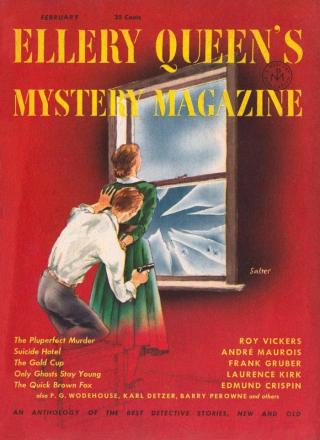
Ellery Queen’s Mystery Magazine. Vol. 19, No. 99, February 1952
- Автор: Грубер Фрэнк, Кемельман Гарри
- Год: 1952
- Язык: английский
- Год: American Mercury
- Жанр: Другие детективы

Электронная книга - «Ellery Queen’s Mystery Magazine. Vol. 19, No. 99, February 1952». Краткое содержание книги:
At the same moment, Lady Bassett, who had been chasing a bat out of the window, stepped in from the balcony and switched on the lights.
To say that Cyril Mulliner was taken aback would be to understate the facts. Nothing like this recent misadventure had happened to him since his eleventh year, when, going surreptitiously to his mother’s cupboard for jam, he had jerked three shelves down on his head, containing milk, butter, homemade preserves, pickles, cheese, eggs, cakes, and potted meat. His feelings on the present occasion closely paralleled that boyhood thrill.
Lady Bassett also appeared somewhat discomposed.
“You!” she said.
Cyril nodded, endeavoring the while to smile in a reassuring manner.
“Hullo!” he said.
His hostess’ manner was now one of unmistakable displeasure.
“Am I not to have a moment of privacy, Mr. Mulliner?” she asked severely. “I am, I trust, a broadminded woman, but I cannot approve of this idea of communal bedrooms.”
Cyril made an effort to be conciliatory.
“I do keep coming in, don’t I?” he said.
“You do,” agreed Lady Bassett. “Sir Mortimer informed me, on learning that I had been given this room, that it was supposed to be haunted. Had I known that it was haunted by you, Mr. Mulliner, I should have packed up and gone to the local inn.”
Cyril bowed his head. The censure, he could not but feel, was deserved.
“I admit,” he said, “that my conduct has been open to criticism. In extenuation, I can but plead my great love. This is no idle social call, Lady Bassett. I looked in because I wished to take up again this matter of my marrying your daughter Amelia. You say I can’t. Why can’t I? Answer me that, Lady Bassett.”
“I have other views for Amelia,” said Lady Bassett stiffly. “When my daughter gets married it will not be to a spineless, invertebrate product of our modern hot-house civilization, but to a strong, upstanding, keen-eyed, two-fisted he-man of the open spaces. I have no wish to hurt your feelings, Mr. Mulliner,” she continued, more kindly, “but you must admit that you are, when all is said and done, a pipsqueak.”
“I deny it,” cried Cyril warmly. “I don’t even know what a pipsqueak is.”
“A pipsqueak is a man who has never seen the sun rise beyond the reaches of the Lower Zambezi; who would not know what to do if faced by a charging rhinoceros. What, pray, would you do if faced by a charging rhinoceros, Mr. Mulliner?”
“I am not likely,” said Cyril, “to move in the same social circles as charging rhinoceri.”
“Or take another simple case, such as happens every day. Suppose you are crossing a rude bridge over a stream in Equatorial Africa. You have been thinking of a hundred trifles and are in a reverie. From this you wake to discover that in the branches overhead a python is extending its fangs towards you. At the same time, you observe that at one end of the bridge is a crouching puma; at the other are two head hunters — call them Pat and Mike — with poisoned blowpipes to their lips. Below, half-hidden in the stream, is an alligator. What would you do?”
Cyril weighed the point.
“I should feel embarrassed,” he had to admit. “I shouldn’t know where to look.”
Lady Bassett laughed an amused, scornful little laugh.
“Precisely. Such a situation would not, however, disturb Lester Mapledurham.”
“Lester Mapledurham!”
“The man who is to marry my daughter Amelia. He asked me for her hand shortly after dinner.”
Cyril reeled. The blow, falling so suddenly and unexpectedly, had made him feel boneless. And yet, he felt, he might have expected this. These explorers and big-game hunters stick together.
“In a situation such as I have outlined, Lester Mapledurham would simply drop from the bridge, wait till the alligator made its rush, insert a stout stick between its jaws, and then hit it in the eye with a spear, being careful to avoid its lashing tail. He would then drift downstream and land at some safer spot. That is the type of man I wish for a son-in-law.”
Cyril left the room without a word. Not even the fact that he now had Strychnine in the Soup in his possession could cheer his mood of unrelieved blackness. Back in his room, he tossed the book moodily onto the bed and began to pace the floor. And he had scarcely completed two laps when the door opened.
For an instant, when he heard the click of the latch, Cyril supposed that his visitor must be Lady Bassett, who, having put two and two together on discovering her loss, had come to demand her property back. And he cursed the rashness which had led him to fling it so carelessly upon the bed, in full view.
But it was not Lady Bassett. The intruder was Lester Mapledurham. Clad in a suit of pajamas which in their general color scheme reminded Cyril of a boudoir he had recently decorated for a society poetess, he stood with folded arms, his keen eyes fixed menacingly on the young man.
“Give me those jewels!” said Lester Mapledurham.
Cyril was at a loss.
“Jewels?”
“Jewels!”
“What jewels?”
Lester Mapledurham tossed his head impatiently.
“I don’t know what jewels. They may be the Wingham Pearls or the Bassett Diamonds or the Simpson Sapphires. I’m not sure which room it was I saw you coming out of.”
Cyril began to understand.
“Oh, did you see me coming out of a room?”
“I did. I heard a crash and, when I looked out, you were hurrying along the corridor.”
“I can explain everything,” said Cyril. “I had just been having a chat with Lady Bassett on a personal matter. Nothing to do with diamonds.”
“You’re sure?” said Mapledurham.
“Oh, rather,” said Cyril. “We talked about rhinoceri and pythons and her daughter Amelia and alligators and all that sort of thing, and then I came away.”
Lester Mapledurham seemed only half-convinced.
“H’m!” he said. “Well, if anything is missing in the morning, I shall know what to do about it.” His eye fell on the bed. “Hullo!” he went on, with sudden animation. “Slingsby’s latest? Well, well! I’ve been wanting to get hold of this. I hear it’s good. The Leeds Mercury says: ‘These gripping pages...’ ”
He turned to the door, and with a hideous pang of agony Cyril perceived that it was plainly his intention to take the book with him. It was swinging lightly from a bronzed hand about the size of a medium ham.
“Here!” he cried, vehemently.
Lester Mapledurham turned.
“Well?”
“Oh, nothing,” said Cyril. “Just good night.”
He flung himself face downwards on the bed as the door closed, cursing himself for the craven cowardice which had kept him from snatching the book from the explorer. There had been a moment when he had almost nerved himself to the deed, but it was followed by another moment in which he had caught the other’s eye. And it was as if he had found himself exchanging glances with Lady Bassett’s charging rhinoceros.
And now, thanks to this pusillanimity, he was once more Strychnine in the Soup-less.
How long Cyril lay there, a prey to the gloomiest thoughts, he could not have said. He was aroused from his meditations by the sound of the door opening again.
Lady Bassett stood before him. It was plain that she was deeply moved. In addition to resembling Wallace Beery and Victor McLaglen, she now had a distinct look of George Bancroft.
She pointed a quivering finger at Cyril.
“You hound!” she cried. “Give me that book!”