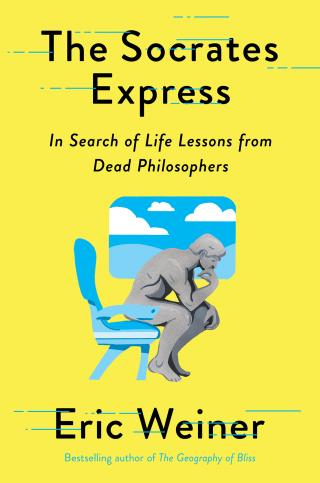
The Socrates Express
- Автор: Вейнер Эрик
- Год: 2020
- Язык: английский
- Год: Avid Reader Press / Simon & Schuster
- Жанр: География, путевые заметки

Электронная книга - «The Socrates Express». Краткое содержание книги:
We contemplate for the same reasons we travel: to see the world from a different perspective, to unearth hidden beauty and find new ways of being. We want to learn how to embrace wonder. Face regrets. Sustain hope.
Eric Weiner, *New York Times* bestselling author of *The Geography of Bliss* , combines his twin passions for philosophy and global travel in a pilgrimage that uncovers surprising life lessons from philosophers around the world, from Marcus Aurelius to Arthur Schopenhauer, Confucius to Montaigne. Traveling by train (the most thoughtful mode of transport) he traversed thousands of miles, making stops in Athens, Delhi,...
It is not malice or masochism that compels the ant to devour itself, but the Will. The ant is no more capable of resisting the Will, Schopenhauer thought, than the coffee mug in my hand right now is capable of resisting gravity should I release my grip. Like the bulldog ant, we are author and reader of our own cruelty, victim and perpetrator, fated to consume ourselves, slowly, after suffering for a long time.
Don’t despair, says the philosopher of gloom. We can escape the black hole that is the Will by “shaking off the world.” There are two ways to do so. Option one: lead an ascetic life, fasting for days at a time, meditating for hours, and remaining celibate. I skip ahead to option two: art. That’s better. Art is not only pleasurable, he says. It is liberating. It offers a reprieve from the ceaseless striving and suffering that is the Will.
The arts accomplish this feat by, in effect, catapulting us free of ourselves. When creating, or appreciating, a work of art, we lose the sense of separateness that Schopenhauer, as well as the Buddha, says lies at the root of all suffering. Art, says Schopenhauer, “takes away the mist.” The illusion of individuality dissolves and “thus we are no longer able to separate the perceiver from the perception, but the two have become one, since the entire consciousness is filled and occupied by a single image of perception.”
This merging of subject and object happens, says Schopenhauer, without the aid of reason, or curators. Aesthetic delight needn’t occur at an art museum or concert hall. It can happen anywhere. Walking down a familiar street, you see something—a mundane object like a mailbox, a fire hydrant, objects you’ve seen many times before. This time, though, you see it differently, as philosopher Bryan Magee explains: “It is as if time had stopped, and only the object existed, standing before us unencumbered by connections with anything else—just simply there, wholly and peculiarly itself, and weirdly, singularly thingy.”
During these aesthetic moments, we aren’t distressed but neither are we happy. Such distinctions—happy, sad—vanish. We have shaken off the world, and with it such false dichotomies. We become a mirror to the object of art, what Schopenhauer calls the “clear eye of the world.”
There’s a catch, naturally. This aesthetic moment is fragile, fleeting. The instant we become aware of it, the Will reenters our consciousness and “the magic is at end.”
Schopenhauer received little recognition during his lifetime and, even in death, can’t get any respect. There is no Schopenhauer museum. The philosopher’s worldly possessions are housed at a local university, out of sight. I emailed the curator and explained my interest in Frankfurt’s forgotten son.
A few days later, I receive a reply from one Stephen Roeper. He is courteous and cheerful and, I get the distinct impression, more than a little surprised. Not many visitors come calling on Arthur these days.
The next morning, appropriately rainy and dreary, I walk the few blocks to the university. I step into a drab, utilitarian building—and promptly get lost. I approach a young woman behind the counter.
“Schopenhauer?” I say—or, rather, ask, as if the name itself constitutes a metaphysical question. She nods grimly. The mere mention of the philosopher of pessimism has soured her mood, or so I imagine. It’s difficult to distinguish a sullen German from a happy German. There are, I’m sure, subtle changes in facial muscles and ocular motion, but these lie beyond the ken of an outsider like me.
I push a buzzer, and a few seconds later, a slight, pleasant, and shy man materializes. Stephen Roeper is mustached with a receding hairline, clear blue eyes, and a rosy complexion that reminds me of a tipsy cherub.
We step into a large room. It smells of old books and disinfectant. As we walk, Schopenhauer looks down at us from the walls. On every square inch is a portrait, and one or two photographs, of Schopenhauer in different stages of life, from a boyish fifteen-year-old in Hamburg to the septuagenarian sage of Frankfurt.
For a man who boldly declared “the world is my idea,” Arthur Schopenhauer felt oddly ill at ease in it. Like Rousseau, he thought of himself as homeless, even when at home. A philosophical untouchable, he was living proof that the only fate worse than being criticized is being ignored. For most of his life, his books went unread, his ideas unloved. He failed to win a Danish philosophy prize even as the sole entrant. Only in the last few years of his life did he achieve a modicum of recognition.
In one of the many ironies that was his life, Schopenhauer, whose philosophical ideas would influence Freud, had a very Freudian childhood. Mother issues explain a lot. Johanna Schopenhauer had high aspirations—literary and social—and raising a young child didn’t factor in those plans. She soon tired of “playing with my new doll,” as she put it, and spent the rest of Arthur’s childhood alternately ignoring and resenting him. “A very bad mother,” Schopenhauer later wrote.
Schopenhauer’s father, a successful merchant, wasn’t much better. In one letter, he urges his son to improve his handwriting by capitalizing properly and curtailing those fancy flourishes. In another, it’s young Arthur’s posture that draws his father’s ire. “Your mother expects, as I do, that you will not need to be reminded to walk upright like other well-raised people,” he wrote, adding, with a twist of the parental knife, “and she sends her love.”
The elder Schopenhauer groomed his son to take over the family business. He even chose the name “Arthur” because it sounded international. Arthur’s social skills, though, were lacking, much to his father’s frustration. “I wish you learned to make yourself agreeable to people,” he sniffed in one letter.
Arthur never did learn. He alienated nearly everyone he encountered. He could be charming when he wanted, but he rarely wanted. He remained a bachelor throughout his life and, with the exception of a brief friendship with Goethe, had no real companions—other than his beloved poodle, named Atman, the Sanskrit word for soul. Schopenhauer displayed a warmth toward Atman he never could muster for people. “You, sir,” he affectionately chided the poodle whenever he misbehaved.
Schopenhauer enlists another animal—the porcupine—to explain human relations. Imagine a group of porcupines huddled on a cold winter’s day. They stand close to one another, absorbing their neighbor’s body heat, lest they freeze to death. Should they stand too close, though, they’re pricked by a needle. “Tossed between two evils,” says Schopenhauer, the animals approach and retreat, again and again, until they discover “the proper distance from which they could best tolerate one another.”
The Porcupine’s Dilemma, as it’s now known, is our dilemma, too. We need others to survive, but others can hurt us. Relationships demand constant course corrections, and even the most skilled navigators get pricked now and then.
Stephen Roeper reaches into a large rectangular box and retrieves a rusting fork and spoon. Schopenhauer carried them, as well as a drinking cup, whenever he dined out. He didn’t trust restaurant hygiene, nor much of anything else. He avoided barbers, fearful they’d cut his throat. He suffered from anxiety and occasional panic attacks.
Stephen reaches into another box and retrieves a cylindrical object. An ivory flute. A gift from the elder Schopenhauer to his son. I pick it up. It possesses a pleasing weightiness, a solidity, as well as that vaguely creepy quality that adheres to the possessions of the dead. Touching it feels like an intrusion, a violation. I can almost hear grumpy Schopenhauer snapping at me. Get your grubby paws off my flute!