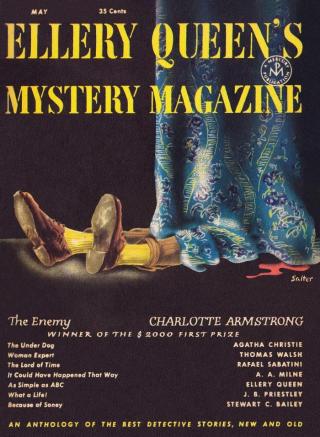
Ellery Queen’s Mystery Magazine. Vol. 17, No. 90, May 1951
- Автор: Кристи Агата, Куин (Квин) Эллери
- Год: 1951
- Язык: английский
- Год: Mercury Publications
- Жанр: Другие детективы

Электронная книга - «Ellery Queen’s Mystery Magazine. Vol. 17, No. 90, May 1951». Краткое содержание книги:
She looked at him then rather blankly with Johnny Scarfe’s big coat lapping down to her heels. But she didn’t answer him, and the tall man, licking his lips once with just the tip of his tongue, handed her the derby hat.
“Write to me,” she said, crumpling the hat down over her hair. “You know where, Johnny. Let me know how you are. And don’t you worry about me.”
“Sure,” the tall man said in a husky voice. “Sure, baby.”
Kerrigan thought maybe she meant to snatch his gun, and plug him to get herself clear — or maybe, at the yard door, she meant to call Lou Evans and tell him how things were upstairs. Kerrigan knew what dames like this were. Still, sometimes they did stupid things; and he wanted her to see just how things stood.
“They won’t play cops and robbers with you, sister. Go out there and you walk into a bullet. That derby—”
She looked back at Johnny Scarfe from the doorway, and she was scared. Kerrigan could see that; her voice, shaky and pretty low, proved it. She was saying something about not to worry, to be sure to write. Then she was gone, and Kerrigan had a funny feeling in his stomach. The room was very quiet; her footsteps died on the stairs. Kerrigan’s face felt clammy. He knew she was going to call Lou Evans, to tell him—
“Lou!” he yelled, just to be sure.
The tall man was over him in two leaps, smashing the gun butt against his head. Things swam. When they cleared he was on the floor, on his side, and the cords were loose around his wrists, Susan Butler was holding his head, and calling him Cornelius in a quick, panicky fashion. At the door Johnny Scarfe was bent forward, listening, one hand clenched at his side, the other tense on the knob.
There was a shout, two shots, close together and echoless as Kerrigan tore his hands free from the bonds, tore his body clear of the chair. Johnny Scarfe was moving with the shots; before Kerrigan got up he was through the door, and had it locked behind him. It was a solid door, set deep in the wall, and it threw Kerrigan’s first lunge back as if it had been made of rubber. He didn’t wait for a second; shaking off Susan Butler’s hold, he ran to the front window and thrust it up. The stone arch that covered the doorway loomed out over the stoop, a floor below him, as he had remembered it. In an instant he was through, lowering himself from the sill by his arms, and dropping when they were out straight from his body.
That way the arch was only four feet below him. No wider than a coffee table, it angled to a point in the center, sloping down sharply on either side. Kerrigan struck the left of it with his knees, grabbed the edge with a desperate lunge, and was torn free from that by the jerk of his body. That instant broke his fall, although he didn’t catch the stoop flat; his feet struck crookedly on the rim of the first step and thrust his body backward, so that he caromed down the stairs on his back, as Johnny Scarfe came through the doorway and jumped over him. The only thing Kerrigan could grasp was his ankle. Johnny Scarfe stumbled, and smashed his fingers loose with the gun. Then he was past Kerrigan, running from his knees like a drunken sprinter staggering for balance. The gun he had dropped ceased spinning on the pavement, three feet from Kerrigan’s hand.
He got to it just as Johnny Scarfe reached the corner. Kerrigan had medals at home — sharpshooters’ medals — and the tall man wasn’t ten yards away. The gun felt small and solid, part of his hand, as he fired. From his knees he watched Johnny Scarfe fall, roll over, and become formless and still against the house wall.
Slowly Kerrigan got up, wobbling and jarred. There was blood all over the four fingers of his left hand, and he stared at them for a moment dazedly, before going up the stoop and into the hall as Lou Evans ran through from the yard.
“A woman!” he cried. “A woman with his hat and coat on. Where’s Scarfe?”
Kerrigan jerked his head backward, and went on through the dim corridor to a door that pushed open on the blacker space of the yard. A man and Dora Scarfe were out there, almost at his feet; the man was standing up. Looking at Kerrigan as he stopped there, in the doorway, the blonde managed to whisper one word. The word was: “Johnny?”
“He got away,” Kerrigan said heavily. “He snatched my car.”
After the ambulance came he walked back to the stairs, to where Susan Butler stood, holding his injured hand in the pocket of his coat, so that she wouldn’t see it. With his good arm around her, he said it was all right, it was all over; he didn’t even mind when she called him Cornelius. “Now, now,” he said softly, patting her shoulder, and not caring what Lou Evans and the rest would say if they saw him.
Something was done with inside the woman expert; something that all the Maizies and Emmas and Ruths couldn’t change. He felt that, although it remained dim — he could only picture it obscurely by thinking of the way that Dora Scarfe had whispered a word in the yard. Women! He was glad he had lied to her, and he was glad he was holding this Susan Butler, because he never wanted to let her go now. They could betray you; and they could give you something. What?
Cornelius Kerrigan couldn’t name it, but in the dim hallway, holding her, it seemed that if you had that, if you were sure of it, even a woman expert wouldn’t be sucker enough to let it go.
It Could Have Happened That Way
by A. A. Milne
Mr. John Mason Brown on the subject of A. A. Milne: “Very definitely a certain sort of person. He is sensitive. He can write charmingly. He can be witty in the fluffiest tradition of English Wit, and his prose is at once facile and precise.” We doubt if Mr. Brown was thinking of Mr. Milne’s detective stories — but all he says is ’tec true...
“Forget the detective story. I’m not saying that because I have written one detective story I’m a good detective. What I do say is that any writer who makes his living by creative fiction is well fortified to do just what your policemen have to do.”
“And what’s that?”
“Invent a story which accounts for all the facts and suspicions and discrepancies which the case presents. That’s our daily job, inventing stories; making a definite pattern of a number of incidents. Why, I could contrive some sort of story out of any assortment of facts: a spot of candle grease, a badly sharpened pencil, a canary which wouldn’t sing any more, and a man who went to bed one night with his wooden leg.” Even as he said this, Colby began to wonder what the story would be. Better start with the canary...
Colonel Saxe went to his desk and unlocked a drawer. He took out a loose-leaf file of papers and said, “Like to try?” Colby came back to his surroundings suddenly, and said, “Oh — what’s that?”
“Our latest murder.” The Chief Constable sat down again and began to turn the pages. “You’d better look at this. It shows you the house in relation to the rest of the town. That’s important.”
Colby looked at it, and said plaintively, “Can’t I have a plan of the room, with X marks the spot?”
“That particular room doesn’t matter so much. Still, here you are: bedroom where the body was found, living-room where the girl and the man were drugged.”
Colby took them, and said, “Drugs too. I am going to enjoy this.”
“I’ll just give you the set-up. Wavetree — silly name — is a bungalow about three hundred yards outside Easton, which is a small country town in my district. It’s got a bit of garden, front and back, and there are half a dozen houses, mostly pretty good ones with a fair amount of land, between it and the town. There were four people at the bungalow that Sunday afternoon. Norris Gaye, the owner, now deceased: elderly, miserly, an invalid, or anyway he preferred to live like one, and generally, I should say, was a crotchety unpleasant person and a great trial to his niece Phyllida. She is thirty minus, very capable, very good-looking in a big, healthy way, if you know what I mean — Captain of Hockey type — and runs the house and her uncle single-handed. Fhyllida’s brother Douglas — hot-tempered, who-the-devil-are-you-sort-of-cove — lives in London, test driver for racing cars, generally dashed down to lunch on a Sunday, and dashed off again, but whether from love for his sister or to keep in with his rich uncle, I can’t say.”