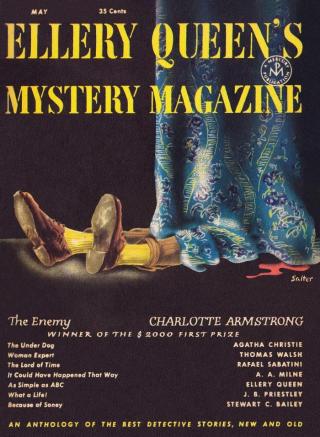
Ellery Queen’s Mystery Magazine. Vol. 17, No. 90, May 1951
- Автор: Кристи Агата, Куин (Квин) Эллери
- Год: 1951
- Язык: английский
- Год: Mercury Publications
- Жанр: Другие детективы

Электронная книга - «Ellery Queen’s Mystery Magazine. Vol. 17, No. 90, May 1951». Краткое содержание книги:
She caught her breath, then continued: “You saw me crawl out, a-holding on to this very branch for dear life. Half-dead I was, in the slime of the bank. And him there, waiting! The minute I was up he put out his hand and shoved me back in again!... Laughing and pointing he was—” she swept them again with her bitter stare — “and some of you here standing by, you laughed too. And others not laughing but afraid to speak. But she wasn’t afraid, my bonny Alice. She knew I was no witch. She came to me when she heard, helped me dry and dress, helped me put a poultice on my bleeding hands...”
Heads were bowed now, and eyes groundward, as they listened to the recital.
“Jenny Stull!” The stake swung over to point out a trembling young girl. “You told us this morning how she came to visit you afterwards, last evening. She told you she was intending to break her engagement with him. Found him out, she did, for his foul, cruel doings to me. And she so proud of her ring and all! She was greatly troubled over it, you said, and cried... And her mother thought she was with you, so she left the door unlatched and went to bed. But come morning, no Alice, and her bed not slept in, though she left Jenny Stull, mind you, at eight of the clock. She came to the pond—” the croaking voice boomed out over their heads — “and then what happened?”
Metcalfe answered, “She must have thrown herself in.”
“Thrown herself in,” repeated Old Liz. “Suicide...” She tested the stake’s point with a skinny linger. “Then she’s to lie at the crossroads, for the unholy spirit that she is. With this through her soft white bosom, till the Day of Doom...”
“No!” The mother screamed it again.
“Yes,” continued Old Liz inexorably. “And the man who murdered her, he’ll live yet a while, with his guilt hidden in his soul. But when he dies...” She shivered involuntarily, and closed her eyes.
“Unless—” her voice came strangely hollow and distant — “unless he owns up... Then she may lie in holy ground, in the churchyard, and the Lord may take mercy on his soul.” Abruptly she pointed the stake at Owen Metcalfe. “You didn’t meet her here, last evening?”
“No! I didn’t see her all day yesterday, nor last night either.”
The old woman laughed then — a high-pitched, rasping, mirthless cackle. “You didn’t quarrel with her, over me? Over breaking the engagement, poor thing, because she’d seen the evil of your soul when you harried me? You didn’t plead with her, beg her to come back to you? You didn’t lose your temper when it was all no use? You didn’t push her in, hold her under till she was still, push her body out into the deeper water...”
“No, no, no! I tell you, I was nowhere near her the whole day.” Metcalfe hesitated. Then: “How do you know she was pushed in?”
“The dead may speak,” said Old Liz, “though they have no tongues. She told me someone pushed her. And you have told me who pushed her — you, Owen Metcalfe!”
Metcalfe cursed her. “You foul, ranting, toothless devil’s hag! Is this your revenge?”
Old Liz touched the body with the stake. “Her bare hand speaks for her, poor lass! Torn and cut, as I cut my hands, on this very branch. She didn’t throw herself in to die — she was pushed! For she tried desperately to pull herself out of the water by this same branch — as I did... And her closed fist — what’s in it, Owen Metcalfe?”
Her voice lifted in a triumphant chant. “You don’t know? You didn’t notice what she was doing the very moment you pushed her? What she clutched in her hand — the one thing which proves you were here with her?... Open her fist, Owen Metcalfe,” Old Liz taunted. “Open it, and see. Or look on the fingers of the other hand, and guess as I guessed!”
The man whirled suddenly, to run. Old Liz lifted the stake, spear-like, and hurled it at his legs. He stumbled, tripped — then the crowd was on him, holding him still.
The mother frantically pried open the girl’s fist. She held up a ring.
“She took it off to return to him,” panted Liz. “How else would it get from her left hand to her right? For whom else would she remove it? And if she’d given it to him earlier, would he not have said so, and shown it to us? But he denied seeing her, all day — twice he denied it!... Do you own up now, Owen Metcalfe? Else it’s the stake for her and hell-fire, sure, for you!”
The man held her beady stare for a long moment. Then he collapsed, weeping softly.
The Affair at the Hotel Splendide
by W. A. Darlington[4]
It takes a really courageous writer to sit down and deliberately create a detective who is supposed to be funny. Not only is one таn’s humor another mail s lament, but too often (if not most often) the trick just doesn’t come off — even in the hands of a Wоdehouse. And too often (if not most often) the character turns out to be funny for the wrong reasons — in ways the author never originally intended.
The American version of the blundering, bumbling bloodhound is usually у in the short-story field, a correspondence-school graduate — summa-cum-laughter. The two most notable examples are Ellis Parlor Butler’s Philo Gubb and Percival Wilde’s P. Moran (of Shetland Yard). The adventures of the former have little more than old-fashioned nostalgia to delight present-day readers — that, and a genuine historical importance; but the misadventures of P. Moran are modern, streamlined laughing-pieces, full of fun and flavor, with meaty plots and richly rewarding insights into human nature.
On the other hand, what about the British version of the dumb detective? We decided to investigate. In due course we made the acquaintance of W. A. Darlington’s Mr. Cronk, and on first reading Chapters XVI and XVII of MR. CRONK’S CASES, we thought them an amusing account of “dirty work at the villa.” But now that we have reread the story, we find ourselves somewhat perplexed. Were we attracted to a subtle parody connotation? Was there something of Hercule Poirot anglicized into the quiet little Mr. Cronk — a faint suggestion, barely perceptible? We leave it to you, with the sad conviction that again that difficult and dangerous experiment has not quite come off...
The Hotel Splendide received Mr. J. W. Carpenter (né Cronk) with outward calm. It allotted him a room with a hath, and proceeded to charge him outrageous prices for their daily use. It fed him sumptuously, and professed itself unobtrusively ready in a score of ways to help that generous sum of money from the Sunday Globe to melt away.
He went quite unrecognized. Even such visitors as read Cronk’s Own Story in the Sunday Globe never dreamed of connecting him with “that quiet little man in the corner.” A year back he would no doubt have caught the eye as being out of place in such surroundings; but Mr. Cronk the successful detective had learned many things about dress and deportment which Mr. Cronk the solicitor’s clerk had never known. Even in this well-dressed crowd he now passed muster.
Accustomed as he was to his own company, he felt neither lonely nor bored; and after his experience at the Tancred Hotel, simply to be part of a crowd that was neither curious nor hostile gave him pleasure. He watched the rich at play, and wove little romances about the younger ones. This was a difficult game, because everybody seemed to be on terms of almost embarrassing intimacy with everybody else, quite regardless of sex or length of acquaintance.
4
Copyright, 1933, by W. A. Darlington