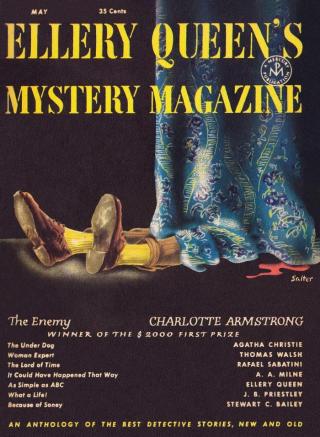
Ellery Queen’s Mystery Magazine. Vol. 17, No. 90, May 1951
- Автор: Кристи Агата, Куин (Квин) Эллери
- Год: 1951
- Язык: английский
- Год: Mercury Publications
- Жанр: Другие детективы

Электронная книга - «Ellery Queen’s Mystery Magazine. Vol. 17, No. 90, May 1951». Краткое содержание книги:
Kerrigan figured she wouldn’t know any more where Johnny Scarfe was than a fortune-teller, and when Lou Evans and his partner were detailed to follow her he thought it was an awfully dumb move. With someone like the blonde, the thing to do was make her jealous; give him five minutes alone with her, he thought, and she’d spill the story of how he got out. That night in his room he was wondering if it wouldn’t be a good idea to try to get in touch with her when the phone rang.
“Listen,” Joe said. “Susan called. She said she wanted to see you.”
“Okay,” Kerrigan grunted, and hung up. Going over to the table he poured himself a small nip of Irish whisky, drank it, and balanced the empty glass thoughtfully on his palm. The woman expert could picture what was coming up.
Kerrigan coached himself thoroughly before starting; he made it very clear how he was going to act, and why he would see her at all. Things like this were better cleared up, with no loose ends...
It was, in theory, simple enough, but Kerrigan felt a dryness in his throat as he went up the stairs. She was standing in her open doorway, outlined against the light, and Kerrigan said, “Hello,” in a surly fashion, brushed by her, and sat down inside with his light gray fedora resting on his knees. She started off as he had known she would, uncertainly, because he would not look at her face. When he hadn’t come into Joe’s all week she was afraid something had happened; she thought he was ill.
“Busy,” he said, with a rasp in his voice. When she didn’t answer, his eyes came up to her at last, and when he saw her face a kind of dumb anguish broke in him. She was trying to smile, and saying something about she just hadn’t known.
“All right,” Kerrigan mumbled. He transferred his hat from one knee to the other, and he wondered how guys like Evans ever got married—
He awoke to what he was thinking with a stunned horror; and then in a moment the horror was gone, and Cornelius Kerrigan, the woman expert, said huskily, “Wait a minute. Don’t look like that.”
He got up, although he didn’t know what he was going to do — maybe get the hell out of there. He felt caught and in the wrong, and when the door to the hall opened behind him he looked at it dumbly.
Johnny Scarfe came in. He pushed the door shut with his left shoulder and then leaned against it, watching Kerrigan for what seemed a long time. Kerrigan wasn’t a fool. He didn’t move or drop the hat out of his hands; he just stood very still. He could see the automatic in Johnny Scarfe’s right hand.
After that long while Johnny Scarfe said, “Get his keys,” to the girl. “His car keys. We’ll need a car. Then cut some rope out of your drier in the kitchen and tie his hands behind him, around his chair. Move.”
When she bent over him for the keys Kerrigan closed his eyes so that he wouldn’t have to see her. It was all very simple: they’d needed a car. And she had said, “If I call Kerrigan—” They had probably laughed about it. Johnny Scarfe would have advised her to put on the weeps.
And Kerrigan took the blame; he accepted it with a rage that was as cold and hard as ice in his heart. He’d been a fool.
She was standing by the door now, very pale, watching him.
“Go downstairs,” Johnny Scarfe said. “Get started.”
“Sure,” Kerrigan said. “Go on. You can always tell yourself you didn’t know what he was going to do. You don’t have to read the papers.”
“Cornelius,” she whispered. “Cornelius, do you think I knew he was coming? I don’t know how he found me. I thought if I did what he asked he wouldn’t hurt you. That’s why — I won’t let him kill you, Cornelius.”
“Baby,” Johnny Scarfe said, touching the side of her cheek with the barrel of his gun, “go downstairs. Now. While you can walk. I went to a lot of trouble looking you up; I took a chance of running into a nest of coppers to pick you up tonight. You go with me or you stay here — right on your back, baby.”
She stared at Kerrigan.
“I’ll stay,” she said.
The woman expert started to speak, but his voice was drowned out in the sudden bang of the downstairs door — a sharp sound that made Johnny Scarfe’s tall body rigid. Quick, light steps pattered on the stairs, and swiftly and quietly he moved against the wall. “Squeak,” he said, looking back. “Just squeak once, Kerrigan.”
The steps came up past the first landing; an instant before they reached the second, Johnny Scarfe had kicked the door ajar. Dora Scarfe stood on the threshold.
The tall man swore softly, with relief, with anger.
“Damn you!” he said. “Why did you come here? Didn’t you know they’d follow you?”
Dora Scarfe cried shrilly: “I hope they have! Do you hear that?”
Her face was twisted in a sobbing frenzy; mascara streaked the dark eyes. She looked older, haggard.
Her eyes darted to Susan Butler, glittering with triumph, with the venomous hate that lay deep in the lines of her mouth. From his chair, looking at her, and remembering that Lou Evans and his partner had been watching her, Kerrigan saw that this was how women were, this was how they betrayed you. Johnny Scarfe must have had the same thought, because he moved over to the window, flattening his body against the wall. There he cursed softly and crossed to the dark kitchen. In a moment he was back, his face pale and shiny in the light of the lamp.
“Covered,” he said slowly. “A guy front and back. The place is bottled up. In five minutes they’ll have a squad car here.”
Very carefully Kerrigan began to loosen his bonds. Susan Butler hadn’t gathered them very tightly.
Going over to the door the tall man stopped before it, with the funny shine still on his face, and the bones in it outlined as if they had been marked with white chalk. His lips were a crazy color — like liver, Kerrigan thought. After a moment he rubbed them, looked at Kerrigan, at the windows, at the blonde.
“Thanks,” he said, stolidly and harshly. “Thanks for turning me up, baby. They’re set out there; they’re waiting. I go out and it’s like doing the Dutch act.”
Dora Scarfe whimpered something that sounded like: “Johnny, Johnny.” Her expression was puffy, stupid, the way she’d look waking from sleep. “I didn’t mean to, Johnny. I didn’t know. When Al told me he’d found out for you where she lived, when I thought you were here, with her — I guess I was crazy, Johnny.” She put her palms against her temples and closed her eyes, staying like that for a long time. “How many are there — two?”
Kerrigan chuckled harshly. “That’s all they’ll need.”
She didn’t heed him. Crossing to the tall man she gripped his wrist.
“Listen, Johnny — give me your hat and coat. There isn’t much light in the yard. I’ll look like you. The one in front will come running back; the street will be clear. You can get away then, through the front.”
Kerrigan glanced up at her, narrow-eyed. He knew the type — he could tell how their minds ran and who they always looked out for, but for a minute he couldn’t figure her play. They were tricky enough; this wasn’t a bad idea. The only trouble with it was that she didn’t see the catch.
Kerrigan showed her the catch. He explained very carefully: “Go out in that derby and nobody’s going to ask you questions. You won’t get three steps. Maybe you didn’t think of that, sister.”
She looked at him then rather blankly with Johnny Scarfe’s big coat lapping down to her heels. But she didn’t answer him, and the tall man, licking his lips once with just the tip of his tongue, handed her the derby hat.
“Write to me,” she said, crumpling the hat down over her hair. “You know where, Johnny. Let me know how you are. And don’t you worry about me.”
“Sure,” the tall man said in a husky voice. “Sure, baby.”
Kerrigan thought maybe she meant to snatch his gun, and plug him to get herself clear — or maybe, at the yard door, she meant to call Lou Evans and tell him how things were upstairs. Kerrigan knew what dames like this were. Still, sometimes they did stupid things; and he wanted her to see just how things stood.
“They won’t play cops and robbers with you, sister. Go out there and you walk into a bullet. That derby—”
She looked back at Johnny Scarfe from the doorway, and she was scared. Kerrigan could see that; her voice, shaky and pretty low, proved it. She was saying something about not to worry, to be sure to write. Then she was gone, and Kerrigan had a funny feeling in his stomach. The room was very quiet; her footsteps died on the stairs. Kerrigan’s face felt clammy. He knew she was going to call Lou Evans, to tell him—
“Lou!” he yelled, just to be sure.
The tall man was over him in two leaps, smashing the gun butt against his head. Things swam. When they cleared he was on the floor, on his side, and the cords were loose around his wrists, Susan Butler was holding his head, and calling him Cornelius in a quick, panicky fashion. At the door Johnny Scarfe was bent forward, listening, one hand clenched at his side, the other tense on the knob.
There was a shout, two shots, close together and echoless as Kerrigan tore his hands free from the bonds, tore his body clear of the chair. Johnny Scarfe was moving with the shots; before Kerrigan got up he was through the door, and had it locked behind him. It was a solid door, set deep in the wall, and it threw Kerrigan’s first lunge back as if it had been made of rubber. He didn’t wait for a second; shaking off Susan Butler’s hold, he ran to the front window and thrust it up. The stone arch that covered the doorway loomed out over the stoop, a floor below him, as he had remembered it. In an instant he was through, lowering himself from the sill by his arms, and dropping when they were out straight from his body.
That way the arch was only four feet below him. No wider than a coffee table, it angled to a point in the center, sloping down sharply on either side. Kerrigan struck the left of it with his knees, grabbed the edge with a desperate lunge, and was torn free from that by the jerk of his body. That instant broke his fall, although he didn’t catch the stoop flat; his feet struck crookedly on the rim of the first step and thrust his body backward, so that he caromed down the stairs on his back, as Johnny Scarfe came through the doorway and jumped over him. The only thing Kerrigan could grasp was his ankle. Johnny Scarfe stumbled, and smashed his fingers loose with the gun. Then he was past Kerrigan, running from his knees like a drunken sprinter staggering for balance. The gun he had dropped ceased spinning on the pavement, three feet from Kerrigan’s hand.
He got to it just as Johnny Scarfe reached the corner. Kerrigan had medals at home — sharpshooters’ medals — and the tall man wasn’t ten yards away. The gun felt small and solid, part of his hand, as he fired. From his knees he watched Johnny Scarfe fall, roll over, and become formless and still against the house wall.
Slowly Kerrigan got up, wobbling and jarred. There was blood all over the four fingers of his left hand, and he stared at them for a moment dazedly, before going up the stoop and into the hall as Lou Evans ran through from the yard.
“A woman!” he cried. “A woman with his hat and coat on. Where’s Scarfe?”
Kerrigan jerked his head backward, and went on through the dim corridor to a door that pushed open on the blacker space of the yard. A man and Dora Scarfe were out there, almost at his feet; the man was standing up. Looking at Kerrigan as he stopped there, in the doorway, the blonde managed to whisper one word. The word was: “Johnny?”
“He got away,” Kerrigan said heavily. “He snatched my car.”
After the ambulance came he walked back to the stairs, to where Susan Butler stood, holding his injured hand in the pocket of his coat, so that she wouldn’t see it. With his good arm around her, he said it was all right, it was all over; he didn’t even mind when she called him Cornelius. “Now, now,” he said softly, patting her shoulder, and not caring what Lou Evans and the rest would say if they saw him.
Something was done with inside the woman expert; something that all the Maizies and Emmas and Ruths couldn’t change. He felt that, although it remained dim — he could only picture it obscurely by thinking of the way that Dora Scarfe had whispered a word in the yard. Women! He was glad he had lied to her, and he was glad he was holding this Susan Butler, because he never wanted to let her go now. They could betray you; and they could give you something. What?
Cornelius Kerrigan couldn’t name it, but in the dim hallway, holding her, it seemed that if you had that, if you were sure of it, even a woman expert wouldn’t be sucker enough to let it go.