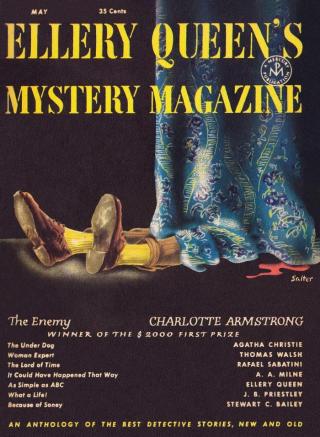
Ellery Queen’s Mystery Magazine. Vol. 17, No. 90, May 1951
- Автор: Кристи Агата, Куин (Квин) Эллери
- Год: 1951
- Язык: английский
- Год: Mercury Publications
- Жанр: Другие детективы

Электронная книга - «Ellery Queen’s Mystery Magazine. Vol. 17, No. 90, May 1951». Краткое содержание книги:
The diner was crowded when he entered, with only one vacant table for two; and he’d just finished his tomato juice when the steward ushered the girl to the chair across from his. She seemed pretty enough, rather timid, a bit too unconscious of him as she read the menu. And Kerrigan himself seemed abashed, avoiding her eyes and clearing his throat several times, until the silence became awkward. Then, hesitatingly, he remarked that it was bad weather.
She looked at him for the first time, with big dark eyes that seemed to have no guile about them.
“It’s January,” she said, after a moment.
Kerrigan had his cue.
“Back East,” he said, “we don’t get winters like this. Baltimore’s my home town. It snows once or twice, and we get cold snaps all along, but day after day—” He shook his head wryly. “I guess it’s all right; I’m not knocking it. Only I hope my next time out it’ll be summer.”
Supply them with a lead, the woman expert knew, and it all would be much easier. She asked, of course, if it was his first visit, so Kerrigan, without being forward, could plant the whole story in her mind. The accountant, the main office in Chicago, the chance at a managership, the interview with the big boss —
“I don’t know,” he went on, with the grin that he could touch up to wistful shyness, “what the boss thought of me. I’m afraid to hope.”
It had been, the woman expert sensed, the right method. It made him a worried young man, nice, and in no way fresh. When she said she wouldn’t worry, it would probably turn out just the way he wanted it, the woman expert knew he had her.
Later, in the club car, where there was no question about their sitting together, there was a faint starry stir of excitement in her eyes. It seemed that she hadn’t thought there were any trains like this, with lamps and little tables. The woman expert didn’t have to lead her on. She was going all the way to New York, to a job — a fine job. There was a glow in her face when she spoke the name. New York! It was, she said, an — an adventure.
In his berth, smoking a last cigarette with an empty toothpaste carton for an ashtray, Kerrigan decided she was very good or a natural. She sounded small-town all right — she was small-town; but, then, even small towns had their measure of off-color dames. Still, if he didn’t know this one was Johnny Scarfe’s girl... The woman expert, slightly amused by himself, yawned and switched off the light. Just before going to sleep he wondered drowsily what names she’d call him when the blowoff came. He’d bet she couldn’t think of any that hadn’t been used.
In the morning, as they entered the tunnel, the woman expert got his bags down. He knew now he had her just where he wanted her.
“Awful nice,” he said. “It was swell to have someone to talk to. And look—” with just the proper mixture of embarrassment and eagerness — “I’m staying in New York tonight, to see my girl. If you wouldn’t be busy — I mean, well—” He looked for a moment confused. “Eleanor works for a ticket agency. She gets passes for all the shows. Tonight we’re planning to see the Scandals, and I just thought it might be nice — well, for you to come along. You’d like Eleanor. If you’ve got a friend we could meet you there, by the theater. If you haven’t, come yourself, anyway. They say it’s a swell show.”
Susan Butler seemed a little uncertain, and Kerrigan didn’t push it, but he thought that “come yourself” might decide her. She’d be followed from the station, of course — Johnny Scarfe would never be dumb enough to meet her there — but it wasn’t hard to slip a tail, even a good one. And Kerrigan, looking shy and eagerly boyish, wanted to work this thing out by himself; he was sure he had her figured.
“I’ll be at the Morris,” he said. “Call me there if you can make it. Been awfully nice knowing you.”
Lou Evans, who had got on the train at Harmon, came through their car then, descending to the platform with them. At the taxi stand Kerrigan shook hands with her, cried, “Don’t forget the call,” and slipped on the grin once more. Lou Evans was a good shadow, but somehow he had a hunch this girl would slip him.
She did. Along toward five o’clock Kerrigan got the news. After she’d registered at a small hotel, she’d gone down to the subway and asked some people for directions to Times Square. There she’d just made a shuttle train that Lou Evans just missed. It might have been an accident, but Kerrigan, the woman expert, only grinned. “Don’t lose your shirts,” he said. At the Morris, John Bronson, the house dick, said the call had come in: Miss Butler would meet him at eight.
She was in the lobby at eight, in the same shiny fur, but Kerrigan cursed silently when he saw she was alone. His smile was a little strained as he went forward with Miss Peel, who was the best-looking policewoman he had been able to find.
“I’ll check the passes,” he said. “You alone, Miss Butler?”
“I don’t know. I thought—” She looked anxiously around, while Kerrigan lit a cigarette and felt his heart beating hard. Johnny Scarfe would want to give him the once-over first, of course; he’d been smart to think of Miss Peel. If he didn’t like their looks— A tall man in bone spectacles and a long brown coat came out of a drugstore and crossed to them. Susan Butler waved an arm. “Mr. Adams,” she called.
The tall man didn’t look much like Scarfe. Going only by pictures, Kerrigan wasn’t sure of him until he was very close, and Susan Butler was turning to him, speaking. Kerrigan put out his hand. “How are you,” he said, and shook his right hand with an earnest, Frank-Carter-of-Baltimore grin, and then smashed him viciously against the chin with a left hook that had all the weight of his body behind it. Little Owen Malley from the undercover squad slipped up behind the man in the brown coat in time to catch him as he staggered back. Steel flashed against the mass of dark coats crowding the lobby. Faces swung toward them, suddenly turned, astounded, while the tall man faced Kerrigan, his glasses hung crookedly across his nose, his hands gathered together behind his back.
It was done deftly and swiftly. Kerrigan picked up Johnny Scarfe’s hat and crushed it carelessly on his head, and Malley hustled him out by the shoulder. To the crowd Kerrigan ordered, “Move on, move on,” taking Susan Butler’s arm while she stared at him, pale, stricken dumb.
“Come on,” the woman expert said. “You, too, sister.”
It was a neat job, even for Cornelius Kerrigan. There was the usual kidding after it, but Kerrigan didn’t mind that much, so long as it stayed within bounds. He knew they all felt pretty good about it, despite the cracks; for, three months before, Johnny Scarfe had killed a cop, and so his taking was, in a way, a point of personal honor.
The girl, this Susan Butler, faded from Kerrigan’s mind, for she was only one job in many to the woman expert, and the job was done with now — or at least in the D. A.’s hands. The next morning, when he entered the cafeteria on the corner down from headquarters, she wasn’t at all in his thoughts; he had, in fact, to frown at her slightly before he remembered who she was. Sitting on the high stool in the cage near the door, she didn’t see him as he came in; and after a startled moment Kerrigan went by her to a chair at the end of the long tiled counter along one wall. He said, “Hello, Joe,” to a fat man in a white apron busy draining one of the coffee urns, and when the fat man turned he jerked his head toward the front.
“Where did you pick that up?”