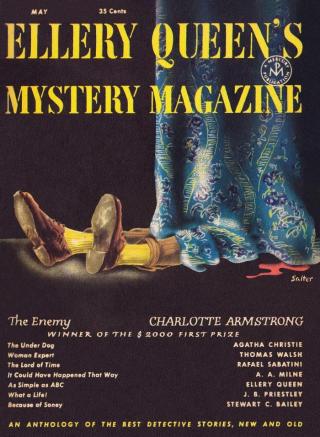
Ellery Queen’s Mystery Magazine. Vol. 17, No. 90, May 1951
- Автор: Кристи Агата, Куин (Квин) Эллери
- Год: 1951
- Язык: английский
- Год: Mercury Publications
- Жанр: Другие детективы

Электронная книга - «Ellery Queen’s Mystery Magazine. Vol. 17, No. 90, May 1951». Краткое содержание книги:
For a moment he could not understand how he had come there, or, indeed, anything. His wits were in chaos. Then, out of it, emerged a sharp pellucid perception of the thing he had done and of the horrible situation in which he found himself. Wild-eyed he looked round, and saw Cagliostro standing as before by the overmantel in such a position that his shoulders eclipsed the face of the Sevres clock. He stood with wide-planted feet, his countenance as enigmatically calm as that of Amhitaba upon his nenuphar.
“Well, sir? Well?” The sight of him thus stirred Monsieur de Guémenée to distraction. “You know what is to do.”
The booming voice answered him. “It is done.”
“Done? It is done?”
Cagliostro shrugged in weariness. “The stupidity of human nature can be unfathomable. Did you expect to witness some visible, material operation? What is done is an effort of the spirit, of the will, sir. Look at your hands.”
The Prince obeyed. He turned his hands about as he stared at them. They were white and clean; there was no faintest trace of blood upon them or upon his ruffles. Vacantly, foolishly, he looked again at Cagliostro, and Cagliostro answered the agonized question in those wide eyes.
“I have accomplished no less than I promised, Monsieur de Guémenée. We have stepped back in time.” He moved aside, disclosing the face of the blue and gold Sevres clock, and as he moved it began to strike the hour of ten, just as it had struck in the moment before de Guémenée had risen to go to his uncle.
A sense of awe encompassed him, of a quite different order from the last. His heart was beating in his throat; he had a sensation of stifling. He was in the presence of forces that he could not understand. Then, with reviving scepticism, another dread arose. He was the dupe of some imposture. Hands could be wiped; clocks could be turned back; but the dead could not be restored to life.
As if answering his thought, Count Cagliostro crossed the room to the closet door, opened it, and spoke.
“I think Your Eminence will now find Monsieur de Guémenée persuaded of the error with which he did me injustice.”
From within the closet he was answered by a movement made manifest by the rustle of silken robes, and, as Monsieur de Guémenée sat forward, wild-eyed, clutching the arms of his chair, the tall handsome figure of the Cardinal came into view and paused under the lintel. His Eminence, smooth of brow and calm of eye, composed and urbane as ever, was quietly smiling his satisfaction.
“I knew he would find it easy to convince you, Charles, and I rejoice in it. Men of the same blood must hold together in all important things.” His elegant hand was placed affectionately upon Cagliostro’s shoulder. “You will find His Excellency, Charles, the arch-enemy of all fraud and error. Trust him as I do, and you cannot fail to profit by it.”
“I think he holds the proof of that,” said Cagliostro quietly.
Monsieur de Guémenée, breathing with difficulty, answered nothing. He asked himself had he merely dreamt, was he still dreaming, or had some unfathomable miracle been wrought? Then, as his uncle advanced into the room, he remembered the deference due to that august personage, and staggered like a drunkard to his feet.
Many years later, in his prison in the fortress of San Leo, when his thaumaturgy had brought him into the clutches of the Holy Office, Cagliostro told this story to a young Dominican who had been charged to show him the error of his ways.
“When we reflect,” he ended, “that all this that the Prince de Guémenée had seen and heard and felt and done had no existence save in my mind and will, may we not ask what, after all, is objective truth?”
Woman Expert
by Thomas Walsh[2]
In his always stimulating, sometimes brilliant column, “Speaking of Books,” in “The New York Times Book Review,” J. Donald Adams once wrote: “Personally, I feel some trepidation in discussing the whys and wherefores of mystery fiction, because, although I have read a fair amount of the best in the field, I am by no means qualified to offer myself as a tried and true fan.” Nevertheless, Mr. Adams goes on to say: “May such an obvious impostor as myself put forth one or two apologetic questions on this sacred ground?” And one of the questions Mr. Adams asks is “why must the man from Scotland Yard, or the chief of our homicide bureau at home, always be presented as having the mental agility of my old friend Zip, whose egg-shaped cranium used to bob above the crowd as it circulated below the platforms of the freaks in the basement of Madison Square Garden...”
Mr. Adams has a point, but the point is not as sharp as it used to be. In recent years there has been a growing movement on the part of detective-story writers to make their official policemen realistic. If anything, the pendulum is now in danger of swinging to the other extreme. But there are some writers who have never depicted their detective characters as “dumb cops” or as “the butt of derision and contempt.” One of those writers is Thomas Walsh.
Indeed, we have heard some acute observers make the statement that Thomas Walsh does not write detective stories — even when his chief character is a professional detective. It is far more accurate, if simpler, to say that Thomas Walsh writes cop stories, and the distinction implied is not a quibble or a splitting of hairs. “Cop stories,” in the sense that they describe Thomas Walsh’s work, implies not only a foundation in realism, but a solid structure rather than a false front. The basic truth is, Walsh’s detectives are always human beings — and that maizes the crucial difference.
She wasn’t at all the kind of girl Kerrigan had built up in his mind. Small and dark, rather sturdy, with cheeks flushed rosily from the cold and crystals of snow sparkling on the collar of her worn fur coat, she came down the aisle behind the porter, smiling a little, obviously excited.
When the porter had racked the luggage on the shelf above her chair, Kerrigan had just a side glimpse of thick dark hair drawn back severely about a round young face — a glimpse that for a moment worried him, until he saw the man in the gray coat and brown hat walk down the station platform outside and stop by her window to light a cigarette. That was the finger, the handover; and, relieved, Kerrigan yawned and picked up his newspaper, deciding that this girl of Scarfe’s was nobody’s dumbbell. The get-up was good; he’d have to be careful. Even a woman expert would never have picked her out of a crowd as Johnny Scarfe’s girl.
In a moment they began to glide past the platform, deserted now save by a few redcaps and the man in the gray coat, who was hurrying along toward the nearest stairway with his collar bundled high about his face. He did not look up as they went by, and Kerrigan, warm and relaxed, seeing the skirts of his coat bellied out by the wind, rather pitied him. Out here they certainly had winters.
Kerrigan shivered delicately and edged his sharp young face deeper into the cushion at his back. It was a bit small for his body, that face, under black hair that curled crisply, close clipped above his temples; and very handsome too with its genial, Irish-blue eyes, its straight mouth that had a twist of perpetual and audacious good humor crinkled at its corners. Little Boy Blue, he was called sometimes in certain quarters — though rarely to his face. Lou Evans favored the woman expert, but that, Kerrigan conceded, wasn’t bad, though you had to know how to say it the right way. Men who knew Kerrigan usually said it the right way.
He thought of all that with a complacent comfort as he sprawled out in the chair, his lean, big-knuckled fingers resting on his knees. He didn’t think of the girl very much until the white-coated Negro came down the aisle with the first call to dinner, for he had decided that he shouldn’t push things too much; there was plenty of time. New York was still a night away and, as it happened, he didn’t have to make the break at all. Things couldn’t have been better.
2
Copyright, 1917, by The Crowell-Collier Publishing Co.