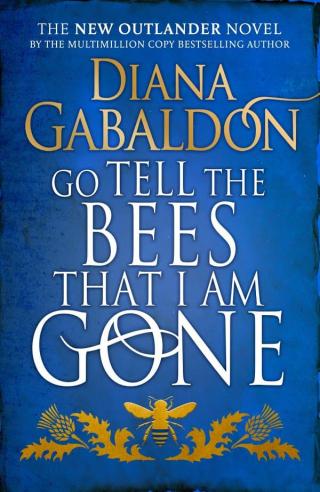
Go Tell the Bees That I Am Gone
- Автор: Гэблдон Диана
- Серия: Outlander #9
- Год: 2021
- Язык: английский
- Год: Delacorte Press
- ISBN: 978-1-473-51900-8
- Жанр: Исторические приключения

Электронная книга - «Go Tell the Bees That I Am Gone». Краткое содержание книги:
The past may seem the safest place to be . . . but it is the most dangerous time to be alive. . . .
Jamie Fraser and Claire Randall were torn apart by the Jacobite Rising in 1746, and it took them twenty years to find each other again. Now the American Revolution threatens to do the same. It is 1779 and Claire and Jamie are at last reunited with their daughter, Brianna, her husband, Roger, and their children on Fraser’s Ridge. Having the family together is a dream the Frasers had thought impossible. Yet even in the North Carolina backcountry, the effects of war are being felt. Tensions in the Colonies are great and local feelings run hot enough to boil Hell’s teakettle. Jamie knows loyalties among his tenants are split and it won’t be long until the war is on his doorstep. Brianna and Roger have their own worry: that the dangers that provoked their escape from the twentieth century might catch up to them. Sometimes they question whether risking the perils of the 1700s—among them disease, starvation, and an impending war—was indeed the safer choice for their family. Not so far away, young William Ransom is still coming to terms with the discovery of his true father’s identity—and thus his own—and Lord John Grey has reconciliations to make, and dangers to meet . . . on his son’s behalf, and his own. Meanwhile, the Revolutionary War creeps ever closer to Fraser’s Ridge. And with the family finally together, Jamie and Claire have more at stake than ever before.
Ian made a small noise that might have been amusement.
“Aye,” Jamie said dryly. “I meant to be. But ye dinna always get to choose what happens to ye, do you?”
“True enough. But Brianna told me her father was dead—so … he was, he is … really dead?”
“Well, I’d thought so. But the bugger wrote a damn book, didn’t he? The one Brianna brought wi’ her—to remember him by. I read it.”
Ian rubbed a thumb across his chin; Jamie could hear the scratch of the bristles, and it made his own chin itch.
“What the devil did he say in it?”
Jamie sighed and saw his breath, white for an instant in the dark. The moon had faded out of sight behind the clouds. They couldn’t stay out here long; Ian needed sleep before the journey, and Jamie’s bad hand was telling him that rain was coming.
“It’s about Scots, ken? In America. What they—we—did, what we’ll do, in the Revolution. The thing is … aye, well. There are a good many men named Jamie Fraser in Scotland, and I’m sure there are plenty here, too.”
“Och, ye’re in his book?” Ian straightened up, and Jamie made a negative gesture.
“I dinna ken, that’s the trouble. It might be me, and it bloody well might not be, too. He mentions my name fourteen times, but never makin’ enough of it to be able to tell whether it’s me or someone else. He never comes right out and says, ‘Jamie Fraser of Fraser’s Ridge,’ or ‘Broch Tuarach,’ or anything o’ that sort.”
“Why are ye worried, then, Uncle?”
“Because he says there’s going to be a battle nearby us—at a place called Kings Mountain. And Jamie Fraser’s killed in it. Will be, I mean. A Jamie Fraser.” Saying it aloud actually steadied him a little. It seemed ridiculous.
Ian wasn’t taking it that way, though. He gripped Jamie’s arm, close in the darkness.
“Ye think it’s you he means?”
“Well, that’s the devil of it, Ian. I canna say, at all. See—” His lips were dry, and he licked them briefly. “The man kent about me, and he had nay reason to love me. We—Claire and Bree and I—think Frank Randall knew that the lass would come back, to find her mother and me. And if he looked, in—in history—he’d maybe find us.”
Ian clicked his tongue in consternation—in just the way his father had, and Jamie smiled involuntarily.
“And if he did …”
“No man is objective about Claire,” Jamie said. “I mean—they’re just not.”
Ian made a wee fizzing noise of assent.
“Which isna to say everyone loves her …”
“A lot of us do, Uncle,” his nephew assured him. “But aye, I ken what ye mean.”
“Aye. Well, what I mean is—and I ken this sounds as though I’ve lost my senses and maybe I have—but … I’ve read his book, and by God, I think the man is talkin’ to me.”
Ian was silent for quite a while. The dim shape of a nightjar rose from the ground near their feet and shot off into the dark with a high, clear zeeek!
“And if he is talkin’ to you?” Ian said at last.
That scared him.
“If he is—and if the Jamie Fraser who dies at Kings Mountain is me … I just … I …” He couldn’t ask it. And for God’s sake, he was not afraid of dying, not so many times as he’d looked Death in the face. It was only—
Ian’s hand slid into his and clasped it firmly.
“I’ll be there with ye, Uncle. When does it happen? The battle, I mean.”
Relief coursed through him, and the breath he took went down to his feet.
“In about a year. October next, it will be. Or … so he says.”
“That’ll be plenty time enough for me to do whatever needs to be done in the North,” Ian said, then squeezed his hand and let it go. “Dinna fash.”
Jamie nodded, his heart full. In the morning he would bid them all farewell, but he would take his leave of Ian Òg now.
“Turn about, Ian,” he said quietly, and Ian did, looking out at the house across the street, dark save for the glow of a smoored hearth, visible at the edge of the shutters. He put a hand on Ian’s shoulder, and spoke for him the blessing for a warrior going out.
63
The Third Floor
IT WAS A BIG house. Roger and Bree were gone, and now Jamie had left to see Ian and Rachel and Jenny safely on their road. The house seemed even bigger now, with only two people and a dog in it.
Fanny, deprived of companionship, clung to me like a small cocklebur, her footsteps echoing behind me—and the tic-tic-tic of Bluebell’s behind hers—as I went to and fro from surgery to kitchen to parlor and back to surgery, the three of us always conscious of the vacant bedrooms overhead and the distant, shadowy, empty third floor high above, its walls a ghostly forest of studs, its glassless windows still covered by laths to keep out rain and snow until the vanished master should return to finish the jobs he’d left undone.
I’d invited her to share my bedroom, and we’d hauled in the truckle bed from the children’s room. It was a comfort to hear each other’s breathing in the night, something warm and quick, almost drowning out the slow, chilled breathing of the house around us—almost imperceptible, but definitely there. Especially at dusk, when the shadows began to rise up the walls like a silent tide, spilling darkness into the room.
Now and then I’d wake at dawn to find Fanny in my bed, curled against me for warmth and sound asleep, Bluey lying in a nest of quilts at our feet. The dog would look up when I woke, gently thwapping her feathery tail against the bedding, but she wouldn’t move until Fanny did.
“They’ll come back,” I assured her, every day. “All of them. We just have to stay busy until they do.”
But Fanny had never lived alone a day in her life. She didn’t know how to deal with solitude, let alone a solitude filled with the menace of one’s own thoughts.
What if—? was the constant refrain of her thoughts. The fact that it was also the refrain—if a silent one—of mine didn’t help.
“Do you think houses are alive?” Fanny blurted one day.
“Yes, I’m sure of it,” I said rather absently.
“You are?” Fanny’s round eyes jarred me back into the present. We were darning socks in front of the fire, having finished the morning chores and eaten lunch. We’d fed the pigs, forked dry hay for the other stock, and milked the cow and two goats—I’d have to churn butter tomorrow, leave aside a couple of buckets for cheese making, and send the rest of the extra milk downhill to Bobby Higgins for his boys.
“Well … yes,” I said slowly. “I think any place that people live for a long time probably absorbs a bit of them. Certainly houses affect the people who live in them—why shouldn’t it work both ways?”
“Both ways?” She looked dubious. “You mean that I left part of me at the brothel—and I brought part of the brothel with me?”
“Didn’t you?” I asked gently. Her face went blank for a moment, but then the life returned to her eyes.
“Yes,” she said, but she was wary now, and added nothing more.
“Who’s doing for Bobby and the boys this week, do you know?” I asked her. The neighbor women—and their daughters—who lived in easy walking distance had been taking it in turn to stop into the Higgins cabin every few days, to bring food, cook supper, and do small jobs of mending and housekeeping, lest the Higginses descend irretrievably into male slovenliness.
“Abigail Lachlan and her sister,” Fanny replied readily. “They always come together because they’re jealous of each other.”