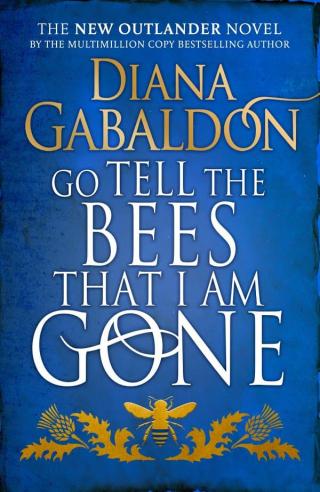
Go Tell the Bees That I Am Gone
- Автор: Гэблдон Диана
- Серия: Outlander #9
- Год: 2021
- Язык: английский
- Год: Delacorte Press
- ISBN: 978-1-473-51900-8
- Жанр: Исторические приключения

Электронная книга - «Go Tell the Bees That I Am Gone». Краткое содержание книги:
The past may seem the safest place to be . . . but it is the most dangerous time to be alive. . . .
Jamie Fraser and Claire Randall were torn apart by the Jacobite Rising in 1746, and it took them twenty years to find each other again. Now the American Revolution threatens to do the same. It is 1779 and Claire and Jamie are at last reunited with their daughter, Brianna, her husband, Roger, and their children on Fraser’s Ridge. Having the family together is a dream the Frasers had thought impossible. Yet even in the North Carolina backcountry, the effects of war are being felt. Tensions in the Colonies are great and local feelings run hot enough to boil Hell’s teakettle. Jamie knows loyalties among his tenants are split and it won’t be long until the war is on his doorstep. Brianna and Roger have their own worry: that the dangers that provoked their escape from the twentieth century might catch up to them. Sometimes they question whether risking the perils of the 1700s—among them disease, starvation, and an impending war—was indeed the safer choice for their family. Not so far away, young William Ransom is still coming to terms with the discovery of his true father’s identity—and thus his own—and Lord John Grey has reconciliations to make, and dangers to meet . . . on his son’s behalf, and his own. Meanwhile, the Revolutionary War creeps ever closer to Fraser’s Ridge. And with the family finally together, Jamie and Claire have more at stake than ever before.
THE FIRST STEP took them from the cabin to the Big House to take their leave. They’d said goodbye to Brianna and Roger and seen them off with their wagon full of children and contraband sauerkraut three weeks before—an experience that had made Rachel’s heart uneasy. Now she was inexpressibly relieved to see Jamie and hear that he intended to accompany the travelers on the three-day journey to Salisbury in the Piedmont, where they would find the Great Wagon Road that would take them north.
“I need to meet wi’ a few men there,” Jamie had said, with a casual reserve that she knew was meant to protect her own feelings. She knew his business was that of war, and he knew how much that troubled her, but she knew how much it troubled him and would not force him to say the things he was thinking, let alone the things he knew.
She’d felt moved to speak about it—the war—in general, in meeting. And then she’d talked about her brother, Denzell. A Friend from birth, as she was; a godly man, but also a doctor, and a man of conscience.
“Such men aren’t always comfortable to live with,” she’d said, half apologetically, but more than one woman had smiled in sympathy, knowing what she meant. “But I wouldn’t have him otherwise, thee knows. And he’s of the mind that God has called him to the battlefield—not to fight with a musket or sword, but to fight Death itself, in the name of Liberty.” She’d drawn a deep breath then, and added, “I have had word that my brother was captured, and is in a British prison. I’d ask thee all, please, to pray for him.”
They had nodded, solemn. And Jamie Fraser had crossed himself, which moved her.
Jamie nearly always came to meeting, but seldom spoke himself. He’d come in quietly and sit on a back bench, head bowed, listening. Listening, as any Friend would, to the silence and his inner light. When people felt moved of the spirit to speak, he would listen courteously to them, too, but watching the remoteness of his face on these occasions, she thought his mind was still by itself, in quiet, persistent search.
“I dinna suppose Young Ian’s told ye much about Catholics,” he’d said to her once, when he’d paused afterward to give her a fleece he’d brought from Salem.
“Only when I ask him,” she said, with a smile. “And thee knows he’s no theologian. Roger Mac knows more, I think, regarding Catholic belief and practice. Does thee want to tell me something about Catholics? I know thee must feel seriously outnumbered every First Day.”
He’d smiled at that, and it made her heart glad to see it. He was so often troubled these days, and no wonder.
“Nay, lass, God and I get on well enough by ourselves. It’s only that when I come to your meeting, sometimes it reminds me of a thing Catholics do now and then. It’s no a formal thing—but a body will go and sit for an hour before the Sacrament, in church. I’d do it now and then when I was a young man, in Paris. We call it Adoration.”
“What does thee do during that hour?” she’d asked, curious.
“Nothing in particular. Pray, for the most part. Say the Rosary. Or sit in silence. Read, maybe, the Bible or the writings of some saint. I’ve seen folk sing, sometimes. I remember once, goin’ into the chapel of Saint Joseph in the wee hours of the morning, long before dawn—almost all the candles were burnt out—and hearin’ someone playing a guitar, singing. Very soft, not playing to be heard, ken. Just … singing before God.”
Something odd moved in his eyes at the recollection, but then he smiled at her again, a rueful smile.
“I think that may be the last music I remember really hearing.”
“What?”
He touched the back of his head, briefly.
“I was struck in the heid wi’ an ax, many years gone. I lived, but I never heard music again. The pipes, fiddles, singin’ … I ken it’s music, but to me, it’s nay more than noise. But that song … I dinna recall the song itself, but I know how I felt when I heard it.”
She’d never before seen a look on his face as she did when he called back that song for her, but now, watching his back, straight and square as he rode before them, quite suddenly she felt what he had felt in the depth of that distant night, and understood why he found peace in silent spaces.
61
’Gin a Body Meet a Body …
“I’M OLDER THAN THIS place,” Jenny said, looking about with a disparaging eye as the wagon pulled up outside an ordinary. “This town looks as though ’twas thrown up yesterday.”
“It’s been here for the last twenty-five years,” Jamie said, wrapping his horse’s reins around the hitching post. “It’s older than Rachel, aye?” He smiled at his niece, but his sister snorted, edging backward out of her nest in the wagon.
“No age at all for a city,” she said dismissively.
“Crawling wi’ Loyalists, too,” said Young Ian, seizing his mother round the middle and swinging her down. “Or so I hear.”
“I hear that, too,” Jamie said, and gave the main street an eye, as though Loyalists might come darting out of the taverns like mice. “But I hear they havena got guns, nor yet a proper militia.”
Despite its relative youth, Salisbury was the largest town in Rowan County. It was also the seat of Rowan County, the closest town between Fraser’s Ridge and the Great Wagon Road—and the military fiefdom of one Francis Locke, a patriot. And one with guns and militia. That being so, Jamie settled Jenny, Rachel, and Oggy temporarily at a decent-looking ordinary with an expensive pot of strong coffee and a plate of stuffed rolls, sent Ian to buy provisions for the journey north, then went himself in search of Colonel Locke.
Once met, Jamie found himself disposed to like Francis Locke. A stocky, red-faced Irishman of about his own age, the man had a direct manner that appealed to him. He was a landowner, a businessman—and the commander of the Rowan County Regiment of Militia.
“One hundred and sixty-seven companies of militia we have on our rolls,” Locke said, with a certain grim satisfaction. “At present. From all over Rowan County—though none from the far backcountry as yet. I’d be glad to welcome you and your company, Mr. Fraser, should ye care to join us.”
Jamie gave him a cordial nod but refrained from committing himself, just yet.
“I’ll not yet have my company fully equipped, sir—though I expect to accomplish that before the snow flies and be ready for the spring.”
The British army surely would be.
Locke gave him the same kind of nod, with the same look of reservation. Locke knew perfectly well that Jamie wouldn’t admit his true state of readiness until he’d made up his mind about Locke and his regiment.
“How many men have you?”
“Forty-seven, at present,” Jamie replied equably. “I think we will have more, once the harvest is in.”
They were sitting in the City Tavern, with a pitcher of ale and a platter of small fried fishes. Tasty fare after three days of journeycake and boiled eggs, though the fish were equipped with an inconvenient number of small bones.
“Might I ask, sir—are ye maybe familiar with a man called Partland? Or Adam Granger?”
Locke’s heavy gray brows cocked upward.
“Nicodemus Partland? Aye, heard of him. From Virginia. Loyalist gadfly. Troublemaker,” he added offhandedly.
“He is that. But perhaps a bit more than a gadfly.” Jamie gave Locke a brief account of Partland’s appearance on his land—his connection with Captain Cunningham—and then of the rifles that Claire and Young Ian had confiscated. Jamie didn’t embellish that encounter, but he knew how to tell a story, and Locke was laughing at the end of it.