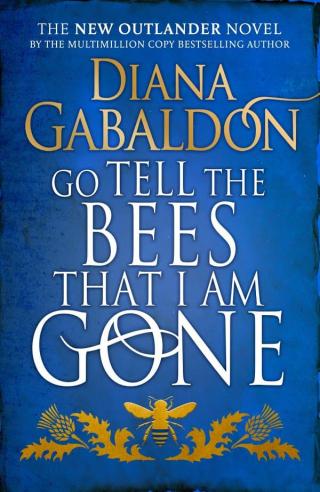
Go Tell the Bees That I Am Gone
- Автор: Гэблдон Диана
- Серия: Outlander #9
- Год: 2021
- Язык: английский
- Год: Delacorte Press
- ISBN: 978-1-473-51900-8
- Жанр: Исторические приключения

Электронная книга - «Go Tell the Bees That I Am Gone». Краткое содержание книги:
The past may seem the safest place to be . . . but it is the most dangerous time to be alive. . . .
Jamie Fraser and Claire Randall were torn apart by the Jacobite Rising in 1746, and it took them twenty years to find each other again. Now the American Revolution threatens to do the same. It is 1779 and Claire and Jamie are at last reunited with their daughter, Brianna, her husband, Roger, and their children on Fraser’s Ridge. Having the family together is a dream the Frasers had thought impossible. Yet even in the North Carolina backcountry, the effects of war are being felt. Tensions in the Colonies are great and local feelings run hot enough to boil Hell’s teakettle. Jamie knows loyalties among his tenants are split and it won’t be long until the war is on his doorstep. Brianna and Roger have their own worry: that the dangers that provoked their escape from the twentieth century might catch up to them. Sometimes they question whether risking the perils of the 1700s—among them disease, starvation, and an impending war—was indeed the safer choice for their family. Not so far away, young William Ransom is still coming to terms with the discovery of his true father’s identity—and thus his own—and Lord John Grey has reconciliations to make, and dangers to meet . . . on his son’s behalf, and his own. Meanwhile, the Revolutionary War creeps ever closer to Fraser’s Ridge. And with the family finally together, Jamie and Claire have more at stake than ever before.
“Aye. So …?”
“Well. About five miles outside the city, along the main road, there’s a small lane—it’s called Mulberry; I’ve drawn ye a map, but ye can ask your way, too. There’s a wee falling-down sort of house at the end of the lane; that belongs to a woman named Silvia Hardman.”
“A woman?” Ian glanced involuntarily at Auntie Claire, too. She was laughing at something Jem had once said to her, her face flushed from the heat of the fire and her mad hair escaping from the scarf she had bound round her head.
“Aye,” his uncle said tersely, turning slightly so his back was to the launderers. “A Quaker lady, a widow wi’ three small girls. She did me a great service, before Monmouth, and since ye’ll be passing by, I’d like ye to see what her condition is, and no matter what it is, oblige her to take this.” He fished in his sporran and came out with another, smaller, purse.
Ian accepted it without question, putting it away in his own pouch. Uncle Jamie was frowning slightly, hesitant.
“Anything else, Uncle?”
“If—I mean—I dinna ken whether …”
“Whatever it is, a bràthair-mhàthair, ye ken I’ll do it, aye?” He smiled at Uncle Jamie, who relaxed and smiled back.
“I do, Ian, and I’m grateful. The thing is—Friend Silvia is a virtuous woman, but her husband was killed, maybe by the British army, maybe by Loyalists, maybe by Indians. He left her badly off, she’s no kin, and … there aren’t so many ways for a woman alone to provide for three wee girls.”
“She’s a hoor, then?” Ian had lowered his own voice, keeping an eye on the steam rising from the laundry kettle. Wee Orrie Higgins was minding Oggy and apparently trying to teach him to play patty-cake, though the bairn couldn’t manage more than waving his chubby arms and crowing.
“No!” Uncle Jamie’s face darkened. “I mean—she sometimes …”
“I understand,” Ian said hastily, suddenly wondering at the nature of the service Mrs. Hardman might have rendered his uncle.
“Not me, for God’s sake!”
“I didna think it was, Uncle!”
“Aye, ye did,” Uncle Jamie said dryly. “But beyond rubbing horseradish liniment into my backside and poulticing my back, the woman never laid a hand on me—or I on her, all right?”
Ian grinned at his uncle and raised both hands, indicating a complete acceptance of this story.
“Mmphm. So, as I said, I want ye to see what her condition is. It may be that she’s found a man to marry her—and if she has, you be damned careful about giving her the money so he doesna see; even if he’s a good man, he might assume things that aren’t true—” And here he gave Ian a hard look. “But if she’s entertaining men that come to her house, you find that out and make sure that none of them are threatening her or seem a danger to her or her wee lassies.”
“And if they are …?”
“Take care of it.”
I FOUND IAN in the springhouse, sniffing cheeses.
“Take that one,” I suggested, pointing at a cheesecloth-wrapped shape at the end of the top shelf. “It’s at least six months old, so it’ll be hard enough to travel with. Oh, but you might want some of the softer cheese for Oggy, mightn’t you?”
There were at least a dozen tin tubs of soft goat’s cheese, some flavored with garlic and chives—one adventurous experiment with minced dried tomatoes that I had severe doubts about—but four unflavored, for use in feeding people with digestive upset and for mixing in medicines that I couldn’t get anyone to swallow otherwise.
“Rachel thinks he might be teething,” Ian assured me. “By the time we reach New York, he’ll be gnawing raw meat off the bone.”
I laughed, but felt a sharp pang at the realization that he was right; by the time we saw Oggy again, he would likely be walking, perhaps talking, and fully equipped to eat anything that took his fancy.
“He might even have a proper name by that time,” I said, and Ian smiled, shaking his head.
“Ye never ken when a person’s right name will come—but it always does.” He glanced down to one side, by reflex. To where Rollo would have been.
“Wolf’s Brother?” I said. That was the name the Mohawk had given him when he became one of them. I was quite aware—and I thought Rachel and Jenny both knew it even better—that he had by no means stopped being a Mohawk, even though he’d come back to live with us again. He hadn’t stopped looking down at his side for Rollo, either.
“Aye,” he said, a little gruffly, but then he gave me a half smile and the Scottish lad showed through the tattoos. “Maybe another wolf will come find me, sometime.”
“I hope so,” I said, meaning it. “Ian—I wanted to ask you a favor.”
One eyebrow went up.
“Name it, Auntie.”
“Well … Jamie said that you plan to stop in Philadelphia. I wondered …” I felt myself blushing, much to my annoyance. His other eyebrow rose.
“Whatever it is, Auntie, I’ll do it,” he said, one side of his mouth curling. “I promise.”
“Well … I, um, want you to go to a brothel.”
The eyebrows came down and he stared hard at me, obviously thinking he hadn’t heard aright.
“A brothel,” I repeated, somewhat louder. “In Elfreth’s Alley.”
He stood motionless for a moment, then turned and put the cheese back on the shelf, and glanced down at the clear brown water of the creek rushing past our feet.
“This might take a bit of time to explain, aye? Let’s go out into the sun.”
60
Just One Step
JUST ONE STEP. THAT’S all it ever took, all it ever takes. Sometimes you see such a step coming, from a long way off. Sometimes you never notice, until you look backward.
Here it was, right in front of her. The door of her cabin—hers, her home, the home of her marriage, of her baby’s first months, of her realest life—was open to the morning and the round gold leaves of the aspens lay flat on the wood of the stoop, gleaming with dew as the dawn came up.
One step over the threshold that divided her small rag rug, with its quiet, homely blues and grays, from that pagan abandon of golds and greens and red outside, and her life here was over. They might come back—Ian had promised that they would, and she trusted that he’d do whatever he could to make it so—but even if they did, it would be a different life.
Oggy—perhaps he would be walking, talking, might have a different name by then. He wouldn’t recall this early life, the closeness of waking against her body in bed, turning at once to her breast and yielding up his separate existence so easily, becoming one with her as he’d been when she carried him inside, just for those moments while he fed from her again. Somewhere he might be weaned, on the road between now and then. He would be a different person when they came back. So would she.
Jenny came up beside her, her face bright and a pack with food and drink, handkerchiefs, clouts, and clean stockings under her arm. She glanced at Rachel’s face, then at the inside of the cabin, as though making an inventory. There was little enough to take note of: the rug, the bed and its trundle where Jenny slept, Oggy’s cradle. They had already given everything else away; what they needed would be given back or built again if they returned.
“Well, then, laddie,” Jenny said to Oggy. “This will be your first journey from home, aye? It’s my third. Just pay attention to me; I’ll see ye right.”
Oggy promptly leaned out of Rachel’s arms, reaching for his grannie, who laughed and took him.
“Ye’re fettled, m’annsachd?” she said to Rachel. “Is the sense o’ the meeting clear? Let’s be off, then, and see what lies ahead.”