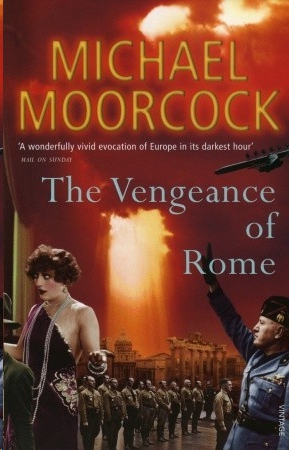
The Vengeance of Rome
- Автор: Муркок Майкл
- Серия: Between The Wars #4
- Язык: английский
- Жанр: Научная фантастика

Электронная книга - «The Vengeance of Rome». Краткое содержание книги:
‘You’re not Jewish, are you?’That was the lean young man’s first question. He did not seem dismayed by the idea.
I took no offence. I shook my head wearily. ’No. I am American. My father is of English extraction and my mother’s family was originally from Madrid. Papa could trace his ancestry back to the Danes, and Mama’s family was in Galicia since before the Arab Conquest. Believe me, I’m used to the question.’ I had learned to offer this level of detail. Otherwise, I knew, I would not be believed.
Because of my wounded penis, bequeathed to me by my ‘clinical realist’ father, many officials in Ettstrasse had also assumed I was a Jew. The truth was too complicated for them. It made no sense to tell them I was actually related to the Russian aristocracy or that I was from South Russia, which in some minds was associated with the Pale of Settlement. As I unpacked my few belongings, I added that I had made it my business, both in my native America and elsewhere, to point out the dangers of the aliens in our midst. Until its takeover by cynical interests, I was a recruiting spokesman for the Ku Klux Klan. If Germany had adopted the same racial laws enacted in Alabama and elsewhere, she would not need to be taking such radical measures now. The American people had a clearer idea what liberalism led to.
This relieved them. They were, they told me, both National Socialists. They shook my hand and introduced themselves. The lean one was Adolf Harben. He was from Karlsfeld. The fat one was an SA sergeant, Christian Weymayer, originally from Pfaffenhofen. Like me, neither had been charged with any specific crime. Unlike me, they were not in protective custody. Harben said he believed he had been accused of some minor treason by his cousin, who disliked him, and Sergeant Weymayer had upset a local official who had had him arrested as a communist. Both expected to be freed soon. They commented on my seedy, hangdog look. Had someone been beating me up? Having arrived in Stadelheim recently, they lacked my experience of the worst prison could deliver.
The rest of their comrades were off on work parties and would be back soon. I looked forward to meeting them, I said. Which was my bunk? I stumbled forward. The two cheerful lads helped me put my parcel and coat on a top bunk at the far end of the cell, but when I attempted to get into it, I was warned that this was forbidden. ‘The SA won’t allow it during the day. We can sit at this table or walk about. There is no smoking either. They look in on us at random, and if they catch us, we get punished.’ Weymayer indicated the peephole in the door. ‘On the other hand, if you need a breath of air at night or want to look out into the courtyard, you can stand on the can and get a bit of a view. At least you can sometimes see who’s coming and going. It’s best to do that in the early morning or evening, before the warders come round. It’s about our only entertainment.’
I sat on my stool and read the VB for a while. My new friends wanted to know what it had been like in Ettstrasse, so I spent a while telling them until we heard a rap on the door. We stood to attention when the door opened to reveal a trustee in a clean overall, a bucket of soup over one arm, a basket of bread on the other. Compared to what I had grown used to this was Ritz-quality service. The guard doled out soup and bread and moved on down the corridor. The food was surprisingly good, containing a reasonable amount of sausage and fresh vegetables. My life was already improving!
After lunch we played noughts and crosses until our other two companions joined us in the cell. Their faces were bright from their exercise. The pair were as good-humoured as my other cellmates. Pale-haired, grey-eyed, well muscled and bronzed, they were almost identical twins. The Grote brothers. Though on good terms with the others, they were Social Democrats, trade union railwaymen from Vaterstatten who had fallen foul of the Gestapo when they had complained about the closure of their headquarters. Not exactly radicals, they were astonished when they were suddenly thrown into jail. They, too, did not expect to be incarcerated for long. More from boredom than anything, they had joined a work party repairing the walls of the old section and had been promised an early release by the SA man in charge.
The food that evening was barley soup and some tough rye bread. We were also given jugs of fresh drinking water. My comrades told me it was now all right to lie down. We took our bunks. They saw me as someone rather exotic, who had travelled widely, and they wanted to know all about America. I told them stories of my adventures, of my career as a film actor and also as an inventor. They were incredulous, finding my tales almost unbelievable, but enjoying them, they said, whether I told the truth or not. Hearing me was as good as listening to the radio. Now, if I could only produce some music for them . . .
I soon became known as ‘the American’. They demanded more stories. They said I should write a book. I laughed. I had known people who wrote books. These days it probably wasn’t the safest profession. Even the SA laughed at this. They were as irreverent about Hitler as the socialists. In spite of my situation, I enjoyed that brief period of comradeship. It quickly ended, of course, when the Grote brothers were transferred to Dachau in the middle of June, and shortly afterwards the two SA lads were released.
I was soon the oldest occupant of the cell, which began quickly to fill up with an entirely different class of prisoner, the scum of Jewish Munich, drug addicts, perverts and criminals of the lowest kind. The worst sort of Jew, as we used to say.
I begged the warders to let me go out on work parties, anything to keep me away from the cell as long as possible, and for a while I was employed painting doors and woodwork in the new wing. But this did not last. They were unsatisfied with my work. I said that I was a trained mechanic. What if I worked on the transport? But they were contemptuous. Somehow they seemed to think because I was not a good house painter, I could not possibly make a reasonable engineer. I thought of telling them how their leader was allegedly a good house painter, if not necessarily Germany’s best choice of Chancellor, but of course I kept my mouth shut rather than jeopardise my release.
My letters were not being forwarded, but I continued to write to my friends in the outside world. I fell into a deep depression, keeping increasingly to myself. While they did not like me much, the Jewish lowlifes scarcely seemed to mind. Most of them brought the foulest habits with them. They had no manners at all. They talked constantly in corrupted Yiddish. They told disgusting stories and revealed obscene desires. They hated everyone, especially any fellow Jews who had made something of themselves. They hated each other. Eventually I developed a habit of deafness, dumbness and daydreaming, which saved me the worst of their noise. I could not entirely block them out. Their smell was dreadful. They belched and farted and left food scraps everywhere. It was like sharing a room with a pack of rats.
Because I complained, they attempted to put hands on me. But they left me alone when I told them of my powerful connections. The experience was terrifying, nonetheless. Almost the whole corridor was now filled with this riff-raff. As the SA and the regular warders were gradually replaced with the more disciplined but less humane SS, I had no one to whom I could complain. When I did make mild protests to an SA man, I narrowly escaped a beating. He told me that he had nothing against me, but anyone else would have used a club or a whip on me. The SS habitually carried dog whips and long truncheons. According to one guard, they had been trained in their use at Dachau, which had become a centre where all SS prison guards learned their trade. I wondered if the camp were quite the wholesome place the newsreels had described.