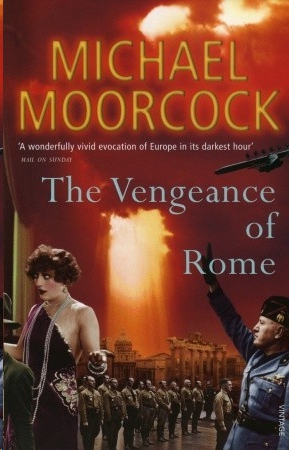
The Vengeance of Rome
- Автор: Муркок Майкл
- Серия: Between The Wars #4
- Язык: английский
- Жанр: Научная фантастика

Электронная книга - «The Vengeance of Rome». Краткое содержание книги:
Sensing my despair, Count Pottendorf reassured me. Even LeBrun was clearly not a Red. If we were suspected of such affiliations we would be with the other musicians and entertainers in Stadelheim and Dachau. I was a victim of bureaucratic thinking, nothing else. Rather than distinguish between us, the Nazis had decided to arrest all foreign artists and writers on the suspicion that they were communists. Slowly, as they investigated us, they would discover who was and who was not guilty and I would be released. My confidence temporarily restored, I determined to make the best of things. I would soon be back in my flat. I prayed that the carefully hidden documents and personal possessions in Corneliusstrasse had not meanwhile been discovered and stolen.
I next began to worry what would happen if, just as I was on the point of being released, LeBrun might bear false witness against me. He was spiteful enough to do so. Did he really remember me from Paris? Certainly I did not remember him from Lipp’s. At that time, Mrs Cornelius and myself had moved in different circles. If she had been in Paris at all, she would have been with Trotsky or her mysterious Persian playboy who had brought her to Constantinople. That was before I had driven from Rome to begin my career in Paris. She had been in London. I had received a letter from her, posted from Whitechapel. From there, inspired by my letters, she had gone with an English touring company to the USA. I did not remember the details, but certainly I had not met her again until we were both in the United States where, to our mutual benefit, Mucker Hever had fallen in love with her. We could never have been together in Paris.
So detached from reality had I become that I even thought of killing LeBrun while he slept. He could ruin me. Of course my instincts would not permit it. I value human life. I would not willingly spill his blood, even though he was loathed by all. Moreover, if he was stifled in his sleep, I was sure to be subject to an inquiry.
My fears were groundless, as it happened. Within a day LeBrun had lost his flashy suit and was wearing only a striped prison shirt which went down to his knees. The guards were amused by this. They said he looked better in a dress. They even took his shoes. We found a spare pair in Bach’s suitcase that were too big for him, but better than nothing. The guards said he would be issued with some sturdier clothes when he got to Dachau. There he would learn what it was to work like a man.
Happily, LeBrun soon gave up his accusatory mode and spoke to us less and less, snivelling himself to sleep every night. I came close to pitying him. He had bruises all over him where he had been kicked and punched by passing SA. If he had not accused my angel, I would have done more to try to help him. Even when he began to bleed from the nose, I sensed something disgusting about him. Helander, like me, avoided him, but the little pervert became pathetically grateful when Count Pottendorf, a Christian gentleman to the marrow, bathed his face, wiping the dried blood off his nose and lips. Pottendorf spoke in a low tone about Paris, which he had loved, her boulevards, her parks, her quays, calming LeBrun to silence so that we could all sleep.
They say that in monetary terms a barrel of good human gore is worth infinitely more than a barrel of crude oil. Tens of thousands of pounds are needed to buy a few gallons of blood. Plasma is, of course, worth even more. I heard this on the BBC the other day. Not that I believe everything the BBC tells us. Buggers Broadcasting Communism, as Miss Brunner, the schoolteacher I see at the pub, would have it. Blood is literally the most valuable liquid on the planet. Is it because we spill it so liberally, I wonder? The Americans used albumin first at Pearl Harbor. It had astonishing properties. Yet it is also the most easily contaminated substance. Oil, the most contaminating of liquids, kills anything it touches. Our oceans and beaches are forever ruined by it, yet we value oil far higher than blood.
The oil had dried on LeBrun’s head and his hair was a spiked mess, giving him an insane, inhuman appearance. Struwwelpeter, indeed! How quickly he had lost his veneer. The rest of us used whatever means we could to keep up our standards, but in a matter of hours the Alsatian went from posturing dandy to slovenly wretch.
The SA began to call for LeBrun regularly. He was gone for hours. He said they were questioning him about French communists he knew. He did not know any communists, he said, whether French or otherwise. He had never had anything to do with politics. He had been beaten up but he would not tell us details. While he was away, we wondered if he was being persuaded to act as a witness against us. Every time he returned he had a fresh bruise and was weeping. Pottendorf said he thought it unlikely they were asking LeBrun about us. Horrible though it was to contemplate, the SA men were beating him for their own pleasure, out of disgust for his kind. He had encouraged them in their prejudice, almost advertised himself.
One afternoon Helander proposed that LeBrun was being used by the brutal homosexual element of the SA. After all, Röhm was notorious.
Naturally I defended my patron. Röhm’s enemies had employed his sensitive letters against him. That Spartan love was a very different thing from LeBrun’s limp-wristed mincing. Helander and Pottendorf seemed surprised by the intensity of my defence, which made me realise it was unwise of me to continue. I could do no good for Röhm or help my own cause.
Nursing his bruises, LeBrun confined himself to his miserable bunk. The rest of us tried to make conversation. The other two prisoners were interested in my scientific ideas, and it took my mind off my situation to talk about such things. In America I had invented a very successful steam-car, but my interest remained mostly in aeronautics. I described my one-man observation airship and asked if they had ever heard of the giant airship the Americans planned to build. I was about to tell them a little of my involvement with such a ship, which, as far as I knew, was still in its shed outside Akron, when Pottendorf gave a bitter laugh. ‘Don’t tell me about airships. Poor LeBrun has already reminded me too much! I lost half my fortune to that miserable confidence trick that was all over the papers a few years ago. I was living in Paris at the time. I invested heavily. I was an idiot. I thought it was the coming thing. Do you remember that scandal? Some ten years or so ago? They used a Russian nobleman to front it. He was a convincing rogue. What was his name? Count something. He married a Parisian banker’s daughter, I think, then ran off with some little whore from Constantinople. The scheme itself was cooked up by a bunch of Jewish fraudsters. I haven’t a prejudiced bone in my body, but I should have known better than to trust them. They made millions from it, of course, but left the rest of us high and dry. Some Russian charlatan claimed to be the inventor. Another Jew. If you’re involved in aeronautics, you might remember him, Mr Peters. Did that news ever reach America? I heard the chief villains fled there, but America is a large country. It is full of defaulting financiers and fleeing criminals. You must have encountered plenty.’
I was shocked to hear this version of my wholly idealistic Parisian experiment. I longed to enlighten him but, in the circumstances, could not.
‘I would not have had to resort to journalism,’ Pottendorf continued, ‘if it had not been for those rogues. And if I had not become a journalist, I would no doubt not be here at all!’