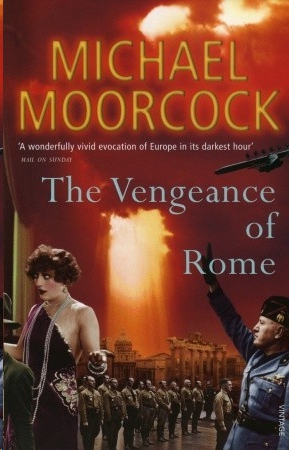
The Vengeance of Rome
- Автор: Муркок Майкл
- Серия: Between The Wars #4
- Язык: английский
- Жанр: Научная фантастика

Электронная книга - «The Vengeance of Rome». Краткое содержание книги:
I was relieved that I had shown forbearance and denied any association with Paris. It seemed impolitic to mention my involvement with the airship company or to try to defend my friend Kolya, for Count Nikolai Feodorovitch Petroff was the man Pottendorf referred to. In reality, of course, I, too, had been a victim of the scheme. Indeed, I had been made the chief scapegoat. My name had not then been Peters, but Pyatnitski. If my friend Kolya had not warned me in time I would even now, no doubt, be in a worse prison on Devil’s Island. Yet the real villains remained at large, still free and respected. Only by a whisker had I had been able to get to America, forced to leave my little Esmé behind in Kolya’s safekeeping. Doubtless she was the ‘little whore from Constantinople’ Pottendorf mentioned.
Not times I liked to remember. I found it unbearable to think of the vast consequences arising from French Jewry’s betrayal of my best ideals. I, too, had lost much. I wish that I could have told Pottendorf the truth but found myself reminding him I had never been to Paris. I agreed that we lived in terrible times, when Russian charlatans were able to deceive even those of us with considerable common sense. Avoiding the subject of large airships, I spoke instead of my other American ventures, of my great Land Cruiser, my fleet of experimental aircraft built for the Sultan of Marrakech, the various projects I had begun with Signor Mussolini. I had rather expected, I said, to interest the New Germany in my scientific ideas. I had much to offer the Third Reich. But this business had soured me. The sooner I could get back to Italy, the better.
Helander was surprised I had never visited the City of Light. ‘Such a sophisticated world traveller,’ he said, ‘and yet —’
Sadly circumstances had never taken me to the French capital. As a race, the French were unattractive, too volatile and unserious. Bismarck had rightly described France as a feminine nation, as compared to masculine Germany. The whole nation had sunk into decadence. One only had to look at M. LeBrun.
My anxiety was returning. Pottendorf’s bitter outburst had again reminded me of the materials in Röhm’s and Prince Freddy’s possession. If someone like Pottendorf saw those cuttings he would turn against me. I might never be released. The Parisian Airship Company scandal was notorious at the time, especially after my name was linked to that of my fellow Ukrainian Stavisky. Yet this uncomfortable reference also came as a revelation! Again I wondered if Kitty von Ruckstühl was actually responsible for my arrest. Did she really still blame me for her mother’s death? Did she believe me to be the father of her half-brother? In her morphine fever could she have turned on me, deciding to take up her mother’s baton?
I shuddered at how those films might now affect my fate. Masks could not entirely disguise me. There were the distinctive marks on my buttocks. These, in turn, reminded me of Grishenko and my Ukrainian adventures. My thoughts went again to Brodmann, the only witness of my humiliation. Unless the Bolshevist agent had deceived them completely, it was unlikely the Nazis would take his word for anything. Hanfstaengl had no reason to hate me. My association with Otto Strasser could not be known unless someone had been watching him for a long time. Was that possible? Who else? Göring, perhaps? Out of jealousy of my relationship with Mrs Cornelius? Again unlikely. The Fraus had no reason to take against me. No, the most obvious enemy was Prince Freddy. If I escaped from this trap, I would ask Röhm to have him killed. I was furious with him and what he had done.
I was becoming increasingly uncomfortable with the company, especially, of course, LeBrun. I feared he would remember something more from when I had been in Paris and reveal my association with Kolya and his friends. The next time I had the opportunity, I begged the guard to change my cell. He was especially sympathetic when I said I feared molestation from LeBrun.
Two days later, while LeBrun was as usual absent, Helander and Pottendorf were playing chess and I was sitting reading the VB. Suddenly there came a loud shout from outside and the door was flung back. ‘Hurry yourself, Peters. Get your things together. At the double, man. We’re leaving.’ It was an SA guard I knew called Fischer.
‘Leaving? I’m released?’
‘At the double. Quick now.’
Rapidly I gathered up my few possessions, said a hasty goodbye to my cellmates and stood before Warder Fischer. The massive SA man had never treated me particularly badly.
‘Am I free?’
‘You wanted to be free of your nancy boy, didn’t you? Come on. Hurry up.’
I was marched along the corridor to cell 40, which the warder unlocked and opened. Bewildered, I stumbled into it. ‘What’s this?’
‘Solitary,’ the warder said. Then the door was shut and locked.
The bunk had no mattress, only a straw-filled sack and a pillow. At its foot was a water closet. The cell was freezing. The radiator was not turned on. It allowed me six paces back and forth and was about two paces wide. High above, the window was impossible to reach. Almost immediately I began to feel claustrophobic. By way of self-comfort I lay down on the sack and closed my eyes, determined to enjoy my privacy, if nothing else. Soon, however, the cold made me get to my feet. As rapidly as I could I walked the length of the cell, leaping up and down in order to keep warm. Eventually I wore myself out and stretched out on the pallet again. I had nothing to read, having left the VB with the others. I was depressed. My common sense told me I had been foolish to believe I was escaping this place. None of the prisoners had gone out before they had received some sort of hearing. Yet more than one had been released after being put in solitary. Did this mean I could now expect my hearing?
This hope sustained me for at least another week. Occasionally on my way to the washroom, I caught glimpses of my former cellmates, but had no chance to talk to them. They had another companion now, a bald, emaciated-looking fellow I remembered from my film-star days, which felt extraordinarily remote to me. He had been a cameraman’s assistant, I recalled, a Greek or a Turk. The cosmopolitan nature of our cell was being maintained. After a while I saw nothing of LeBrun, the reason for my being put in solitary. He had been replaced by a pallid, squat fellow who seemed to have nothing to wear but a pair of extremely garish pyjamas. I never did discover who he was.
The radiator in my cell remained cold. I became obsessed with keeping warm. I constantly begged the warders to have something done. Shortly after I ran out of sneg, whose properties were so useful in protecting against disease, I developed terrible influenza. I began to sweat and tremble badly. Obviously I was catching pneumonia. The guards asked me if I wished to see the doctor. They warned me that anyone taken to the doctor would, these days, usually be passed on to Dachau where they had hospital facilities. I insisted I was not as sick as I seemed.
The best of the guards were genuinely sympathetic. Regulations demanded that prisoners be kept in reasonable comfort, and the original staff of Ettstrasse did their best to stick to the rules. The SA men were less reliable, though some were kindly enough. I could afford a few small luxuries, including the daily paper and a variety of chemist-shop medications, but it took me some time to recover. Still the radiator was not turned on. I longed for something to distract me and begged for a Bible, anything to read. One guard did eventually pass me a book, in English, which I read several times over, relishing the adventures of a slick, American detective who lived in the penthouse of a gleaming white modern apartment building and drove a supercharged roadster. With his barking automatics and sultry lady friends, Dick Dutton helped me escape from my gloom and reminded me of a time when I had also lived the life of a playboy, envied by all. I wished that I could have read some tales by Sexton Blake, Britain’s greatest living detective. His courage in adversity was an example which even now I attempted to follow.