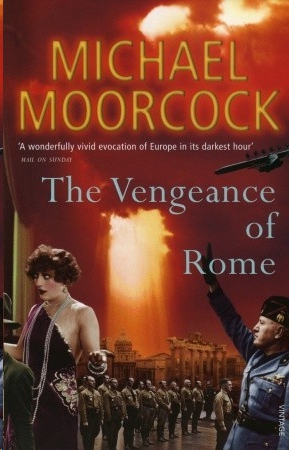
The Vengeance of Rome
- Автор: Муркок Майкл
- Серия: Between The Wars #4
- Язык: английский
- Жанр: Научная фантастика

Электронная книга - «The Vengeance of Rome». Краткое содержание книги:
My natural vitality got me through my ordeal. I longed for a little ‘snow’ to put me back on my feet, but even without it I was soon able to stand steadily and feed myself. Was I in a state of shock? How had I descended so suddenly from fame and fortune? One moment I had been a highly paid public figure, the next I was a mere number. Whatever happiness I could achieve was entirely dependent on the mood of my jailers. Every day I asked about my hearing. Every day I begged someone to get word to Röhm or Hanfstaengl, Göring or Mrs Cornelius. I was afraid I would die there.
I had been abandoned. I knew Mrs Cornelius would never have let me rot in Ettstrasse. She was either back in London or on location with no notion of what had happened to me. Göring was horribly overworked. Hugenberg had important Cabinet duties. Röhm was probably still in Berlin struggling to reorganise the army, while Hanfstaengl could already have left for the United States, as he had been threatening. Possibly Putzi was himself a prisoner.
I enjoyed one or two breaks in my confinement. At one stage I was taken downstairs and photographed. I had to fill in forms, giving the details of my arrest. I wrote that I was in ‘temporary protective custody’ in the hope this would attract the attention of whatever bureaucrat was in charge of the documents. I complained about my cell and was told they were having difficulty finding plumbers. It was on the tip of my tongue to suggest they arrest some plumbers and release some journalists and actors, who were an impractical bunch at best. After a brief medical examination I was interviewed by a young man who warned me this was not a hearing. He had been assigned merely to verify the truth of my written statement. He was almost apologetic. When I complained that my cell had no heat, he immediately tried to sort the matter out, assuring me the police were not attempting to torment me. Ettstrasse, he told me, was never designed for so many people. They were already beyond their capacity.
The prison was becoming more and more crowded. Increasingly, from all parts could be heard the yells, screams and imploring sobs of the prisoners. Fewer regular guards were on the corridors. The SA seemed to be taking over. Some of these were decent enough, especially the older ones who had served in the War. It was the younger, less experienced SA who gave us the most trouble. They were a rougher element, probably ex-communists and worse, who had jumped on the Nazi bandwagon after the election successes of 1933.
I believe the young man who interviewed me meant well, but his intervention scarcely improved matters. After a month I was taken out of my cold single cell and put back with a group. But now I was with well-known Jewish entrepreneurs! Powerful in the outside world, they were in a state of shock. They assumed I was of the same persuasion as themselves. After I politely but firmly told them the truth, they tended to ostracise me. I must admit their action was not entirely disagreeable. However, when I complained to the SA guards about being identified with these people, they laughed and told me that I had better get used to it.
And then one morning in early June the entire cell was ordered into the corridor. There was to be a clear-out. The prison was beyond capacity. Did this mean my release at last? Perhaps they had decided to keep only the prisoners accused of identifiable crimes. With our poor little bundles of possessions, we were marched downstairs and out into the courtyard where lorries were waiting. My anxieties immediately increased. Earlier I had glimpsed from above prisoners being herded aboard these transports. Shouted at, confused and frightened, we climbed into the overburdened vehicles. Where were we bound? Stadelheim? Dachau? My voice joined those of many trying to convince the guards that we had been wrongfully arrested. In the end I realised it was pointless. I was just another scream in the general cacophony.
I decided very quickly that I would rather retain my dignity. I fell silent. I entertained some idea of climbing out from under the lorry’s’ canopy when we stopped and slipping away into the street. Had I any friends left in Munich? An opportunity of escape never presented itself. Having been institutionalised for so long, I had lost all initiative. Eventually I managed to reach a corner of the lorry where I could at least keep my balance and so made the journey in relative comfort. With relief we disembarked. My spirits rose when I saw guards in conventional uniform. From the high, stone walls and the general old-fashioned appearance of the place, I realised I was in Stadelheim. Amid further yelling, we tumbled out on to the cobbles of the castle. I looked around me. The castle’s walls were set at regular intervals with the barred windows of dozens of cells. It had been rebuilt and extended since Hitler’s time. I had seen it, of course, from the Tegernsee road. For such an old building, it had always seemed a rather agreeable place. From within, however, it had a bleak, hopeless atmosphere.
Blinking in the bright summer light, I must have looked a wretch. My only shirt was worn and torn. My trousers were greasy and my jacket not in much better shape. Over my arm was my winter overcoat. I carried a parcel containing the few possessions I had managed to keep. Yet the warders were not unkind. They spoke to us with that rough good humour I had come to expect from the best of them. One warder even helped me into the building. Nobody shouted at us. We eventually reached the reception office and stood in line before a wide, low desk where officials checked off our names.
‘Wankel? Discharge 12th August. Sentence begins at noon today. Jungerer? Release in a year. Sentence began noon yesterday.’ When it came to my turn I had to give my own particulars. They had no room in their ledgers for those of us under protective custody and seemed uncomfortable with the idea. I was sent to another desk with a smart SA man, as cordial as the others. He wrote down everything I told him, including my understanding that I had nothing to fear in the outside world, into a brand new leather-bound book, dipping his pen into his inkwell and wiping the nib carefully on a blotter. Then I was marched into the next room.
Here we were told to strip to our shirts. Anything we carried, be it pencils, money, cigarettes, hats and ties, were listed on the outside of a bag which was then sealed. Those with conventional sentences were given prison clothes and told to keep them on, unless they had sentences of only a few weeks, in which case they could keep their clothes. I, too, was allowed to keep my own clothes. This gave me some hope, indicating that I might, after all, only be spending a short time in Stadelheim. Before I moved on to the next stage, I asked the SA man if he knew whether I had received any letters. I had written, I said, to his chief, Ernst Röhm, a friend of mine, and also to Göring and my wife, Mrs Cornelius. He looked at me as if I was touched and shook his head, smiling. If any letters came from Staff Chief Röhm or Air Minister Göring, he would be sure to let me know. Was my wife by any chance also an office holder in the government?
Consoling myself that he would not be smiling quite so widely if my friends in the Nazi hierarchy found out where I was, I allowed myself to be directed into the medical room, decorated with terrifying posters depicting various forms of venereal disease. Here a prison doctor looked me over. Pronouncing me fit, he signalled for my SA escort to lead me away down a long corridor. The wooden floor was evidently maintained by prisoners and was so highly polished it almost dazzled me. I could look down and see my gaunt, sickly features staring back. Moments later a cell door was thrown open.
I found myself in a long, gloomy room lined on both sides with tiers of bunks. A shaft of sunlight pierced through a dusty window above the WC, seeming to increase the depth of surrounding shadows. The cell was occupied only by two young men. One of them was short and fat, the other long and lean. They reminded me of the comic characters from the English magazines of my childhood, Phil May’s Weary Willy and Tired Tim. In spite of wearing prison uniform, they were both good-humoured but rather startled by my appearance.