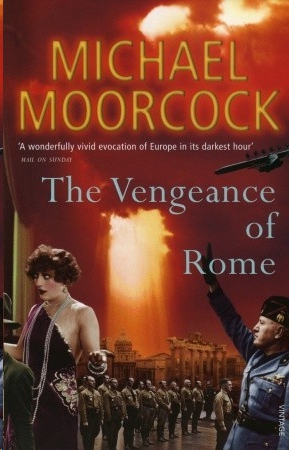
The Vengeance of Rome
- Автор: Муркок Майкл
- Серия: Between The Wars #4
- Язык: английский
- Жанр: Научная фантастика

Электронная книга - «The Vengeance of Rome». Краткое содержание книги:
I fully expected to be notified of a hearing and to be released by that afternoon, but the hours dragged on and no such notification was received. We took turns in pacing the tiny cell. Pottendorf and Helander did their physical jerks. After a while I lost patience and rang the electric bell to attract the warder’s attention.
‘What is it?’ came his voice from the other side.
‘I need my case to be heard. Important matters await my decision. I need to know the reasons for being placed in protective custody.’
The warder promised to report my request.
Surreptiously sustaining myself with a little of my coca, I waited for the rest of the day. Pottendorf and Helander said nothing. They seemed strangely non-committal when I asked them what they thought was happening. Of course, they had been in Ettstrasse rather longer than I.
At last, when the afternoon was fading to twilight, the door opened. I arose hopefully only to stare into the face of one of the SA who had earlier come to claim Doctor Bach. His companion stood just behind him. Next to him stood a short, slender creature whose face had the pallor of one living by night rather than by day. He wore a well-cut grey silk suit of a rather exaggerated line, a pale blue shirt and a tie of light turquoise. In his buttonhole was a fading pink carnation. His hair was oiled and parted sharply and was as black as the patent-leather shoes on his feet. His eyes stared peevishly into the cell.
‘Do you really expect me to spend the night with this rabble?’ he asked the policeman. He turned to say more but was shoved roughly forward.
‘He can have Bach’s blankets,’ said the warder, laughing behind the policemen. ‘They’re not too dirty. If you don’t mind Jew-sweat.’
‘My hearing!’ I managed to shout before the cell door was closed on us again. ‘You told me you would find out about my hearing.’
‘No notice, so far,’ he said through the bars. We heard him and the police stump off up the corridor. Coarse laughter. We heard the far door slam.
I slumped down on my bunk, oblivious of the newcomer.
Pottendorf, ever-polite, offered the man his hand. ‘Greetings, sir. Welcome to our club. I am Count von Zinzendorf und Pottendorf, this is Herr Helander and the gentleman over there is Professor Peters. I take it you are not a German.’
The little man bridled. ‘Why should you think that?’
‘Because I’m gaining some understanding of the minds of our captors. Our previous cellmate has been removed to be with the other Jews, and we are all foreigners. I am Austrian, Herr Peters is American and Herr Helander is Swedish. You are . . . ?’
Some of the defiance left the newcomer’s manner. ‘I’m French, but I’ve lived in Berlin and Munich since the end of the War. You probably know my name. Bernhardt LeBrun?’
The others did not recognise him, but I did. ‘You’re the cabaret comedian! We have colleagues in common. I saw you last at the Simplicissimus here in Munich.’
He turned in some surprise. ’Colleagues in common?’ He appeared to find the notion disagreeable.
‘I myself have acted in a number of films here,’ I told him, ‘and I have friends in show business. You no doubt know Miss Gloria Cornish?’
LeBrun snorted with disgust and turned away from me. ‘Know that slag! I suppose I do. She got out while the going was good. Went back to Berlin. I wouldn’t be surprised if she wasn’t the bitch who libelled me and had me arrested by the Gestapo!’
With a shout of rage, I flung myself at him, only to be restrained by my companions. LeBrun seemed taken aback. He preened in front of me, his hands before his face in mock fear.
‘What are you,’ he asked, his voice squeaking with aggression, ‘her pimp?’
I stared fiercely into his nasty little brown eyes, my words forced through clenched teeth.
‘Count Pottendorf, Herr Helander,’ I said with as much dignity as I could muster, ’I would be obliged if you would release me. This man has just insulted my wife.’
FORTY-SIX
That disgusting little Frenchman believed my beloved had betrayed him to Hermann Göring. Months ago he and she had been on the same bill at the Flashlite — he was the resident comedian — and they had not got on well. LeBrun did not know why he was arrested but was certain it was because ‘Gloria Cornish’ had said something to Göring. ‘I was too outspoken,’ he said. But he had always been careful not to attack the Nazis. No doubt ‘La Cornish’ had convinced her lover otherwise.
I told him that this was complete nonsense. Mrs Cornelius was simply Göring’s friend; she was not his mistress. Whatever else they said about him, nobody ever accused Göring of infidelity. But LeBrun claimed Gloria Cornish was an adventuress, ruthless in her jealousy, whom he had first encountered in France, where she had been involved in a famous scandal. ‘She slept her way into the movies.’ He recognised me, too, he said. He had seen me in Paris. Perhaps with her. He had worked as a waiter at Lipp’s, a restaurant I had favoured. I, of course, denied this. I thought it best to say I had never been there at all. I was still worried about Kitty’s inherited collection of press cuttings and Röhm’s ‘dossier’.
LeBrun knew he had alarmed me and pressed his advantage. After some thought he swore he had seen me at Lipp’s with Gloria Cornish. This was a complete nonsense. We were never together in Paris. Mrs Cornelius was in the United Kingdom at that time. LeBrun was doubtless terrified, flailing about for any advantage. Anything that might ingratiate him with the authorities. It was disgusting. I refused to be intimidated. I told him he was a madman and a slanderer. He was lucky I did not tear him limb from limb.
LeBrun was in his own nightmare. In his babbling panic he accused all and everyone. He could not understand the reasons for his arrest. His accusations became wilder and wilder. They were so clearly his own transference, as Helander suggested, that my anger eventually dissipated. I came to treat him with disgusted contempt. He was not, it emerged, a French citizen, but was from the Alsatian border. My cellmates disliked him as much as I did. He was a poisonous little homosexual, a natural gossip and troublemaker. We could easily imagine how he had come to be arrested. I could not bear to be in the same cell with him.
In spite of his attempts to engage them in conversation, Pottendorf and Helander did their best to ignore him. At my first opportunity I complained bitterly to the guard. We found LeBrun repellent, I said. When not moaning and groaning about his situation, he was accusing each and every one of us of some imagined crime. None of us wanted to risk going to bed. It was not fair that we should be forced to share quarters with an obvious pervert. The guard was sympathetic. As soon as a single cell was available, LeBrun would go there.
Two days passed and LeBrun was still with us. Worse, I still did not get a hearing for my own case. Obviously I had no need of ‘protective custody’. I was an honest American citizen, a taxpayer, a friend of the new Germany. I demanded the Chief of Police be notified. Others might be there for political reasons, but I should not be. I, not LeBrun, was in Ettstrasse as a result of false accusation. It was in Prince Freddy’s interest to get rid of me now that he had what he wanted. If Göring were made aware of my presence in the jail he would immediately have me released. I asked for pen, ink and paper and eventually received a few rough sheets, torn from a schoolbook, and a pencil. Doing my best with these materials, I wrote to Mrs Cornelius and to Aviation Minister Göring, but I despaired. Unless they recognised my handwriting, my notes would look like a thousand others they received every day.
Along with writing materials, tobacco and food, the only newspaper we were allowed to buy via the guards was the Völkischer Beobachter. Those guards made a handsome profit from us. Even the paper was a few more pfennigs than the published price. On the fourth day of my captivity, I was scanning its pages when I noticed a small news item which referred to foreign Bolshevist elements being rounded up for questioning. Many of these Reds were associated with the arts. Writers and actors were particularly under suspicion. They were responsible for corrupting the minds of Germans through their films and books. I asked Pottendorf if this could refer to us and he said he thought it could. I began to feel less than optimistic.