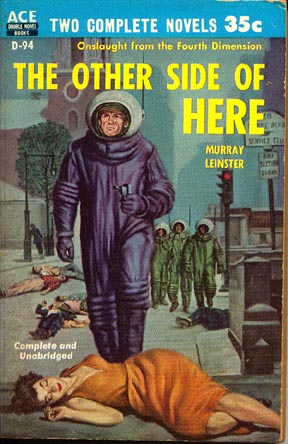
The Other Side of Here
- Автор: Лейнстер Мюррей
- Язык: английский
- Жанр: Научная фантастика

Электронная книга - «The Other Side of Here». Краткое содержание книги:
Newark ... Manhattan ... Baltimore—one by one they went out. A succession of thriving communities suddenly put out like a guttered flame—men, women, children sprawled like grotesque mannikins.
Steve Waldron knew it couldn't be plague. There had to be some connection with the disappearance of the nation's top scientists. And then he plunged to the very center of a dead city and gaped at a truth he could not believe. What could he do against so fearsome a force that threatened to engulf the whole nation?
Here's a spine-tingling science-fiction novel by an old master. It will open up a new dimension of suspense and excitement.
The radio voice went on: ... There is some hope that the virulence of the plague is dying down. This is not unusual in epidemics. In any case, the failure of the plague spots to spread is encouraging. No sporadic outbreaks have been reported, proving that the plague is at least not wind-borne. It has been suggested to the Plague Administration, in fact, that the plague may be artificial—
Waldron's eyes brightened. "Brains at last!"
... in that Steven Waldron, known to have been the source of infection in the New York plague spots, had been working in antibiotic research. It is suggested that during his work he produced some mutation of a familiar organism which is the deadly agent at work now. It has been suggested that his mind became unhinged and that he has released the culture deliberately. This view has not been officially accepted by the Plague Administration but all police officers everywhere have been urged to seize Waldron wherever he may be found. His description and facsimile photograph is being transmitted to every police department in fourteen states. If possible, he should be taken unharmed for questioning, but at all costs his career as a plague-spreader ...
Waldron laughed without any mirth. "I was a little ahead of myself. But at that I'd probably have guessed the same thing about somebody else. Take care, Doctor, not to admit you've seen me until you've proved you can revive the patients they're planning to bury, and until other men doing other revivals are protected as you are."
The doctor very deliberately finished filling the gas tank of the car Waldron had stolen.
"I shall be careful," he said dryly. "I pay you no compliments. Not yet. They would be rather futile when I think what your discovery means. I drive on to New York at once.... Will Miss Blair accept my protection back to the city?"
Waldron was silent.
"N-no," said Lucy. "I've been with Steve. They'd lock me up as a plague-spreader, too. And ... Steve and I..."
"You may be wise," said the doctor cynically. "I'll go now."
Starting the first stolen car and meshing the gears, he drove off into the night. Waldron loaded up the other, larger car with batteries and assorted parts with which small HF generators for personal protection could be made. The doctor, of course, had done exactly the right thing. But Waldron could not feel that what the soft-speaking physician did would make any difference. Certainly with police departments urged to hunt Waldron down dead or alive, he and Lucy were in no cheerful situation.
Dr. James Armistead reached the edge of New York just as news of the blotting out of his own home town became known to the public. There had been panic enough before. But after this last bit of news, the frenzied craving for the means of flight became a mania. However, when the doctor approached the city with knowledge of how to alleviate its terror and revive the victims of what everybody believed a plague, he ran into a blockade. Men swarmed into his car, battered him into unconsciousness. They then fought savagely among themselves for possession of the car.
Meanwhile, Waldron and Lucy had driven off into the darkness in another direction, leaving behind them a filling station attendant looking up at a gasoline gauge with an expression of absorption which would remain upon his face for days or weeks.
Waldron drove. At first he used only the parking lights and moved slowly. But after some miles he turned on the full headlights and the big car leaped ahead. A long time later, when a rabbit leaped frightenedly from the road before them, he was sure they were beyond the area of affliction. He relaxed, for he had felt a nagging anxiety that one of the high-frequency packs might cease to work at any instant.
"We're out of the dead spot," he told Lucy. "Tell me: while you were frozen, did you know it?"
"N-no," said Lucy. "One instant I was sitting in the chair, watching you twist two wires together. And suddenly the doctor was holding me toward you and you had your hands on my arms and I wasn't in the chair at all. I had no feeling of time-lapse."
"I think we should thank God for that!" said Waldron. "If all those hundreds of thousands of people could see and hear and feel but not move, they'd be better off actually dead. But they won't know anything until they're revived. That, at least, is merciful."
He slowed the car and searched the sides of the road.
"What are you looking for, Steve?"
"A hiding place," said Waldron briefly. "The packs we have are all right. They saved us. But they're makeshift. I want to connect them up so they'll use storage-battery current while we're in the car and go on dry cell only if we get out. And I want to change the dry cells. Also, I think you need some rest."
"How about you?"
Waldron shrugged. He did not feel sleepy, but he was beginning to feel that numbness which came from complete weariness of mind and body.
Presently he found a small side road. It was hardly more than a dirt road that led through the pinewood that bordered the highway. Seeing that it showed no sign of recent use, Waldron turned in it and drove a hundred yards or so. The road wound and twisted, and low-hanging branches swished over the car's roof.
"Okay," he said, and cut the ignition. "Now we should be all right for a while. I'm going to fix our life savers. When they're done, I'll take a nap until sunrise. Curl up in the back and go to sleep if you can."
Lucy hesitated, and then obediently moved to the wide, soft rear seat. Waldron cut all but the instrument-board lights and set to work as best he could in the unsatisfactory illumination.
There was silence. A breeze blew outside and tree branches sighed and whispered. Lucy was still. Waldron spliced wires and made contacts. From time to time, there was a faint humming sound as he tested some new arrangement.
Lucy stirred and sat quietly for a long time. She stirred again. Then she said: "Steve ... I haven't asked anything about my father for a long time. Does what you've found out tell anything about him?"
"He's in Fran Dutt's homeland," said Waldron flatly. "Fran said he was unharmed. I more than suspect he is. I believe it."
"But ... where's that? What country? Where?"
Waldron frowned. He scraped wires. He twisted them together. "Tricky to explain," he said slowly. "But you remember that your father was working on Straussman's Theory. Straussman sprang his wild ideas all of thirty years back, or even more. Scientists laughed at him. They classed him with Fort. He said two objects could be in the same place at the same time. Compenetration was philosophically possible. But in fact—they said it was ridiculous. When Straussman claimed experimental proof, nobody would even look at it. So Straussman disappeared. He vanished into thin air. Nobody cared. His theory lay fallow for thirty years, until somebody noticed that he'd anticipated some extremely ticklish wave-mechanics stuff. Then they realized that he had something. But I don't think anybody understands it all yet."
"My father said that much, Steve."
"Just so. Your father examined his theories. He published a paper on that two-objects-in-the-same-space-and-time angle. It was just about then that Fran Dutt turned up, so brilliant and so admiring that your father took him on as assistant. Remember?"
"He offered to work without pay for the privilege of serving with Father in pure research."
"With the purest of motives," said Waldron ironically, "as we know now. He was sent to spy on your father, just in case he found out something in this pure research of his."
He tightened two twisted wires with pliers.
"In the living room of your house," he said presently, "there's a mirror hanging on the wall. If you look in that mirror you see another living room in the space where actually there's a dining room. Right?"
"You see a reflection," said Lucy. "What has that to do with my father?"