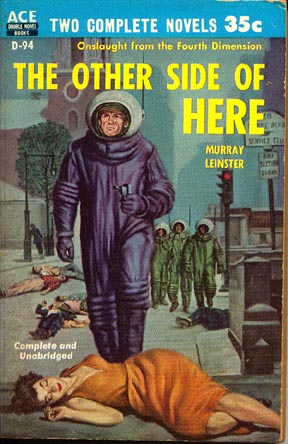
The Other Side of Here
- Автор: Лейнстер Мюррей
- Язык: английский
- Жанр: Научная фантастика

Электронная книга - «The Other Side of Here». Краткое содержание книги:
Newark ... Manhattan ... Baltimore—one by one they went out. A succession of thriving communities suddenly put out like a guttered flame—men, women, children sprawled like grotesque mannikins.
Steve Waldron knew it couldn't be plague. There had to be some connection with the disappearance of the nation's top scientists. And then he plunged to the very center of a dead city and gaped at a truth he could not believe. What could he do against so fearsome a force that threatened to engulf the whole nation?
Here's a spine-tingling science-fiction novel by an old master. It will open up a new dimension of suspense and excitement.
Waldron stared in stupefaction. The bit of tissue vanished completely from between the two electrodes. It seemed to evaporate instantly. It simply ceased to be.
He paced up and down the room, thinking furiously. Lucy watched anxiously. She'd been watching silently all the while he labored.
Presently he took one of the remaining cataleptic little creatures and moistened its fur in two places. He put electrodes in the two spots. He motioned to Lucy to watch. She came close, staring. He threw the switch.
The immobile white thing which was the mouse disappeared like the blown-out flame of a candle.
"Steve!" cried Lucy. "Where did it go?"
To the place Straussman guessed at," said Waldron, with a grim and savage satisfaction. "You might call it the Other Side of Here. Some people have called it the fourth dimension, but that's wrong. And some have called it Avalon, and Tir-nam-beo, and some have called it Hell. I suspect the last is closest. I'm certainly going to work like the devil to keep you from going there!"
He began to work more furiously than before. Now he used another tiny strip of muscle tissue from the dissected creature.
"Halfway between," he muttered. "Intermediate stage. Now what will cancel it? Hm ... Orientation ... The mouse is as if it were magnetized.... A crazy idea! But the way to demagnetize something..."
He worked swiftly with wires and rheostats. The doctor's office had X-ray machines, and an electrocardiograph machine, and diathermy— He used the diathermy machine. He placed two terminals on moistened spots of a strip of muscle. The diathermy machine would send high-frequency currents through the tiny bit of flesh.
He turned on the diathermy current. The muscle stretched. It sagged.
Waldron paced up and down yet, and Lucy watched him with absorbed attention. He seemed to be suffering as he frowned in concentration and scowled at some mental difficulty. Clenching and unclenching his hands unconsciously, he worked out one item after another. Lucy began to feel uneasy. But Waldron was actually feeling the deepest satisfaction a scientific worker can experience. The items of a difficult problem were beginning to fit themselves together. Answers to other parts of the large problem were beginning to suggest themselves.
He was working on the third mouse, fitting the electrodes to its body, when the doctor came back. Waldron called him. His hands were shaking with triumph and excitement.
"Watch this, Doctor!" he commanded feverishly. "I've put this mouse in a diathermy circuit! I doubt that such high-frequency is necessary, but—" He brought himself under control. "Check the mouse, please. I think a diathermy circuit will bring it back to normal-tissue condition. I've even got a crazy idea— Check this!"
The doctor asked questions. Waldron told him, with difficulty, of the effect of the diathermy current on muscle tissue that had been dissected out. He showed that bit of tissue. He showed the other dissected parts of the mouse, still iron-hard. The doctor fumbled at his chin. Then, without words, he picked up the mouse Waldron had made ready. He examined it carefully. It was iron-hard. It was at least cataleptic. He put it back as Waldron had arranged it. In silence, he waved Waldron away and threw the diathermy switch.
There was a faint humming sound and the smell of ozone. A frightened squeak rose and a small white mouse fought frantically to release itself from entrapment. The doctor picked the rodent up and dropped it in a porcelain tray. The mouse ran about feverishly and then subsided, its beady small eyes fearfully regarding the humans above it.
Waldron's face glowed. "They're not dead!" he cried. "The hundreds of thousands of people like that—they can be brought back to normal and to life with diathermy machines! The odds are that even simpler stuff—any high-frequency current of high enough voltage—will do the trick. But if you try to tell anybody about it, Doctor, one of the spies of the people who're pulling this trick will be on the job to stop you. They're after me. We've got to work out a fool-proof trick."
The doctor said quietly: "Without wasting words congratulating you, I think you must be right. I'll call every doctor in town here, describe your results and invite them here for a demonstration. Then, separately, we will head in for New York. We assuredly have data justifying the use of diathermy machines on patients nobody else has any idea how to treat. We will revive those patients. And then we will name you. Not before. If anyone admitted he had been in contact with you, he would probably be mobbed. Have you been listening to the news broadcasts?"
Waldron shook his head.
"It's bad," said the doctor calmly. "So bad, indeed, that I would suggest that you tear some of my equipment apart and try to improvise something on the order of a high-frequency generator that will not produce a fever. To use as —ah—an immunizer against whatever causes this condition of catalepsy."
There were two white mice left in the condition which had seemed to be rigid death. The doctor carefully put them aside for use in his scheduled demonstration. Then he began to make his calls to fellow-physicians.
Waldron got to work. He understood, with deep satisfaction, what the device Fran had put under the car had done. It had generated high-frequency currents in the metal of the car. Those currents had induced high-frequency currents in Waldron's and Lucy's bodies. He took out the gadget and examined it. Melted as it was, it was useless. He threw it away. It was much easier to improvise small battery-operated generators of his own.
He made one battery-operated high-frequency generator, then another. He set to work on a third, a fourth. Meanwhile, the doctor made one phone call after another. Waldron could hear his voice, very calm and unexcited, as he talked to other doctors or tracked them down through their nurses. He was setting a time for the demonstration so that all of them should be able to attend. There were only two mice left to use in the experiment.
The doctor finished his calls and came to watch Waldron at work. Darkness fell outside. However, the office remained brightly lighted, and the expression on the faces of the three remained enwrapped. Waldron was absorbed in his work and in speculations as to the complete disappearance of a mouse when a direct current was passed through its body. Straussman's Theory gave a clue to that. Straussman had expounded a completely unconvincing theory, which among other things implied the possibility of such a disappearance. He, himself, had disappeared. But nobody believed it. It was quite irrational and nobody believed in things that do not make sense.
The doctor watched with professional interest, while Lucy observed with a peculiarly wistful, almost maternal pride. Outside, there was a continuing faint noise of the traffic on the Merritt Parkway, half a mile out of town. Also, there were the closer sounds of the town's cars and human beings.
"It was a crazy guess," said Waldron, almost ashamedly. "I thought of the analogy to magnetism. The mice, according to Straussman's Theory, would be partly in a state analogous to magnetism. And the way to demagnetize a magnet is to use alternating current. I had controlled alternating current in the diathermy machine. I even figured that high-frequency would be better than low-frequency. But it was a crazy idea. I had the break of a lifetime when it worked."
He slipped dry batteries into place in the little generator he had made. He turned it on. It was almost soundless, but it created tiny high-frequency currents. It should—
There was an impact somewhere out in the street. There was a thunderous crash somewhere a block away. A long distance off, there rose a growling noise. It was a most unusual and extremely distinctive noise. Waldron was probably the only man in the world who would have recognized it instantly. It was the sound of innumerable crashings of unguided cars. It was the roar of sound rising out of uncountable collisions.