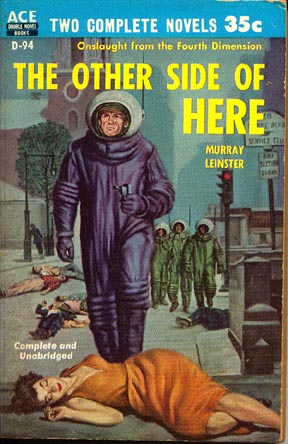
The Other Side of Here
- Автор: Лейнстер Мюррей
- Язык: английский
- Жанр: Научная фантастика

Электронная книга - «The Other Side of Here». Краткое содержание книги:
Newark ... Manhattan ... Baltimore—one by one they went out. A succession of thriving communities suddenly put out like a guttered flame—men, women, children sprawled like grotesque mannikins.
Steve Waldron knew it couldn't be plague. There had to be some connection with the disappearance of the nation's top scientists. And then he plunged to the very center of a dead city and gaped at a truth he could not believe. What could he do against so fearsome a force that threatened to engulf the whole nation?
Here's a spine-tingling science-fiction novel by an old master. It will open up a new dimension of suspense and excitement.
A rustling rose at Waldron's elbow and a voice rasped a challenge. The challenge was unintelligible. A figure came close. It rasped its challenge in cryptic, snarling, alien speech. It was definitely suspicious—and it had hundreds of fellows within call.
SIX
Waldron said: "Sh-h-h-h!"
It is not possible to guess what that man thought. But he lowered his arm—which may have been holding a weapon— and bent his head toward Waldron to try to make out his features in the almost complete blackness of the night. Waldron's fist lashed out. It landed accurately on the point of the other man's jaw. There was not light enough to judge distances. It was either blind luck or a miracle, according to one's estimate of such matters. But the other man staggered, and Waldron hit him again and again in such blazing ferocity of attack that the man did not even cry out.
He collapsed, and Waldron flung himself upon him, his hands groping for his enemy's throat.
A long time later he whispered over his shoulder: "He's got some kind of armor on. Scale armor. I'm guessing that it works like our frequency-packs to protect him. I've got to get it off. Then he'll stiffen like everybody else, I think. And if we hide him—"
He rose, heaving the inert figure to his shoulders. Then a sudden cold sweat came out upon his body. This other man was somehow protected against the thing which made all unprotected humans into inflexible images. All his fellows were protected. They were wholly and permanently safe. But Waldron was preserved from catalepsy only by an improvised, dry-cell contrivance which was not designed to be fought in.
Cold sweat came out on his face as he carried off the man he had battered into unconsciousness. He felt panic for fear that at any second his generator of high-frequency current might stop working. Its flickering tongue of metal seemed horribly fragile. Its twisted connections seemed makeshift and insecure. And having fought, Waldron felt sick and dizzy with the realization of the chance he'd taken in entering into battle while depending on so uncertain a device.
With this odd panic upon him, he did not carry his prisoner far. Fifty feet, perhaps. Then he laid the man down. He pulled off the close-fitting helmet and put it on his own head. He stripped off the close-fitting, curiously worked scale armor and with whispered and urgent instructions to Lucy in case he "froze," he slipped it on. Then he felt curiously secure. Lucy's life depended on his own, and for battle he needed something more certain than dry-cell connections.
He felt the body of his victim. It was hard. This man, a compatriot of Fran Dutt, had yielded to the strange force that had made and still kept the city a place of grotesquely posed pseudo-corpses.
Then Waldron hid his victim and he and Lucy crept away. In whispers he explained to her what he had done. He could not find the weapon that had been pointed at him. Most probably it had fallen from the sentry's hand and now lay somewhere in the darkness, heating itself to destruction, its glow unseen.
He oriented himself carefully by the rumbling of muffled, quietly driven trucks. They were heading toward the business section of the city and they were moving without lights. Their drivers must possess the eyes of cats, Waldron thought. He went quietly along a parallel street, Lucy clinging to his hand. For block after block, they moved through soft and horrible darkness. The stars were not to be seen through the mist that hung overhead. Belleville Avenue joined Broad Street. Waldron peered and listened. It seemed to him that another stream of silenced trucks came from somewhere and joined the first.
They went on. And now and again they saw a vague grayness, or a vague whiteness, or an indefinite difference in the color of the sidewalk on which they quietly moved. Those patches of color were human beings, toppled where they had stood. Sometimes there was wreckage on the sidewalks. They passed one place where huge objects, which must have been motor trucks, blocked the sidewalk altogether. The smell of stale, spilled gasoline saturated the air.
They circled that broken mass and plodded on. Gradually, even Lucy ceased to gasp faintly if by chance she trod on a frozen arm ... a leg. Yet they gained a new alertness in avoiding such accidents. And all the while the soft, purring mutter of many motor trucks moved parallel to their course.
"I don't understand," protested Waldron, straining his eyes before and all about him. "They're looting, but they're taking pains to do it silently. They're not using lights so there'll be no glow in the sky. Why? And where is the loot going to?"
There were plausible guesses that could have been made, but he was not equipped to make them, just then. For example, the first reaction to the news of the disaster in Newark had been uncertainty. There had been suspicion that it was the result of some horrible action by the Reds—not too good a guess. There had been guesses that it was the final fruition of all the flying-saucer stories that had been cropping up for years on end. Fran Dutt's compatriots could not be sure that the explanation of a plague would be accepted as the true one. Very probably, the tactic of invisible looting was merely a precautionary measure. A terrified America, convinced that the population of Newark was dead anyhow, in desperation might use an atomic bomb against possible invaders from the stars. Such an action might have been undertaken had activity been observed within the blackedout, silent town.
They came to a wide, open space where a triangular park verged upon the downtown street. It seemed that here the overhanging gray mist let through more starlight, or possibly the dim light was supplied from some other source. In any case the line of trucks could be seen turning and lurching across the soft green sward of the park. They vanished into a great building on the farther side, and none of them seemed to come out again.
"I have a suspicion I know what's going on in that building," murmured Waldron, "but I want to be sure. We'll get around to the back."
It took them half an hour to go the short distance required. This was the part of the city where traffic had been thickest and where stiffened bodies were most numerous everywhere.
Then they came to a place where lights shone. These were not from inside windows. Rather the lights seemed to seep out from rooms within the building. Yet the lights that fell outward was too scant to be seen from afar. For that matter, surrounding buildings would prevent radar detection of the moving trucks.
Waldron moved with infinite caution through the darkness behind the budding. But there would be no watchers. The man whose protective armor he wore had probably been on guard as much to watch against looters finding valuables for their own account as for any other purpose.
Presently Waldron drew his revolver and went quietly to look inside. Lucy followed close.
He flattened himself against a wall and edged to a window from which feeble light came. His hand, holding Lucy's to give her reassurance, closed hard as he took his first glimpse within. Then he drew his head back and motioned for her to peer in.
She gazed into what had been a sort of grand foyer—an exaggerated open ground-floor space, with a twenty-foot ceiling. A very neat concrete floor held specks of marble and mica that glistened. There had been a newsstand with magazines, packaged candy and tobacco, and a soft-drink stand, and there had even been a certain number of plate-glass frames serving as directories. But the revolving door and plate-glass panels had been ruthlessly hacked away. The opening now served as an entrance for motor trucks to run in a growling, unending stream into the building.