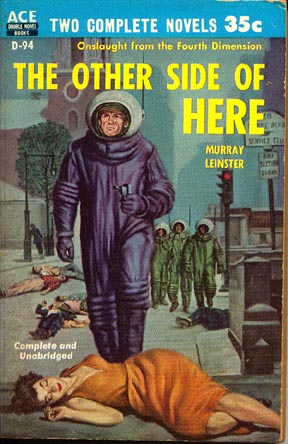
The Other Side of Here
- Автор: Лейнстер Мюррей
- Язык: английский
- Жанр: Научная фантастика

Электронная книга - «The Other Side of Here». Краткое содержание книги:
Newark ... Manhattan ... Baltimore—one by one they went out. A succession of thriving communities suddenly put out like a guttered flame—men, women, children sprawled like grotesque mannikins.
Steve Waldron knew it couldn't be plague. There had to be some connection with the disappearance of the nation's top scientists. And then he plunged to the very center of a dead city and gaped at a truth he could not believe. What could he do against so fearsome a force that threatened to engulf the whole nation?
Here's a spine-tingling science-fiction novel by an old master. It will open up a new dimension of suspense and excitement.
The taxi lurched. In half a block there was a traffic jam. In a block there was a red light. Waldron said fiercely: "Straight ahead—keep going!" The light glowed green and the cab started again.
There was a tumult of crashings behind them. Screams suddenly filled the air. Heavy, sodden bumps mingled with other screams and there was the shattering of plate glass and the roaring of automobile horns and the shrilling of police whistles.
Waldron looked back. He said evenly to the driver: "Driver, the stuff that hit Newark is at work back there. You'd better step on the gas!
THREE
That night occurred the most monumental traffic jam in New York's history. The business of Newark, alone, should have been sufficient stimulus to panic. But it hadn't been fully believed. However, the discovery that a small area-circular, and two crosstown blocks in diameter—in the very middle of New York was similarly affected, made panic inevitable.
In that two-block area, human beings lay frozen in that position and gesture they had held when struck by some unknown force. They lay toppled on the street or leaned drunkenly against some object that had arrested their fall. Motor vehicles had gone blindly mad, crashing into each other and into sidewalks. Some of them had rolled out of the stricken area like juggernauts, seeming corpses at their wheels.
With the spread of the news, the traffic jam began. As through repetition the facts about Newark became more and more plausible, more and more people uneasily decided to take their families farther away from the scenes of desolation. Suddenly it seemed that a whole city had taken to wheels.
This was the worst thing possible. The Holland and Lincoln tunnels could be crossed, and the George Washington Bridge was open. But nobody wanted to go closer to what they considered a plague spot. The bridges to Brooklyn and Long Island—these became the roads to safety. As a result, a ghastly crush built up at these exit points.
But most of the population wanted to get away by the highways leading north from Manhattan. The result was a jam to stagger the imagination. The cab in which Waldron and Lucy rode was caught in it. At first the cab moved yards, stopped, moved yards again. Presently it moved only feet at a time. But later it moved only inches.
At four o'clock in the morning their cab was hopelessly fixed in place. It had not stirred at all in almost an hour. Waldron grimly paid the driver and he and Lucy made for the sidewalk. They had to climb over bumpers. There appeared to be no sidewalk. Cars had filled all lanes in the streets, of course, and then desperate drivers had tried to use the sidewalks for traffic lanes. And they were stalled too.
Waldron led the way northward, squeezing past cars that were almost pressed against building walls.
"If we can get out of this and to where we can get a train," panted Waldron, helping Lucy get past a particularly tight place, "we can lose ourselves from Fran's crowd, and I'll be able to find out something from these mice."
He still had the mice from Professor Jamison's flat, and he was bitterly certain that no police had gone there to get the others for doctors to work on. He was also certain that the young man who looked so much like Fran Dutt had not been arrested. And that some men had had a weapon which did on a small scale what had been done to all Newark and one four-block area in New York.
When the sun rose, they were still not at the end of the jam. The streets running north and south were rivers of stalled cars, over which hung reeking clouds of exhaust gases. And the traffic congestion was more hopeless than ever, because many cars had run out of gas, or had overheated and stopped. Many others had been abandoned by their owners, desperately resolved to try to escape the city by subway or by train.
Waldron and Lucy turned into a tiny lunchroom which was open despite the panic. Business was not normal, of course. The most important thing in life, this morning, seemed to be the news broadcasts. All broadcasting stations had abandoned all attempt at programming and simply ran news. This continued to be essentially that there was no news about anything within either Newark or the area around the Mayfair Hotel. Then two records were played and the same news was repeated.
Waldron ordered breakfast for Lucy and himself. Then he started for a telephone. A news broadcast came on. He listened.
... the authorities announce that the outbreak of plague in Manhattan—which, however, does not seem to be spreading; repeat, does not seem to be spreading —is due to the bringing of germs from Newark by a Mr. Steven Waldron, who claimed to have escaped the onset of the plague there. The new plague area has been surrounded by a military cordon. It is known that Waldron had been in the hotel. Everyone to whom he talked at a newspaper office has been isolated and every precaution is being taken against spread of the contagion....
Waldron went back to Lucy. Nick Bannerman couldn't be reached, evidently, if he'd been isolated. Waldron drummed on the table, while immobile traffic outside the tiny restaurant filled all the air with misty exhaust fumes. He wondered if the mist he'd seen in Newark had appeared in the New York area now classed as a plague spot.
But then another broadcaster came on.
... Rumors of an invasion from outer space, as the cause of the incredible disaster in Newark, continue to be spread. Physicians, examining the passengers and crew of a tube train which arrived from Newark with everybody seemingly dead, are unable to confirm or deny this report. The victims seem dead, but doctors refuse to perform autopsies in the absence of normal changes usually following death. While the use of extraterrestrial weapons cannot be ruled out, as yet, a plague of previously unheard-of virulence is considered the more likely explanation. The sternest possible sanitary measures are now in force—
Waldron scowled. He got up.
"I'll call the Health Department and tell them where there are some plague-stricken mice," he said to Lucy, his tone sardonic. "If they do autopsies on them, they'll find out something—maybe."
He went into the phone booth and swung the door shut. The two breakfasts arrived and Lucy began to eat her bacon and eggs. She was mildly astonished that she could eat at all. But the events of the past sixteen hours were much too far out of normal to have normal effect. She watched Waldron as he talked on the phone. She saw his frowning concentration as he dialed again. Then he asked for someone and waited, and then he talked crisply. An instant later he looked incredulous. Then, infuriated, he barked at the instrument and slammed down the receiver.
When he returned he did not sit down to his own meal. He said briefly: "We've got to move—and fast."
She rose unquestioningly. Outside, he raged: "I told them they'd find cataleptic mice in Professor Jamison's apartment, together with a tied-up character who knew everything they wanted to know if they could sweat it out of him. And they wrote that down, very carefully, and then the imbecile I was talking to commanded me very impressively to stay where I was, until quarantine officials could come for me. He added that the phone call would be traced instantly."
Then he looked out at the steaming, stinking river of stalled cars.
"They won't get any squad cars here very fast. Come on."
He led her through the motionless mass of throbbing motors and headed for an alley on the far side of the street.
Two hours later they were far uptown. By that time bulldozers had been brought into play on the traffic. Bulldozers pushed stalled cars to one side and went rumbling down the cleared space in search of other stalled vehicles. Slowly but effectively abandoned or useless cars were weeded out. Traffic began to move a bit. The bulldozers kept on the job.