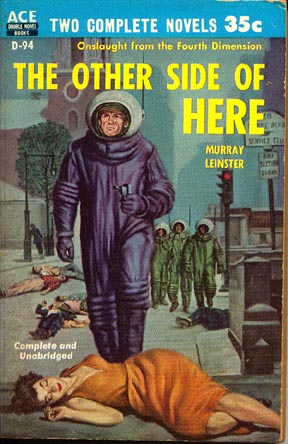
The Other Side of Here
- Автор: Лейнстер Мюррей
- Язык: английский
- Жанр: Научная фантастика

Электронная книга - «The Other Side of Here». Краткое содержание книги:
Newark ... Manhattan ... Baltimore—one by one they went out. A succession of thriving communities suddenly put out like a guttered flame—men, women, children sprawled like grotesque mannikins.
Steve Waldron knew it couldn't be plague. There had to be some connection with the disappearance of the nation's top scientists. And then he plunged to the very center of a dead city and gaped at a truth he could not believe. What could he do against so fearsome a force that threatened to engulf the whole nation?
Here's a spine-tingling science-fiction novel by an old master. It will open up a new dimension of suspense and excitement.
Waldron jerked his head up, his face going white. The other two in the office sat quite still. Lucy did not move a muscle; the doctor did not even blink. They were stiff, motionless—cataleptic.
Waldron swore thickly. The sound of crashings ended. The town outside fell silent—utterly silent. It was as still as Newark and those "plague spots" in Manhattan. It was the silence of death—no, it was worse than that. It was the silence of life which was frozen and chained and hopelessly imprisoned in stiffened flesh.
Then he heard quiet, unexcited voices. They spoke an unintelligible language. He heard footsteps. They moved in an approximate cadence, like men marching together upon a certain definite errand.
The footsteps came closer. They moved directly for the small building housing the doctor's office. Waldron listened with his hands clenched fiercely on the small object he'd made. Lucy and the physician were absolutely motionless. They did not even breathe.
Waldron knew bitterly that this small town had become what men would call a plague spot. One of the city's physicians, informed of a prospective proof of a way to cure the "plague," had reported that specimens of "plague-stricken" experimental animals were in the city. He had named the physician who proposed to display them to other medical men. And Fran Dutt's compatriots had learned of the report. They had, therefore, made a new dead spot, a new plague spot of this small town, so that they might seize that doctor. And they would seize Lucy and, of course, Waldron himself. They would completely prevent anybody from finding out what Waldron now knew.
FOUR
Waldron found himself standing up, gripping the little device he'd just made with fury-tautened fingers. He didn't have the pistol that had belonged to Lucy's father. She had it. He'd get it and at least kill some of this crew. Veins throbbed on his forehead with his hatred and his rage.
But then he looked down at the small device in his hands. In its interior a tiny tongue of metal wavered back and forth, and a tiny blue spark flickered. Because of that spark and the high-frequency currents it generated, Waldron himself was still able to move and breathe. And there around him were the other outfits.
He moved clumsily to the diathermy machine and turned its switch without releasing the device in his hands. He picked up the two leads which had revived the mice. Very, very carefully—not breaking the effect of his own tiny machine—he sent the diathermy current through the doctor's body.
The doctor stirred.
"Quiet!" said Waldron in a low tone. "You've had a dose of what they call the plague. Now you're out of it. But keep quiet and listen. While I keep high-frequency flowing through your body, start up that other pack on the table Start it!"
The doctor stared hard at Lucy. Then he listened.
"Yes!" said Waldron bitterly. "The town's dead! Quick!"
The doctor moved like a man accustomed to emergencies. Waldron drew back. The doctor still moved.
"Good!" said Waldron. "Lift Lucy over here. The wires won't reach her."
The doctor obeyed without words. He was very pale, but a man who confronts the daily emergencies of a general practitioner learned to act without stopping to talk. He lifted Lucy to within Waldron's reach with the diathermy terminals. Waldron touched them to her. She shuddered, stared and then gasped, looking at Waldron with horror-filled eyes.
"Right," said Waldron. "They've frozen the town around us. Doctor, give her that third generator. Start it."
He withdrew the diathermy terminals. Lucy continued to move and breathe. There was no sensation from either the diathermy or Waldron's own make of high-frequency generator. He switched off the big machine. He still breathed. He had been unreasonably fearful about that.
Now the sound of nearing footsteps was very plain.
"They stopped to check a street number," he said grimly. "Fran Dutt's compatriots, Lucy. We've got to get out of here and we've got to do it quietly. We can't fight. Doctor, it's up to you to get us out of here without a sound."
Without a word, the doctor led the way. They went through a side door from his office and came to a dark hallway. Steps led down and Waldron steadied Lucy, cautioning her under his breath. At last, the doctor opened a door ahead of them with infinite caution. The cool fragrance of night swept against their faces. Behind them, feet tramped into the building they had just left.
They went swiftly away into the dark. Behind them they heard voices: argument in an unknown tongue. Somebody tramped heavily down stairs again. The fugitives moved faster.
There was gruesomeness and terror all about. The street lamps still burned brightly. Lights in the houses were on. But no living creature moved anywhere. The three could see into a lighted room. A family was seated there, but not a person moved. They passed a car in which were a young man and a girl. The motor idled softly. The girl had just gotten in beside her sweetheart. He had snatched a furtive, quick and eager kiss—and had frozen in the act.
And a long, long way on—when they felt almost safe— they saw a woman sitting on the step of one of the meaner houses. She was bent over a tiny, carefully wrapped bundle which she held in her arms. The bundle was a baby. The woman would sit in that pose of unconscious tenderness through the night, and through days and nights to come.
They came to another parked car. There was no one in it. Waldron reached inside and fumbled with his hand.
"Somebody left the key in the lock. He meant to be right back. We need this, Doctor."
Very quietly, they climbed in and Waldron pressed the starter. There was very little sound. The car purred softly and Waldron drove away, moving swiftly into high gear to avoid the telltale whine. He did not turn on any lights, as his eyes were now fairly well accustomed to the dark.
Three times, he checked the car sharply to keep from running into something. Once, with tight-clamped jaws, he went up on a sidewalk to avoid running over persons lying absurdly in the street. He knew they were alive, no matter how they looked.
They got out of the town. Just beyond the houses there was a brightly lighted filling station, in which blared a radio. A big, black, glistening car was pulled up at the tank. A station attendant worked the pump. But it had shut itself off and nobody moved. The car itself was empty. Its occupants had probably gone into the filling station for cigars or soft drinks. Waldron saw a huddle of bodies on the floor. One of them had been frozen in the act of hearty laughter.
"We take this car," said Waldron coldly. "Hunted as I am, I need something with speed to it. You keep the car you've got, Doctor, and head in to New York. If you get to a hospital and revive a few patients, maybe some of the fatheads who think this is a plague will believe you. But make sure you get some more high-frequency generators made up!" The radio inside the filling station blatted: In fourteen hours there has been no enlargement of the three plague spots in Manhattan. The area about Newark, however, has enlarged twice. The first enlargement was near sunrise this morning, when a number of Army quarantine teams were overwhelmed, and the other was late this afternoon when a party of newspapermen and press photographers, touring the edges of the plague spot, were apparently overtaken. It is understood that though every precaution had been taken against infection...
"I notice," said the doctor quietly, "they don't mention the name of any well-known medical authority as calling it a plague."
"I can guess," said Waldron bitterly, "that anybody big enough to have more sense was picked off ahead of time—or else was caught in one of those two 'enlargements.'"