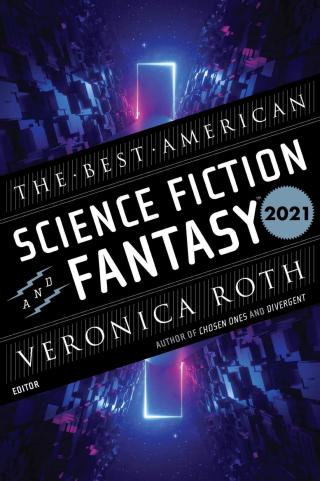
The Best American Science Fiction and Fantasy 2021
- Автор: Рот Вероника, Адамс Джон Джозеф
- Год: 2021
- Язык: английский
- Год: HMH Books : Mariner
- ISBN: 9780358470076
- Жанр: Малые литературные формы прозы

Электронная книга - «The Best American Science Fiction and Fantasy 2021». Краткое содержание книги:
This year’s selection of science fiction and fantasy stories, chosen by series editor John Joseph Adams and bestselling author of the Divergent series Veronica Roth, showcases a crop of authors that are willing to experiment and tantalize readers with new takes on classic themes and by exchanging the ordinary for the avant-garde. Folktales and lore come alive, the dead rise, the depths of space are traversed, and magic threads itself through singular moments of love and loss, illuminating the circulatory nature of life, death, the in-between, and the hereafter.
The Best American Science Fiction and Fantasy 2021 captures the all-too-real cataclysm of human nature, claiming its place in the series with compelling prose, lyrical composition, and curiosity’s never-ending pursuit of discovering the unknown.
“I’ll buy a set,” Consuelo says, leaning across the table and putting her hand on mine.
I fight the urge to pull my hand back. “Really?”
“I’ll buy the whole kit,” she says.
“But that costs over a thousand dollars,” I hear myself say. How can I be so bad at this job?
“No problem,” she says. She rises and comes back with an expensive-looking leather wallet. She takes out an Amex card and puts it on the table.
“Will selling a kit make your life better?”
“Yes,” I say automatically.
“Well,” she said. “There’s something I’ve wanted to do for a long time that will make my life better.” She looks away from me and picks up a napkin. She starts folding it with her bejeweled fingers.
I look at her dumbly, then back over my shoulder at the front door, which is barely visible at the end of the long, dark hallway. My underarms start to sweat.
“It’s not dangerous,” she says. With steady fingers, she folds the napkin in on itself, over and over, until it’s a small fat square. “I want to take your grief out,” she says, then says it again when it’s clear that I don’t understand.
“H-how?”
She unsheathes a butcher knife from its crisp paper sleeve. “In your wrist,” she says. “Your grief, I want to cut it out.”
I jump up and back, catching my foot in the strap of the messenger bag and knocking over the juice box. Red liquid dribbles onto the table.
“I’ll buy two sets of knives, if that will help you decide. What’s that, two thousand dollars?” Her voice is low and soft. “And I’ll demonstrate on myself first. It won’t hurt. I’ll show you first and you decide.”
Pulling the chair an arm’s length from the table, I sit back down, holding my messenger bag in front of my body.
A bird pops out of the cuckoo clock behind Consuelo and we wait while it performs seven pealing, pathetic coo-koos.
Consuelo picks up the knife with her right hand and shows me her left wrist, which already has a thin vertical strip of a scar on it about two inches long. With the tip of the knife, she applies enough pressure to make the scar a wound, a narrow red line. I expect the blood to pour from her wrist like something out of a horror movie, but the cut seems impossibly thin, as if drawn with the tip of a pen.
“I don’t have grief,” she says. “Someone took it out for me. I can take yours out, too.”
I am anchored to the kitchen floor. I look at the inside of my wrist and then I look back at her. “What’s the small print?”
“No small print,” she says, holding out her wrist for me to see again. “I take the grief out and then it’s no longer yours. It’s gone.”
“What’s in it for you?” I say, watching the thin red line begin to darken. Is it already healing?
“Making the world less sad,” she says, opening and closing her palm slowly on the table as the line darkens to scab-maroon. “Someone did it for me once, and I want to pass it on. Isn’t that what you want?”
I watch as my own arm drapes itself across the small table, my palm turns upward, and my wrist presents itself to her. She cradles my hand and uses the knife to draw a thin, sure line from me to her. I look away from the cut and focus on the vertical lifelines of my palms, the whorled tips of my fingers. I don’t feel the knife.
She nudges the cut open with the tip of the blade and shifts the point around until she finds something just beneath the skin. An object the size and shape of a grain of rice sits on the tip of her knife, coated in blood. I feel a sense of release in my belly that I’ve never felt before. I feel as if I could float up, up, up in Consuelo’s kitchen, and touch the ceiling.
“You don’t need that anymore,” she says brightly. She turns the knife and lets the grain of rice drop to the table with a faint plink, then brushes it to the linoleum floor with the back of her hand, where it bounces and disappears amid the crumbs. Consuelo gets up to rummage around in what appears to be a junk drawer, then returns with a box of medical gauze and a roll of bandage tape. She deftly wraps my wrist in a bandage before wrapping her own.
I take my wrist back and place it on my lap, afraid of reopening the wound. My rib cage blooms.
Consuelo buys $2,000 worth of knives and I swipe her credit card on my Kutco phone attachment. I pack up, unsteady but relishing this new, delicious weightlessness. Everything feels the same, but easier, somehow.
When Consuelo walks me to the door, though, I see a small shadow run across the far end of the hallway. A fat, rodent-sized blur.
“Oh, don’t worry about the rats,” says Consuelo behind me. “They don’t hurt anyone.”
Reason returns for a split second, a chill thin as thread: I have just allowed a stranger with a rat-infested apartment to perform a bizarre amateur surgical procedure on me in her kitchen. I wrap a hand around the bandage and pray that the wound doesn’t get infected.
Then a frisson of pure delight and forgetting washes over me, and all I think is how crisp and cool the air feels in my lungs. I pull my shoulders back to breathe deeper and remember that my rent is now paid for two whole months. My eyes crinkle at the corners when I smile at Consuelo, and my chest feels like it will burst open to release a thousand birds. I thank her and briefly squeeze her hands in mine, then bound toward the door as if my shoes are made of springs.
My pleasant fog practically carries me out of the subway, up the stairs, and down Broadway. In my apartment, I flutter directly to the tower of white garbage bags filled with my dead mother’s things.
Possessed by an unfamiliar clarity, I dump one of the bags out on the bedroom floor and pick out the things that might be useful to keep: the angora sweater I loved, her costume jewelry, her makeup, a photo album. I sift through the piles with ruthless fingers, the drugstore pressed powders two shades too light for my skin, the photos of her dancing in Cuba as a girl, a sequined blouse she must have worn before I was born.
Efficiently, I work through all of the Hefty bags and throw away everything except a handful of items, and these I put away among my things, cleaning and humming as I go. I also throw away all of the empty lipstick tubes. As I scrub the remnants of red lipstick from the bathroom sink, I catch my reflection in the mirror and realize that I have not stopped smiling since leaving Consuelo’s house.
Out in the kitchen, I open a window and let in the summer night air while I wash the dishes in the sink. The sounds of the city bubble in from the street: car horns, a distant radio, sirens, shouts of kids playing. Tomorrow, I think, and for the first time in a long time, the word expands before me like unmarred snow.
When the apartment is clean, I change into pajamas. On my back, I spread my arms and drift, weightless and cradled, on the sea of my bed. I sleep like a baby, my mind blank, pristine.
I wake up with the sun and float around my apartment, getting dressed. I go to two appointments downtown and sell two sets of knives. At the second appointment, the woman says, smiling, “You seem so happy. You must really like your job.” On the train home, people smile at me, and it’s as if I’m emanating something beautiful and pure, something people want more of.
A memory surfaces, unbidden, of the day after my mother died. How I had gone to the funeral home to choose her casket, and then cried on the subway, my head in my hands, a Hefty bag of her belongings stuffed between my knees. How people had looked in the other direction, and sidled silently away, as if sadness were an airborne disease you could catch.
I let the memory go and focus instead on a cute guy sitting across from me. I catch his eye and smile. He flushes and smiles back. My stop is next and I walk home, awake to the electricity of the city. I turn onto my street and see a rat standing in the middle of the sidewalk, waiting. I give it a wide berth, shivering with disgust as I enter my building, where I spend the evening lounging on the couch, imagining new jobs, boyfriends, and tropical vacations.