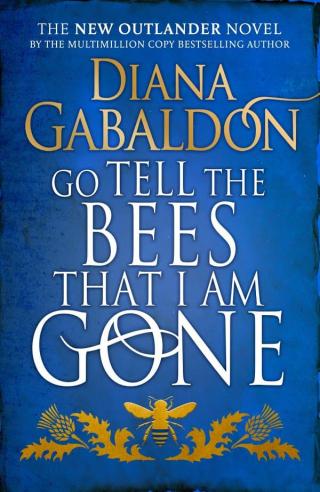
Go Tell the Bees That I Am Gone
- Автор: Гэблдон Диана
- Серия: Outlander #9
- Год: 2021
- Язык: английский
- Год: Delacorte Press
- ISBN: 978-1-473-51900-8
- Жанр: Исторические приключения

Электронная книга - «Go Tell the Bees That I Am Gone». Краткое содержание книги:
The past may seem the safest place to be . . . but it is the most dangerous time to be alive. . . .
Jamie Fraser and Claire Randall were torn apart by the Jacobite Rising in 1746, and it took them twenty years to find each other again. Now the American Revolution threatens to do the same. It is 1779 and Claire and Jamie are at last reunited with their daughter, Brianna, her husband, Roger, and their children on Fraser’s Ridge. Having the family together is a dream the Frasers had thought impossible. Yet even in the North Carolina backcountry, the effects of war are being felt. Tensions in the Colonies are great and local feelings run hot enough to boil Hell’s teakettle. Jamie knows loyalties among his tenants are split and it won’t be long until the war is on his doorstep. Brianna and Roger have their own worry: that the dangers that provoked their escape from the twentieth century might catch up to them. Sometimes they question whether risking the perils of the 1700s—among them disease, starvation, and an impending war—was indeed the safer choice for their family. Not so far away, young William Ransom is still coming to terms with the discovery of his true father’s identity—and thus his own—and Lord John Grey has reconciliations to make, and dangers to meet . . . on his son’s behalf, and his own. Meanwhile, the Revolutionary War creeps ever closer to Fraser’s Ridge. And with the family finally together, Jamie and Claire have more at stake than ever before.
“Let’s go. The tide’s coming in and I’m dining with General Prévost in half an hour.”
They made their way slowly through the twilight, the rough marram grass rasping at their boots.
“Besides,” his uncle went on, head down against the wind, “I had another title—one without taint. Refusing to use the Pardloe title meant I also refused to use the income from the title’s estates, but it meant almost nothing in terms of my daily life, bar a bit of eye-rolling from society. My friends largely remained my friends, I was received in most of the places I was accustomed to go, and—the important point—I continued doing what I intended to do: raise and command a regiment. You—” He glanced at William, running an appraising eye over him from slouch hat to clodhopper boots.
“Not to put too fine a point on it, William—it might be easier to ask what it is you want to do, rather than asking how not to do what you don’t.”
William stopped, closed his eyes, and just stood, listening to the water for a few moments of blessed relief from the tick-tock thoughts. Absolutely nothing was happening inside his head.
“Right,” he said at last, taking a deep breath and opening his eyes. “Were you born knowing that’s what you wanted to do?” he asked curiously.
“I suppose so,” his uncle answered slowly, beginning to walk again. “I can’t recall ever thinking of being anything save a soldier. As to wanting it, though … I don’t think that question ever occurred to me.”
“Exactly,” said William, with a certain dryness. “You were born into a family where that’s what the oldest son did, and that happened to suit you. I was raised believing that my sacred duty was to care for my lands and tenants, and it never occurred to me for an instant that what I wanted came into it—no more than it did to you.
“The fact remains,” he went on, taking off his hat and tucking it under his arm to keep it from being carried away by the wind, “that I don’t feel entitled—as it were—to any of the titles I was supposedly born to …. Besides—” A thought struck him, and he gave his uncle a narrow look.
“You said you didn’t accept the dukedom’s income. I don’t suppose you also neglected the care of the estates you weren’t profiting from?”
“Of course n—” Hal broke off and gave William a look in which annoyance was tempered by a certain respect. “Who taught you to think, boy? Your father?”
“I imagine Lord John may have had some small influence,” William said politely. His insides had turned over—as they did with monotonous regularity recently—at mention of his erstwhile father. He couldn’t forget the look of fearful eagerness in John Cinnamon’s eyes … oh, bloody hell, of course he could forget. It was a matter of will, that’s all. He shoved it aside, the next best thing.
“But you didn’t in fact renounce your responsibilities, even though you wouldn’t profit by them. You’re telling me, though, that you couldn’t have done so. There are no circumstances in which a peer can stop being a peer?”
“Well, not at his own whim, no. Mind you, a peerage is the gift of a grateful monarch. A monarch who ceases to be grateful can indeed strip a peer of his titles, though I doubt any monarch could do so without support from the House of Lords. Peers don’t like to feel threatened—it so seldom happens to any of them these days, they’re not used to it,” he added sardonically.
“Even so—it isn’t a matter of kingly whim, either. Grounds for revoking a peerage are rather limited, I believe. The only one that comes to mind is engaging in a rebellion against the Crown.”
“You don’t say.”
William had spoken lightly—or meant to—but Hal stopped and turned a piercing look on his nephew.
“If you consider treason and the betrayal of your King, your country, and your family a suitable means of solving your personal difficulties, William, then perhaps John hasn’t taught you as well as I supposed.”
Without waiting for an answer, he turned and stumped off through the beds of rotting waterweed, leaving amorphous footprints in the sand.
WILLIAM STAYED BY the shore for some little while. Not thinking. Not feeling much of anything, either. Just watching the currents move through the river, washing out his tired brain. A squadron of brown pelicans with white heads came floating down the sky, keeping formation as they skimmed two feet above the surface of the water. Evidently seeing nothing interesting, they rose again as one and sailed back over the marshes toward the open sea.
No wonder that people run away to sea, he thought, with a small sense of longing. To slough off the small cares of daily life and escape the demands of a life unwanted. Nothing but miles of boundless water, boundless sky.
And bad food, seasickness, and the chance of being killed at any moment by pirates, rogue whales, or, much more likely, the weather.
The thought of rogue whales made him laugh and the thought of food, bad or not, reminded him that he was starving. Turning to go, he discovered that while he had stood there vegetating, a large bull alligator had crawled out of the shrubbery behind him and was reposing about four feet away. He shrieked, and the reptile, startled and indignant, opened a horrifying set of jaws and made a noise between a growl and an enormous belch.
He had no idea exactly how he’d done it, but when he stopped, panting and drenched with sweat, he was in the middle of the army camp. Heart still pounding, he made his way through the neat aisles of tents, feeling once more safe amid the normal noises of a camp settling toward supper, the air thick with the smells of wood fire, hot earth from the camp kitchens, grilling meat, and simmering stew.
He was ravenous by the time he reached Papa’s house, though at this time of summer, it would be broad daylight for another hour at least. He assumed that Trevor would be abed, sunlight notwithstanding, and so walked as quietly as he could, using the damp grass beside the brick walk.
As Trevor—and necessarily Trevor’s mother—was in his mind, he glanced round the side of the house and discovered that the bench in the grape arbor was occupied, all right, but not by Amaranthus, with or without baby attached.
“Guillaume!” John Cinnamon spotted him and erupted from the leafy bower with such force as to scatter leaves and stray grapes across the gravel.
“John! How did it go?” He could see Cinnamon’s broad face, shining with joy, and his inner organs shriveled. Had Papa accepted John Cinnamon as his son?
“Oh! It was—he was—your father is a great, good man, Guillaume! You’re so fortunate to have him.”
“I—er—yes,” William said, a little dubiously. “But what did he say—”
“He told me all about my father,” Cinnamon said, and stopped to swallow at the enormity of the word. “My father. He’s called Malcolm Stubbs; have you ever met him?”
“I’m not sure,” William said, frowning in an effort at recollection. “I’m sure I’ve heard the name once or twice, but if I’ve ever met him, it must have been when I was quite young.”
Cinnamon flapped a large hand, dismissing this.
“He was a soldier, a captain. He was badly hurt in the big battle for the City of Quebec, up on the Plains of Abraham, you know?”
“I know about the battle, yes. But he survived?”
“He did. He lives in London.” Cinnamon squeezed William’s shoulder in a transport of delight at the name, and William felt his collarbone shift.
“I see. Well, that’s good, I suppose?”
“Lord John says that if I choose to write a letter, he will see that Captain Stubbs receives it. In London!” Clearly, London was next door to Faery-land, and William smiled at his friend, at once truly happy that Cinnamon was genuinely thrilled about this revelation—and secretly and shamefacedly relieved that, after all, Cinnamon really wasn’t Papa’s natural son.