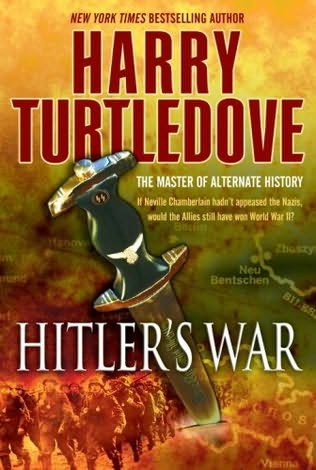
Hitler's war
- Автор: Тертлдав Гарри Норман
- Серия: The War that came early #1
- Язык: английский
- Жанр: Альтернативная история

Электронная книга - «Hitler's war». Краткое содержание книги:
Now, in this thrilling, provocative, and fascinating alternate history by Harry Turtledove, another scenario is played out: What if Chamberlain had not signed the accord? What if Hitler had acted rashly, before his army was ready-would such impatience have helped him or doomed him faster? Here is an action-packed, blow-by-blow chronicle of the war that might have been-and the repercussions that might have echoed through history-had Hitler reached too far, too soon, and too fast.
Turtledove uses dozens of points of view to tell this story: from American marines serving in Japanese-occupied China to members of a Jewish German family with a proud history of war service to their nation, from ragtag volunteers fighting in the Abraham Lincoln Battalion in Spain to an American woman desperately trying to escape Nazi-occupied territory-and witnessing the war from within the belly of the beast.
A novel that reveals the human face of war while simultaneously riding the twists and turns that make up the great acts of history, Hitler's War is the beginning of an exciting new alternate history saga. Here is a tale of powerful leaders and ordinary people, of spies, soldiers, and traitors, of the shifting alliances that draw some together while tearing others apart. At once authoritative, brilliantly imaginative, and hugely entertaining, Hitler's War captures the beginning of a very different World War II-with a very different fate for our world today.
“Ja. I know,” Moritz answered. “But think first. Would I go up there to get my ass shot off if I weren’t loyal to the Vaterland?”
Nobody without a death wish would fly a Stuka if he weren’t doing it for his country. Even so, Hans-Ulrich said, “You can’t be loyal to the Vaterland if you’re not loyal to the Fuhrer. We’d lose for sure if anyone else tried to run the war, or if we bugged out of it. We’d stab ourselves in the back, the same way we did in 1918.”
“No doubt,” the other pilot said. Was that agreement, or was he just trying to get Hans-Ulrich out of his hair? Hans-Ulrich knew which way he’d bet. He didn’t know what to do next. Anyone who wondered about vengeance was less loyal to the Party and the Fuhrer than he should have been. But if you were a brave pilot, and you hurt the French and British every time you flew…
Rudel was still chewing on that when he headed off to hear Colonel Steinbrenner’s morning briefing with the rest of the pilots. His ankle still hurt, but he could walk on it and use the Stuka’s aileron controls. That was all that counted.
“If we can break through north of Paris, we have them,” Steinbrenner declared. “Then we wheel around behind the city, the way we would have done it in 1914 if von Kluck hadn’t run short of men and turned too soon.”
He was in his forties-old enough to remember von Kluck’s turn, maybe old enough to have been one of the footsloggers who made it and then got hurled back from the Marne. By the way he spoke, he still took it personally a generation later.
“We’ve done better this time than we did in 1914,” he went on. “Thanks to the panzers and to you boys, we’ve got most of the French Channel ports. That makes it harder for England to send men and machines to the Continent. And who’s to thank for the panzers and the Stukas and the rest of our toys? The Fuhrer, that’s who.”
Hans-Ulrich nodded vigorously. So did most of the other men in the wing. He judged that some of them, like him, meant it from the bottom of their hearts. Others wanted to be seen nodding so the new wing commander would have no reason to doubt their loyalty. Whited sepulchers, he thought scornfully. His father had plenty of things to say about parishioners who acted pious in church but behaved like animals as soon as they got outside again.
And a few stubborn souls, Moritz among them, just sat there listening as if Colonel Steinbrenner were going on about the weather. Maybe they had the courage of their convictions. Some men did fight for Voter-land rather than Fuhrer. Rudel didn’t think the two were separable. He was willing to bet Germany’s foes didn’t, either.
After a moment, Steinbrenner resumed: “Your target is Chaumont. There’s a railway viaduct there-it’s more than six hundred meters long, and it crosses the Suize. Artillery hasn’t been able to knock it out, and the enemy keeps sending men and materiel across it. Time to put a stop to that, by God!”
Now everybody nodded. Give the Luftwaffe a purely military problem, and it would handle things just fine. Even Hans-Ulrich was relieved that he wouldn’t have to think about politics while he was flying. If any of the other men felt differently, he would have been very surprised.
Groundcrew men were already bombing up his Stuka and fueling it when he went out to the revetment. Sergeant Dieselhorst was grabbing a premission cigarette a safe distance away. “What’s on the plate?” Dieselhorst asked.
“Chaumont. Railroad bridge,” Hans-Ulrich said.
“Ach, so.” The sergeant’s cheeks hollowed as he took one last drag. He crushed the butt underfoot. “Flak’ll be thick enough to walk on,” he said mournfully. “They know what those bridges are worth.”
“You can always bow out,” Hans-Ulrich said. The rear gunner sent him a reproachful look. Rudel gestured toward the Ju-87. “Well, come on, then. Heil Hitler!”
“Heil!” Dieselhorst echoed. Whatever he thought of the rumored coup, he didn’t say much. He just did his job. That wasn’t the worst attitude for a noncom-or anyone else-to have.
Inside the plane’s cabin, he and Hans-Ulrich went through their preflight checks. Everything came up green. With all the flying the planes were doing, the groundcrews had to work miracles to keep so many of them airborne. So far, the mechanics and armorers seemed up to it.
A groundcrew man spun the prop. Hans-Ulrich fired up the engine. Another groundcrew man sat on the wing to help guide him as he taxied out of the revetment and onto the airstrip’s chewed-up grass. The ground crewman hopped off with a wave. Rudel gave him one, too. When he got the takeoff signal, he gunned the Stuka. It bounced down the runway and lurched into the air. It might not have been pretty, but it flew, all right.
Chaumont wasn’t far on the map, but it was far enough: farther than the Kaiser’s army had ever got. “We have company,” Sergeant Dieselhorst said, distracting Rudel.
He looked around, making sure he’d read the noncom’s tone the right way. Yes, those were Messerschmitts flying with the Stukas, not Hurricanes or French fighters streaking in to attack them. Chaumont was important, then. Flights over France, unlike those across the Channel, didn’t always get escorts laid on.
Hans-Ulrich saw the flak well before he reached the target. It did look thick enough to walk on. Yes, the enemy also knew how important Chaumont was. Hans-Ulrich muttered to himself, but didn’t say anything out loud. He didn’t want Dieselhorst worrying any more than necessary. Worrying as much as proved necessary would likely be bad enough.
Hurricanes streaked at the Stukas maybe a minute and a half later. The 109s zoomed away to meet the British fighters. Hans-Ulrich had seen over England that that was the best way to hold off enemy planes. Sticking too close to the bombers you were escorting gave attackers a big edge.
Sometimes the enemy got through no matter what you did. Sergeant Dieselhorst’s machine gun chattered. Rudel saw a couple of Stukas diving for the deck, hoping to outrun the Hurricanes on their tails. He wished them luck, and feared they’d need it.
He started his own dive for the railroad bridge sooner than he’d intended to, which also meant it had to be shallower. That gave the antiaircraft gunners plenty of time to fire at him. Shells burst all around his Stuka. He hung on to the stick as tight as he could-it was like driving a car on a badly rutted dirt road. Puffs of evil black smoke came closer and closer. A few bits of shrapnel rattled off the plane or tore into it-luckily, only a few.
Trying not to think about anything else, Hans-Ulrich bored in on the bridge. The viaduct had three levels, towering more than fifty meters above the river it overleaped. Some plump, pipe-smoking, mustachioed French engineer of the last century must have been proud of himself for designing it. Rudel yanked at the bomb-release lever. With a little luck, he’d make that Frenchman’s grandchildren unhappy.
As soon as the bombs fell free, the Stuka got faster and friskier. More flak burst behind it, in front of it, all around it. And Sergeant Dieselhorst’s voice rang tinnily through the speaking tube: “You nailed the fucking bridge! It’s going down!”
“Danken Gott dafur!” Rudel said. He sped back toward the east, keeping his gauges at the edge of the red till he was sure he’d made it to German-held territory. If one of the Hurricanes had chosen to chase him, red-lining the gauges wouldn’t have done much good. The Stuka made a fine dive-bomber, but a poor tired donkey in a sprint on the flat.
He got down. To his surprise, Colonel Steinbrenner trotted up before his prop stopped spinning. “Rudel!” the colonel said. “They swore you’d got shot down again. They said nobody could go into that kind of fire and come out the other side in one piece.”
They, whoever they were, hadn’t tried it themselves. Hans-Ulrich shrugged. He hadn’t thought-much-about going down. All he’d thought about was doing his job. Letting the other get in the way would have distracted him. It might have given him cold feet. Now that he’d made it through, he wondered why the devil it hadn’t.