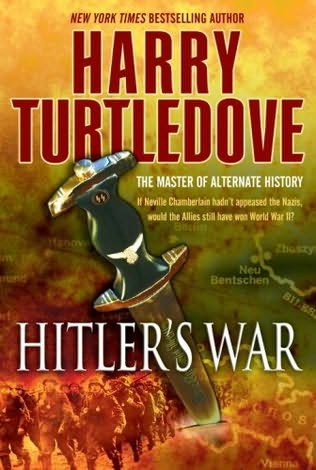
Hitler's war
- Автор: Тертлдав Гарри Норман
- Серия: The War that came early #1
- Язык: английский
- Жанр: Альтернативная история

Электронная книга - «Hitler's war». Краткое содержание книги:
Now, in this thrilling, provocative, and fascinating alternate history by Harry Turtledove, another scenario is played out: What if Chamberlain had not signed the accord? What if Hitler had acted rashly, before his army was ready-would such impatience have helped him or doomed him faster? Here is an action-packed, blow-by-blow chronicle of the war that might have been-and the repercussions that might have echoed through history-had Hitler reached too far, too soon, and too fast.
Turtledove uses dozens of points of view to tell this story: from American marines serving in Japanese-occupied China to members of a Jewish German family with a proud history of war service to their nation, from ragtag volunteers fighting in the Abraham Lincoln Battalion in Spain to an American woman desperately trying to escape Nazi-occupied territory-and witnessing the war from within the belly of the beast.
A novel that reveals the human face of war while simultaneously riding the twists and turns that make up the great acts of history, Hitler's War is the beginning of an exciting new alternate history saga. Here is a tale of powerful leaders and ordinary people, of spies, soldiers, and traitors, of the shifting alliances that draw some together while tearing others apart. At once authoritative, brilliantly imaginative, and hugely entertaining, Hitler's War captures the beginning of a very different World War II-with a very different fate for our world today.
* * *
Out on the streets of Munster, away from any possible microphones, Sarah Goldman said, “I wish we’d get another letter.” Even here, she named no names and gave no details. You never could tell who was listening. If people in Germany had learned anything since 1933, that was it.
Her mother nodded. “So do I. But we were lucky to get one, and Frau Breisach put herself in danger to bring it to us.”
“I know. It was kind of her. Brave of her, too,” Sarah said.
Propaganda posters sprouted like mold on walls and fences and tree trunks. Some showed jut-jawed, blue-eyed men in coal-scuttle helmets: recruiting posters for the Wehrmacht and the Waffen-SS. Sarah didn’t mind those so much. Germany was at war, after all. Father and Saul would have joined if the country had let them. In spite of everything, Saul had joined.
There’d been more Waffen-SS posters lately, especially since the coup against Hitler failed. Sarah didn’t like that, but she didn’t know what she could do about it. No. Actually, she did know. She couldn’t do a thing.
Other posters showed hook-nosed, flabby-lipped Jews pulling the strings on puppets of Chamberlain and Daladier, or a capitalist Jew in a morning coat and top hat shaking hands with a Communist Jew in overalls and a flat cloth cap above a woman’s corpse labeled GERMANY. Still others carried a stark, simple message: THE JEWS ARE OUR MISFORTUNE.
“Why do they hate us so much?” Sarah whispered. The poison made her want to hate herself.
“I only wish I knew,” Mother answered. “Then maybe I could do something about it.” She sighed. Her breath smoked. Spring was supposed to be on the way, but it hadn’t got here yet. “Or maybe knowing wouldn’t make any difference. Sometimes things just are what they are, that’s all.”
“That’s what I was afraid of,” Sarah said. “If it made sense, though…” She shook her head in frustration. “If it had to make sense, the goyim wouldn’t do it.”
“They might. Sometimes people don’t care what they do.” Mother paused, then added, “And look at the name you just called them. If you could, you’d do worse than call them names, wouldn’t you?”
“I wouldn’t start anything,” Sarah said. “But after all they’ve done to us, shouldn’t we get even if we can?”
“An eye for an eye. A tooth for a tooth. And after a while everyone’s blind and nobody has any teeth,” Mother said sadly.
Laborers were still repairing British bomb damage and hauling away rubble one wheelbarrow at a time. The RAF wanted to make sure Germany had no eyes or teeth. Sarah had always thought of herself as a German, at least till the Nazis wouldn’t let her any more, and the enemy bomber crews were trying to kill her, too. All the same, she wouldn’t have shed a tear if one of their bombs blew up Hitler and Hess and Goebbels and Goring.
The laborers paused when Sarah and her mother went by. Sarah felt their eyes on her-and maybe on Mother, too. She tried to pretend the sweaty men in overalls weren’t there: that was one more complication she didn’t need.
And looking at them would have reminded her of Saul working in a gang just like this one…and of his shovel caving in the gang boss’ skull. She wished she could forget she’d ever seen that. She wished she could forget she’d ever heard it, too.
“Hey, sweetheart!” one of the workmen called. He rocked his hips forward and back. His buddies laughed.
Sarah just kept walking. “They don’t know we’re Jews,” she said in a low voice.
“A good thing, too. They’d be worse if they did,” her mother answered. “I keep hearing they’re going to make us put yellow stars on our clothes. Thank God it hasn’t happened yet-that’s all I can say.”
“Like the ghetto in the old days.” Sarah shivered.
“Not quite,” Mother said. Sarah raised a questioning eyebrow. The older woman explained: “In the old days, they wouldn’t have charged us ration points for the cloth we need to make the stars.”
“Where did you hear that?” Sarah’s heart sank. It had the ring of truth: exactly the kind of thing the Nazis, with their often maniacal drive for efficiency, would think of.
“I forget who told me. Maybe I don’t want to remember.” Mother’s face twisted. “It sounds too much like something they’d do.”
“I was thinking the same thing,” Sarah said. “I was hoping you’d tell me I was crazy.” She said verruckt, the proper German term. Back before the Nazis took over, or back at home even now, she would more likely have said meshuggeh. It was a friendlier, more comfortable word. But she didn’t want to speak any Yiddish where Aryans might overhear.
Aryans! Her father had had several instructive things to say on that score. He tore Mein Kampfs claims to little pieces and then stomped on the pieces. He really knew what he was talking about, where the half-educated Hitler cobbled together bits and pieces from pamphlets and political tracts and lying, outdated books he’d read. Hitler reassembled them into his own mosaic, which had precious little connection to real history.
Samuel Goldman was scholar enough to know as much. He could prove it, citing chapter and verse. All of which, of course, did him no good whatever. He wasn’t going to change the Nazis’ minds. Knowing how much of the Party’s antisemitism was built on lie atop lie only gave him a sour stomach and heart palpitations.
With an effort, Sarah dragged her mind away from Father’s frustrations. She had plenty of her own to dwell on. The most immediate came out: “I hope we’ll be able to get what we need. I hope we’ll be able to get anything.”
“Well, we haven’t starved yet,” Mother said, which was true but less than encouraging. With Jews able to shop only as things were about to close, and with their being unwelcome in so many shops anyhow, staying fed and clothed was even harder for them than for their German neighbors.
One clever Jew in Hamburg had given her family’s ration coupons to a gentile friend, who used them to shop for her. The friend could have used the coupons for her own kin, but she hadn’t done that. She’d played square-till someone betrayed them. The Jewish family got it in the neck for evading rationing regulations. And the gentiles got it in the neck for helping Jews.
For all Sarah knew, they had side-by-side bunks in the Dachau camp. Or maybe they’d all been shot. She wouldn’t have been surprised. If you were a German Jew-or an Aryan rash enough to remember you were also a human being-you couldn’t win.
A trolley rattled by. The motorman ignored Sarah and her mother, as they ignored him. Jews weren’t supposed to ride streetcars, either, except going off to the work gangs in the morning or coming back from them at night. No, you couldn’t win.
“I hope our soles will last,” her mother said. Leather and even synthetics for shoe repairs were impossible to come by. Sarah nodded. She hoped her soul would last, too.
Chapter Eighteen
Victory will come soon. So the official from the German department in charge of interned neutrals had assured Peggy Druce. Konrad Hoppe, that was the bastard’s name. Well, Herr Hoppe wasn’t as smart as he thought he was. Here it was a month later, and Germany was still fighting hard.
Here it is, a month later, Peggy thought. More than a month. Pretty soon it’ll be spring. And here I am, still stuck in goddamn Berlin.
The RAF had come over several times. French planes had dropped bombs once or twice. Even the Russians had shown up, flying all the way across Poland and eastern Germany in bombers said to be bigger than anybody else’s.
None of that had done a hell of a lot of actual damage. Berlin was a long way off for enemy planes-a long way off from anywhere civilized, in Peggy’s biased opinion. The bombers had to carry extra fuel, which meant they couldn’t carry so many bombs.
German searchlights ceaselessly probed the night sky, hunting marauders. German antiaircraft fire was like a million Fourths of July all folded into one. It didn’t do much good, though.