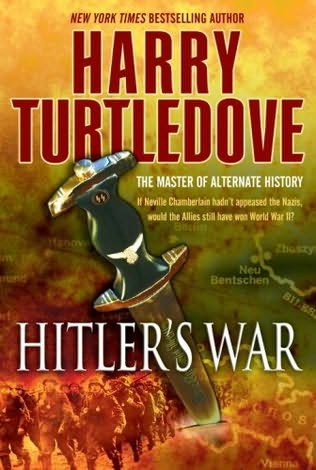
Hitler's war
- Автор: Тертлдав Гарри Норман
- Серия: The War that came early #1
- Язык: английский
- Жанр: Альтернативная история

Электронная книга - «Hitler's war». Краткое содержание книги:
Now, in this thrilling, provocative, and fascinating alternate history by Harry Turtledove, another scenario is played out: What if Chamberlain had not signed the accord? What if Hitler had acted rashly, before his army was ready-would such impatience have helped him or doomed him faster? Here is an action-packed, blow-by-blow chronicle of the war that might have been-and the repercussions that might have echoed through history-had Hitler reached too far, too soon, and too fast.
Turtledove uses dozens of points of view to tell this story: from American marines serving in Japanese-occupied China to members of a Jewish German family with a proud history of war service to their nation, from ragtag volunteers fighting in the Abraham Lincoln Battalion in Spain to an American woman desperately trying to escape Nazi-occupied territory-and witnessing the war from within the belly of the beast.
A novel that reveals the human face of war while simultaneously riding the twists and turns that make up the great acts of history, Hitler's War is the beginning of an exciting new alternate history saga. Here is a tale of powerful leaders and ordinary people, of spies, soldiers, and traitors, of the shifting alliances that draw some together while tearing others apart. At once authoritative, brilliantly imaginative, and hugely entertaining, Hitler's War captures the beginning of a very different World War II-with a very different fate for our world today.
“Merci.” The barman made the silver coin vanish.
“Damn shame about the Eiffel Tower, too,” Walsh added awkwardly.
“When the top part falls off-fell off-it should fall on the government’s head,” the French veteran said. “Then maybe it do some good. After we beat the Boches, we build it again.”
“There you go.” Alistair started to suggest that the Germans could pay for it, but he swallowed that. Reparations had been nothing but a farce after the last war. Why expect anything better this time around?
“Drink up, mon ami,” the Frenchman said. “You will look for other sport, eh? Night still comes too soon, especially with blackout.”
“Too right it does.” Walsh realized the barman really liked him. Otherwise, the fellow would have tried to keep him in there forever. But the man must have realized he’d do all right from his other customers. Soldiers wearing several different uniforms packed the place. As long as none of them was in German kit…
Walsh had to push through double blackout curtains to get out onto the street. A little light leaked out despite the curtains. A flic blew his whistle and shouted something irate. Since Alistair didn’t understand it, he didn’t have to answer. That was how he felt, anyhow. And it was already dark enough to let him fade into the crowd before the copper could get a good look at him.
He knew where he was going, or thought he did. The house was supposed to be around the corner and a couple of streets up. He figured it would be easy to find even in the dark: places like that always had queues-or, given French carelessness about such things, crowds-of horny soldiers outside waiting their turn for a go with one of the girls.
But he missed it. Maybe he walked past the corner in the gloom, or maybe the place wasn’t where he thought it was. He wandered around, bumping into people and having others bump into him. “Excuse me,” he said, and, “Pardon.” It wasn’t curfew time yet, and Paris kept going regardless of such tiresome regulations.
Cars honked like maniacs as they rattled along. They had headlamps masked with black paper or cloth so only a tiny slit of light came out: with luck, not enough to see from 20,000 feet. The faint glow wasn’t enough to let drivers see much, either. Every so often, the sound of crunching bumpers and frantic cursing punctuated the night.
Another couple of steps and Alistair bumped into somebody else. “Excuse me,” he repeated resignedly.
“Pardon,” said his victim: a woman.
They both stepped forward again, trying to go around each other, and bumped once more. “Bloody hell,” Walsh said. You could be as foul-mouthed as you pleased in a country where most people didn’t know what you were talking about.
But the woman laughed. “I was thinking the same thing,” she said, her English better than the barman’s.
“Sorry,” Alistair mumbled.
“Don’t worry,” she answered. “My husband would say that when he was alive. He was a soldier from the last war.”
“You were married to a Tommy?” Walsh asked.
“That’s right,” she said. “My father was a butcher. My brother got killed at Verdun, and so Fred took over the business. Better than he could have done in England, he always said. But he died five years ago…and now we have war again.”
“Too right we do.” Walsh wondered what the hell to say next. Verdun was gone, lost, this time around, though not with the titanic bloodbath of 1916. He couldn’t very well ask a woman where the maison de tolerance was. He wondered if he could talk her into taking him home with her. If she was used to British soldiers (though he was no damned Englishman-by the way she sounded, her Fred had come from Yorkshire or thereabouts)…
Before he could find anything, she said, “Maybe you should go left at the next corner. It’s not far at all-only a few meters. Good luck, Tommy.” Then she was nothing but fading footsteps on the street: this time, she stepped around him nimbly as a dancer.
Alistair laughed at himself. So she wasn’t a widow who needed consoling-not from him, anyhow. “Too damned bad,” he muttered. “She’d be better than what I could pay for.” And then, thoughtfully, “Left, is it?”
He didn’t think in meters, but he could make sense of them. You had to if you were going to fight on the Continent. He found the corner by stepping off the curb. He didn’t fall on his face, which proved God loved drunks. He didn’t get run over crossing the street, either-no thanks to the French drivers, most of whom tooled along as if they could see for miles, not six inches past their noses if they were lucky.
A long block down the street, he bumped into somebody else. “‘Ere, myte, watch yourself,” growled an unmistakable Cockney.
“Oh, keep your hair on,” Walsh retorted, not only showing he was from Britain himself but suggesting he had the bulge to deal with any ordinary soldier. He paused. He still couldn’t see much, but his ears told him a long file of men stood here breathing and muttering and shuffling their feet. A light went on in his head, even if it illuminated nothing out here. “Is this the queue for-?”
“You fink Oi’d wyte loike this for anyfing else?” the Cockney answered.
“I suppose not,” Walsh said. Fred’s widow knew soldiers, all right, and knew what they’d be looking for. If she knew he also wouldn’t have minded looking for her…well, that was how the cards came down. She might have been better, but this wouldn’t be bad-not while it was going on, anyhow. Later, he’d likely wonder why he wasted his money on some tart who’d forget him as soon as he got off her.
But that would be later. The queue lurched forward a few feet. Somebody joined it behind Alistair, and then somebody else. He wished he could light a cigarette, but that was against the blackout rules, too. One more thing he’d have to wait for. Well, it wouldn’t be long.
* * *
Breakfast at the airstrip was rolls and strong coffee. Hans-Ulrich Rudel longed for milk. By the way a lot of the Stuka pilots and rear gunners went on, they longed for schnapps or whiskey. He didn’t care what they drank, as long as it didn’t hurt what they did in the air. They sassed him unmercifully. He’d got used to that-by all the signs, he was the only teetotaler in the Luftwaffe. He didn’t much like it, but he couldn’t fight everybody all the time.
And then someone said something different to him: “What do you think of the new wing commander?”
“Colonel Steinbrenner?” Rudel shrugged. “He seems like a good enough officer-and I’m sure he’s a good German patriot.”
“Do you think Colonel Greim wasn’t?” asked the other pilot, a new fish. Was he Maxi or Moritz? Moritz, that was it.
Hans-Ulrich shrugged again. “He’d still be in charge of the wing if the powers that be thought he was. Me, I say ‘Heil Hitler!’ and I go about my business. What else can you do?”
Moritz started to say something, stopped, and then tried again: “The war hasn’t gone the way everybody hoped it would when it started.”
“And so?” Rudel gulped coffee. He needed help prying his eyelids open-like most flyers these days, he was chronically short on sleep. And this brew would do the trick, too, which meant it had to come from captured stock. But he could see some things even with his eyes closed. “How many wars do go just the way one side thinks they will beforehand? Do we toss out the Fuhrer because things aren’t perfect?”
“Of course not,” Moritz said quickly.
“Of course not,” Hans-Ulrich agreed. He hadn’t expected his colleague to say anything else. That the other man might not dare say anything else never crossed his mind. He believed in Fuhrer and Party at least as strongly as he believed in his father’s stern Lutheran God. Till the latest political upheavals, he’d assumed everybody else felt the same way. “This foolishness isn’t doing the war effort any good.”
Moritz looked down into his coffee mug. Then he eyed Hans-Ulrich again. “Which foolishness?” he asked quietly. “The coup, or what’s happening now to anybody who might have known anything about it?”
“Why, the coup, of course.” Rudel’s answer was as automatic as the mechanism that pulled a Stuka out of a dive. Only after it came out did he fully realize what the other man had said. “I could report you for that!” he exclaimed. He almost said, I should report you for that!