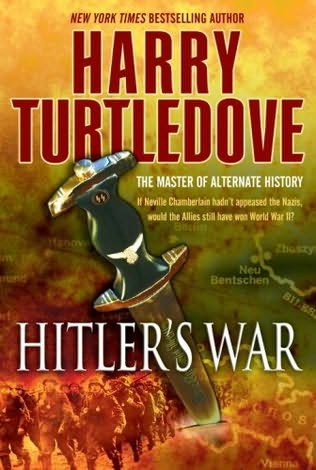
Hitler's war
- Автор: Тертлдав Гарри Норман
- Серия: The War that came early #1
- Язык: английский
- Жанр: Альтернативная история

Электронная книга - «Hitler's war». Краткое содержание книги:
Now, in this thrilling, provocative, and fascinating alternate history by Harry Turtledove, another scenario is played out: What if Chamberlain had not signed the accord? What if Hitler had acted rashly, before his army was ready-would such impatience have helped him or doomed him faster? Here is an action-packed, blow-by-blow chronicle of the war that might have been-and the repercussions that might have echoed through history-had Hitler reached too far, too soon, and too fast.
Turtledove uses dozens of points of view to tell this story: from American marines serving in Japanese-occupied China to members of a Jewish German family with a proud history of war service to their nation, from ragtag volunteers fighting in the Abraham Lincoln Battalion in Spain to an American woman desperately trying to escape Nazi-occupied territory-and witnessing the war from within the belly of the beast.
A novel that reveals the human face of war while simultaneously riding the twists and turns that make up the great acts of history, Hitler's War is the beginning of an exciting new alternate history saga. Here is a tale of powerful leaders and ordinary people, of spies, soldiers, and traitors, of the shifting alliances that draw some together while tearing others apart. At once authoritative, brilliantly imaginative, and hugely entertaining, Hitler's War captures the beginning of a very different World War II-with a very different fate for our world today.
* * *
Anastas Mouradian was drunk. Yes, a blizzard howled outside. Even so, a proper Soviet officer wasn’t supposed to do any such thing. Sergei Yaroslavsky knew that perfect well. He would have been angrier at Mouradian if he weren’t drunk himself.
They couldn’t fly. They had plenty of vodka. What were they going to do- not drink it? Try as he would, Sergei couldn’t come up with a good reason for leaving it alone.
Ivan Kuchkov was bound to be drinking with his fellow enlisted men. If the Chimp got smashed, the rest of the aircrew should, too. It showed solidarity between enlisted men and officers. It also showed that neither enlisted men nor officers had anything better to do when they couldn’t get an SB-2 off the ground to save their lives.
“If Hitlerite bombers show up now, if we have to take shelter outside, we’ve got plenty of antifreeze in our blood,” Sergei said.
“Never mind Hitlerite bombers. What about Hitlerite soldiers?” When Mouradian was sober, he spoke excellent Russian. He stayed fluent when he got drunk, but his Armenian accent turned thick enough to slice.
Sergei laughed and laughed. When he got drunk, everything was funny. “Where would Hitlerite soldiers come from?”
“Out of the sky. With parachutes. Like they did in Holland and Belgium.” Anastas looked around the inside of the tent, his eyes big and round like an owl’s: he might have expect Nazi parachutists to pop up any minute now.
That owlish stare only made Sergei laugh harder than ever. He looked around the inside of the tent, too. Enough of the wind outside got in to make the flame from the kerosene lamp flicker. That wasn’t why his wide, high-cheekboned face registered dismay. “We’re out of pelmeni! And pickled mushrooms! Where’d they go?”
Mouradian patted his stomach. “Good. Not spicy enough, but good.” Being a southerner, he liked everything full of fire. As far as Sergei was concerned, the mushrooms and the meat dumplings were fine this way. Russians had all kinds of snacks that went with vodka. Even a half-skilled cook at a forward airstrip could do a decent job with some of them.
“We had a big plate of them,” Sergei said sadly. The plate was still there. But for a couple of crumbs from the pelmeni, it was bare. Sergei sighed. He pointed at Anastas. “Not even the fucking Germans would be crazy enough to drop parachutists in this weather.”
“God shouldn’t have been crazy enough to make this weather.” Mouradian must have been very drunk, or he wouldn’t have talked about God so seriously. It gave Sergei a hold on him, which wasn’t something anybody in the USSR wanted to give anyone else. Of course, there was something close to an even-money chance neither of them would remember anything about this come morning.
Even without dumplings or mushrooms, Sergei raised his tumbler. “Za Stalina!”
“To Stalin!” Anastas echoed. They both drank. The vodka was no better than it had to be. It went down as if Sergei were swallowing the lighted kerosene lamp. The really good stuff slid down your throat smooth as a kiss, then exploded in your stomach like a 500kg bomb. But this got you there, smooth or not.
Sergei sighed. If it was harsh now, he’d feel it worse in the morning. The good stuff didn’t make you think elephants in hobnailed boots were marching on top of your skull.
“We have aspirins?” he asked.
“Somewhere,” Mouradian said vaguely. Then he brightened. “We’ll have more vodka.”
“Da.” That cheered Sergei up, too: at least a little. Another dose of what made you feel bad could make you feel better. He reached for the bottle again. If he drank it now, he’d feel better right away.
“Leave me some,” Anastas said.
“Leave me some, sir,” Sergei said. The drunker you got, the more important military discipline seemed…unless, of course, it didn’t. He passed Mouradian the bottle. They drank till there was very little left to drink. They would have drunk till nothing was left to drink, but they both fell asleep first.
Getting up in the morning was as bad as Yaroslavsky had known it would be, or maybe a little worse. The first thing he did was drink half the remaining vodka. He would have drunk all of it, but Anastas snatched the bottle out of his hands. “To each according to his needs,” the Armenian croaked, and no one in the USSR, no matter how hung over, dared quarrel with unadulterated Marx.
Fortunately, the aspirins turned up. Sergei dry-swallowed three of them. Mouradian took four. As sour as Sergei’s stomach already was, the aspirins felt like a flamethrower in there. If he belched, he figured he could incinerate the whole airstrip.
Mouradian didn’t look or sound much happier. “Breakfast,” he said. The mere thought made Sergei groan. Then Anastas added, “They’ll have tea-coffee, too, maybe.”
“Well, maybe.” Sergei peeled back the tent flap and looked out. The sun shone brilliantly off snow. He squinted at the alarming landscape. “Don’t want to bleed to death through my eyeballs,” he muttered.
“Tell me about it!” Mouradian said fervently.
Both being brave men, they made it to the field kitchen. Shchi -cabbage soup-seemed safe enough to Sergei. Anastas stuck to plain brown bread. The cooks had one battered samovar full of tea, another full of coffee. After getting outside of some of that-and after the aspirins took hold-Sergei decided he’d live. Eventually, he would decide he wanted to.
The radio blared out music. Mouradian turned it down. Sergei would have loved to turn it off, but he didn’t dare. People might think you didn’t want to listen to the news. If you didn’t want to listen to the splendid achievements of the glorious Soviet state, people would wonder why not. Some of the people who wondered would have NKVD connections, too. And you’d be heading for a camp faster than you could blink.
Nobody complained about turning down the radio, though. Several other men eating breakfast had red-tracked eyes, sallow skin, and a hangdog expression. When it was snowing at an isolated airstrip, what were you going to do besides drink?
The song ended. An announcer gabbled about the overfulfillment of production norms at factories in Smolensk, Magnitogorsk, and Vladivostok. Not easy to imagine three more widely separated places. “Thus, despite the efforts of Fascists and other reactionaries, prosperity spreads throughout this great bulwark of the proletariat!” the announcer said.
Sergei had nothing against the bulwark of the proletariat. In his present fragile state, though, he didn’t much want to hear about it. He made himself seem attentive even so, as he would have during a dull lecture in school. The penalty for obvious boredom then would have been a rap on the knuckles, or maybe a swat on the backside. He might pay more now.
Music returned. He didn’t have to seem to be listening to that so closely. He couldn’t ignore it altogether, however, or show he didn’t like it. It wouldn’t have gone out without some commissar’s approvaclass="underline" without the state’s approval, in other words. And if the state approved, citizens who knew what was good for them needed to do the same.
At the top of the hour, a different announcer came on the air. This fellow sounded better educated than the joker who’d been bragging about production norms. “And now the news!” the man said.
Several people with Red Air Force light blue on their collar tabs perked up. News from around the world mattered. “Soviet forces continue to punish the Polish reactionaries and the Nazi bandits who support them,” the announcer crowed. “Over the past several days, Soviet infantrymen have driven another twenty kilometers deeper into Poland. Knowledgeable officers report that enemy resistance is beginning to crumble.”
Nobody said anything. Nobody even raised an eyebrow. Sergei didn’t think anyone actually fighting the Poles and Germans believed their resistance was crumbling. He knew damn well he didn’t. That particular item had to be aimed at bucking up civilian morale hundreds if not thousands of kilometers from the front.