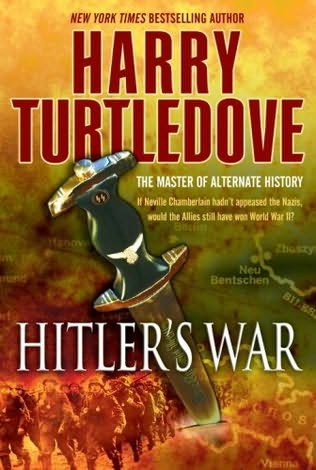
Hitler's war
- Автор: Тертлдав Гарри Норман
- Серия: The War that came early #1
- Язык: английский
- Жанр: Альтернативная история

Электронная книга - «Hitler's war». Краткое содержание книги:
Now, in this thrilling, provocative, and fascinating alternate history by Harry Turtledove, another scenario is played out: What if Chamberlain had not signed the accord? What if Hitler had acted rashly, before his army was ready-would such impatience have helped him or doomed him faster? Here is an action-packed, blow-by-blow chronicle of the war that might have been-and the repercussions that might have echoed through history-had Hitler reached too far, too soon, and too fast.
Turtledove uses dozens of points of view to tell this story: from American marines serving in Japanese-occupied China to members of a Jewish German family with a proud history of war service to their nation, from ragtag volunteers fighting in the Abraham Lincoln Battalion in Spain to an American woman desperately trying to escape Nazi-occupied territory-and witnessing the war from within the belly of the beast.
A novel that reveals the human face of war while simultaneously riding the twists and turns that make up the great acts of history, Hitler's War is the beginning of an exciting new alternate history saga. Here is a tale of powerful leaders and ordinary people, of spies, soldiers, and traitors, of the shifting alliances that draw some together while tearing others apart. At once authoritative, brilliantly imaginative, and hugely entertaining, Hitler's War captures the beginning of a very different World War II-with a very different fate for our world today.
“Jawohl,” the gunner and radioman said. “I was listening, too.”
Hans-Ulrich tipped the Ju-87 over into a dive. Acceleration slammed him back in his seat. It would be trying to tear Dieselhorst out of his. Hans-Ulrich had never heard of a rear gunner’s straps and harness failing-a good thing, too. That wasn’t pretty to think about.
Down below, the highway swelled. Yes, that was a truck convoy. As the shriek from the Stukas’ sirens mounted, soldiers started bailing out and running like ants. Too late, fools. Too late.
Everything had a red tinge. Rudel was right on the edge of blacking out. He pulled the bomb-release lever, then yanked back on the stick as hard as he could to bring the Stuka out of its deadly plunge. Behind him, the poilus would just have discovered hell on earth.
“You all right?” Sergeant Dieselhorst’s voice said he wasn’t sure about himself, let alone Rudel.
“I-think so.” Hans-Ulrich made himself nod. As they usually did after a steep dive, his thoughts needed a few seconds to come back to normal. He muzzily recalled the Stukas in Spain that had crashed before the Luftwaffe installed that gadget to pull out of dives if pilots didn’t.
He fought for altitude. He’d got up to 2,500 meters when Dieselhorst’s machine gun started chattering. “Dodge!” the gunner yelled. “French fighter!”
Hans-Ulrich threw the big, clumsy Ju-87 around the sky in ways the manufacturer never intended. An open-cockpit Dewoitine monoplane zoomed past-obsolescent, but flying. A 109 could have hacked it out of the air with the greatest of ease. It still outclassed a Stuka, though.
Here it came for another pass. Hans-Ulrich saw the skeleton with a harrow painted on its dark green flank. The machine guns firing through the Grim Reaper’s propeller disk blazed. Rudel jinked again-right into the stream of bullets.
His engine coughed and quit and started smoking. A round punched through both sides of the cockpit in front of him before he had time to blink. “We’ve got to get out!” he yelled to Dieselhorst, praying the sergeant would answer.
“I was hoping you’d be here to tell me that,” Dieselhorst said. “Sounds good to me. Are we still inside French territory, or did we make it back to our own lines?”
“Only one way to find out.” Rudel eyed the gauges. “Don’t waste time, either-we’re losing altitude.”
He yanked back on the canopy. The Stuka’s glasshouse had two movable parts: one for the pilot, the other for the gunner-radioman. Hans-Ulrich hoped the bullet that almost nailed him hadn’t messed up the track along which his part slid. He breathed a sigh of relief when it retracted smoothly enough.
Wind tore at him. It didn’t want to let him get out. He fought his way clear of the cockpit. A quick glance told him Sergeant Dieselhorst was already gone. Rudel threw himself into space.
He missed smashing himself against the Stuka’s upthrust taiclass="underline" the first risk every pilot bailing out took. Then he counted down from ten and yanked the ripcord. Wham! The blow he took when the chute opened made him gray out for a second, the same as dive-bombing would have done. He came to faster than he would have pulling out of a dive, though.
He looked around. There was another canopy, below him and to the left. Dieselhorst hadn’t hit the tail, either. Good.
Back in the last war, pilots hadn’t worn parachutes. The powers that be thought having them would turn men into cowards. Soldiers had gone into that war without steel helmets, too. They’d learned better there sooner than they had with chutes.
The Luftwaffe model still left something to be desired. Hans-Ulrich dropped faster than he would have liked-but not nearly so fast as if the chute hadn’t opened! He couldn’t steer very well, either.
He bent his legs and tried to relax as the ground rushed up at him. He sprained an ankle anyway, but didn’t think he broke it. He used his belt knife to cut away the canopy before it dragged him into some trees. He couldn’t see where Sergeant Dieselhorst had come down.
“Hold it right there, shithead, or you’re fucking dead meat!” somebody yelled. Hans-Ulrich needed a moment to realize he understood the obscenity-laced command. It was in German. He’d landed among friends.
Happily, he raised his hands. “I’m a Stuka pilot!” he shouted back. “My number two’s around here somewhere.”
Three men in field-gray cautiously emerged from those trees. “Get under cover, you Dummkopf” one of them said. “There’s Frenchies only a few hundred meters from here.”
Hans-Ulrich tried to stand. His ankle didn’t want to let him. “My leg-” he said.
One of the soldiers had a machine pistol. He covered the other two, who were riflemen. They trotted forward and each got one of Rudel’s arms over his shoulder. “We’ll take you to an aid station,” one of them said. They lugged him back to the woods.
* * *
A knock on the door. Up till now, Sarah Goldman hadn’t known something so ordinary could be so terrifying. The ordinary police thumped. The Gestapo pounded. She could guess who was there from the different knocks, and she proved right most of the time. If only proving right would have done her the least bit of good!
This knock didn’t seem quite so frightening. So Sarah told herself, anyway, as she went to the door. Maybe she was trying to find hope whether it was really there or not. She braced herself to face some scowling SS man all in black.
But no. “Oh! Frau Breisach!” she exclaimed in glad surprise. Even if Wilhelmina Breisach liked to grumble about every little thing, the people across the street had always got on well with the Goldmans till the Nazis started making things tough on Jews. And, naturally, no one from the neighborhood seemed eager to stop by after Saul did…what he did. Better to pretend you didn’t have any idea who those people were than to have to explain why you wanted anything to do with them. So Sarah hesitated before asking, “Won’t you come in?”
“No, thank you. Please excuse me, but I’d better not.” Frau Breisach shook her head. She was a plump, reasonably pretty blond a few years younger than Sarah’s mother. Now she thrust an envelope into Sarah’s hand. “This was addressed to us, but I think it may be for you.” She didn’t wait for any answer from Sarah, but scurried away as if hoping no one had seen her come. She probably was hoping exactly that, too.
“Thank you,” Sarah said, but she was talking to Frau Breisach’s back.
She closed the door, scratching her head. “What was that all about?” her father asked.
“I don’t know.” Then Sarah looked down at the envelope, and she did. Ice and fire rippled through her, fractions of a heartbeat apart. She recognized the handwriting on the address. “I think maybe you’d better have a look at this. Mother, you, too.”
Samuel and Hanna Goldman came out to see why she was fussing. Without a word, she handed her father the envelope. Behind his glasses, his eyes widened. So did those of Sarah’s mother. Neither of them said much. They didn’t know the Gestapo had put microphones in their house, but they also didn’t know it hadn’t. In Adolf Hitler’s Germany in 1939, they didn’t want to take any foolish chances.
Sarah’s father took the letter out of the envelope. Sarah and her mother crowded close to read it with him. Hello, Uncle, Aunt, and Cousin Elisabeth, it said. Just a note to let you know basic training is going well. Don’t listen to the rubbish you hear from some people. We get plenty to eat. The work is hard and we are often tired, but this is no Strength through Joy cruise. We are getting ready for war. I may end up in panzers. The drill sergeants say I have the knack for them. I hope so. They hurt the Reich ’s enemies more than anything else does, I think. I must go now-more drills. Stay well. Heil Hitler! The scrawled signature was Adalbert.
Sarah and her father and mother all eyed one another. That was Saul’s handwriting. “How in the world did he-?” Sarah began, and left it right there.
“He must have got some identity papers,” Samuel Goldman whispered. “And when he did…” The professor’s chuckle was most unprofessorial. “Well, who would guess to look for him there?”