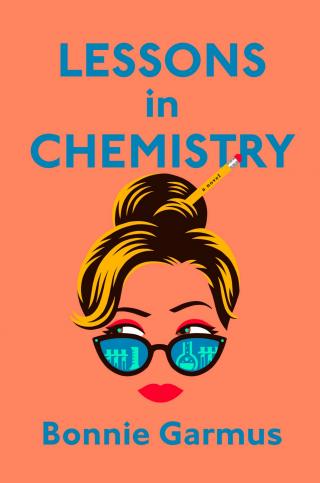
Lessons in Chemistry
- Автор: Garmus Bonnie
- Год: 2022
- Язык: английский
- Год: Doubleday Canada
- Жанр: Современная русская и зарубежная проза

Электронная книга - «Lessons in Chemistry». Краткое содержание книги:
“But I think Calvin’s childhood really takes the cake.” She went on to explain the death of his parents, then his aunt — the result of which had landed him in a Catholic boys home, where he’d experienced abuse at the hands of priests until he’d grown big enough to stop it. She’d found his old diary buried in the boxes she and Frask had stolen. Although his childish scrawl was often impossible to read, his sorrow sang.
What she didn’t tell Roth was that it was within the pages of Calvin’s diary that she’d discovered the source of his permanent grudge. I’m here even though I should not be, he’d written, as if implying that there’d been an alternative. And I will never ever forgive that man, him. Never. Not as long as I live. After reading his correspondence with Wakely, she now understood that this was the father he’d hoped was dead. The one he promised to hate until the day he died. It was a promise he’d kept.
Roth stared down at the table. He’d had a normal upbringing — two parents, no suicides, no murders, not even a single wayward touch by the priest in his parish. And yet he still found plenty to complain about. What was wrong with him? Just as people have a bad habit of dismissing others’ problems and tragedies, so too did they have a bad habit of not appreciating what they have. Or had. He missed his wife.
“As for Calvin’s death,” she said, “I’m one hundred percent responsible.” He paled as she went on to describe the accident and the leash and the sirens, and how because of it, she would never hold anyone back in any way, ever again. As she saw it, his death spawned a series of other failures: blindsided by Donatti’s theft, she’d given up her research; determined to help her daughter fit in, she’d enrolled her in a school where she did not; worse, she’d become the very person she least wanted to be, a performer like her father. Oh, and also, she’d given Phil Lebensmal a heart attack. “Although I don’t actually consider that last one a failure,” she said.
—
“What were you guys talking about in there?” the photographer asked on the way to the airport. “Did I miss anything?”
“Not a thing,” Roth lied.
Before he’d gotten in the cab, Roth had already decided he wouldn’t reveal what he’d learned. He would write his piece on deadline, to spec, and not a word over. He would write plenty but say nothing. He would tell about her, but not tell on her. In other words, he would meet his deadline, and in journalism, that is 99 percent of the law.
Despite what Elizabeth Zott will tell you, Supper at Six is not just an introduction to chemistry, he wrote that day on the plane. It’s a thirty-minute, five-day-a-week lesson in life. And not in who we are or what we’re made of, but rather, who we’re capable of becoming.
In lieu of any personal information, he wrote a two-thousand-word description of abiogenesis, followed by a five-hundred-word section on how the elephant metabolizes its food.
“This is not a story!” his new editor had written after reading the first draft. “Where’s the dirt on Zott?”
“There wasn’t any,” Roth said.
—
Just two months later, there she was, on the cover of Life magazine, arms folded across her chest, countenance grim, flanked by a headline that read “Why We’ll Eat Whatever She Dishes Out.” The six-page article included fifteen photographs of Elizabeth in action — on the show, on her erg, in makeup, petting Six-Thirty, in conference with Walter Pine, adjusting her hair. The article opened with Roth’s line about her being the most intelligent person on television today, except the editor had swapped out “intelligent” and replaced it with “attractive.” It then included a short description of her show’s biggest hits — the fire extinguisher episode, the poison mushroom episode, the I-don’t-believe-in-God episode, and countless others — ending with his observation that hers was a show of life lessons. But the rest?
—
“She’s the angel of death” was the quote a hungry cub reporter got from Zott’s father in the visitation room at Sing Sing. “The devil’s spawn. And she’s uppity.”
The cub reporter had also managed to get a quote from Dr. Meyers at UCLA, who characterized Zott as a “lackluster student more interested in men than molecules,” adding that she wasn’t nearly as good-looking in person as she was on TV.
“Who?” Donatti had asked when the cub reporter first brought up Zott’s employment record. “Zott? Oh wait — you mean Luscious Lizzie? ‘Luscious’ is what we all called her,” he said, “which she used to protest in that way women do when they aren’t actually protesting.” He smiled, proving his point by producing her old lab coat, which still sported her initials, E.Z. “Luscious was a great lab tech — that’s a position we have for people who want to be in science but don’t have the brains.”
The last quote was from Mrs. Mudford. “Women belong in the home, and the fact that Elizabeth Zott is not in the home has proven to be disruptive to her child’s well-being. She often exaggerated her child’s abilities — the first sign of a status-conscious parent. Naturally, when her daughter was my student, I worked very hard to counter that effect.” Mudford’s quote was accompanied by, of all things, a copy of Madeline’s family tree. Lies! Mudford had written across the top. See me!
Out of everything in the article, it was the tree that did the most harm. Because on it, Madeline had not only written in Walter as a relative — readers instantly assumed this meant Elizabeth was sleeping with her producer — but had also included a small drawing of a grandfather in prison stripes, a grandmother eating tamales in Brazil, a large dog reading Old Yeller, an acorn labeled “Fairy Godmother,” a woman named Harriet poisoning her husband, a dead father’s tombstone, a kid with a noose around his neck, as well as some hazy ties to Nefertiti, Sojourner Truth, and Amelia Earhart.
The magazine sold out in under twenty-four hours.
Chapter 38
Brownies
JULY 1961
Some say there’s no such thing as bad publicity, and in this case, they were right. Supper at Six exploded in popularity.
“Elizabeth,” Walter said as she sat facing him in his office, her face stony. “I know you’re upset about the article — we all are. But let’s look on the bright side. New advertisers are lining up in droves. Several manufacturers are begging to create all-new lines in your name. Pots, knives, all sorts of things!”
She pursed her lips in a way he knew meant trouble.
“Mattel even sent over specs for a girl’s chemistry set—”
“A chemistry set?” She perked up slightly.
“Keep in mind, these are just specs,” he said carefully, handing her a proposal. “I’m sure some things can—”
“ ‘Girls!’ ” she read aloud. “ ‘Make your very own perfume…using science!’ ” Good god, Walter! And the box is pink? Get these people on the phone right now— I want to tell them where they can stick their plastic vial.”
“Elizabeth,” he said soothingly, “we don’t have to say yes to everything, but there’s some potential here for lifelong financial security. Not just for us, but for our girls. We have to think beyond ourselves.”