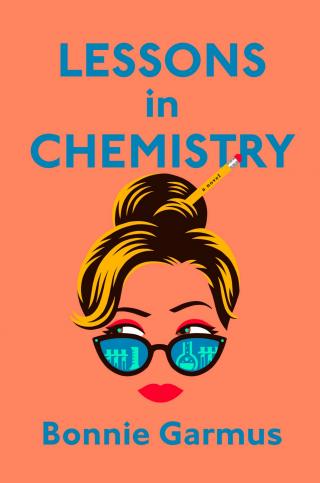
Lessons in Chemistry
- Автор: Garmus Bonnie
- Год: 2022
- Язык: английский
- Год: Doubleday Canada
- Жанр: Современная русская и зарубежная проза

Электронная книга - «Lessons in Chemistry». Краткое содержание книги:
“Death threats?” The reporter perked up. “So this is — what— a news show? Political opinion? Debate?”
“Cooking,” Walter said.
“If you hadn’t gotten hold of that bag, Mr. Browne, this day might have ended very differently. How’d you do it, anyway?” the officer pressed. “How’d you get the bag without her knowing?”
“That’s what I keep telling everyone. I didn’t,” Seymour insisted. “It was just sitting on my table.”
“You’re being too modest,” Walter said, patting him on the back.
“The mark of a true hero,” the police officer nodded.
“My editor is going to eat this up,” the reporter said.
From a distance, Six-Thirty lay in a corner watching the men, exhausted.
“Just a few more photos and that should—” Out of the corner of his eye the reporter spied Six-Thirty. “Hey,” he said. “Don’t I know that dog? I know that dog.”
“Everyone knows that dog,” Seymour said. “He’s on the show.”
The reporter looked at Walter, confused. “I thought you said this was a cooking show.”
“It is.”
“A dog on a cooking show? What does the dog do exactly?”
Walter hesitated. “Nothing,” he admitted. But as the words hung in the air, he suddenly felt awful.
From across the room, Six-Thirty’s eyes met his. He wasn’t a dog person, but even Walter could see: the mutt was crushed.
Chapter 36
Life and Death
“Big news!” Walter said a week later, his body trembling with excitement as he joined Elizabeth, Harriet, Madeline, and Amanda at the table. This had become a regular occurrence — Sunday night dinner in Elizabeth’s lab. “Life magazine called today. They want to do a cover story!”
“Not interested,” Elizabeth said.
“But it’s Life!”
“They’ll want personal details — things that are no one’s business. I know how this works.”
“Look,” Walter said. “We really need this. The death threats have ended, but we could use some positive exposure.”
“No.”
“You’ve turned down every single magazine, Elizabeth. You can’t keep doing this.”
“I’d happily talk with Chemistry Today.”
“Yes,” he said, rolling his eyes. “Fantastic. Not exactly our target audience, but I’m so desperate, I actually called them.”
“And?” she said eagerly.
“They said they weren’t interested in interviewing some lady who cooks on TV.”
Elizabeth stood up and walked out.
—
“Help me, Harriet,” Walter begged as they sat outside on the back step after dinner.
“You shouldn’t have called her a TV cook.”
“I know, I know. But she shouldn’t have told everyone she doesn’t believe in God. We’re never going to live this down.”
The screen door opened. “Harriet?” Amanda interrupted. “Come play.”
“In a bit,” Harriet said, encircling the little girl with her arm. “Why don’t you and Mad build a fort first. Then I’ll come.”
“Amanda is very fond of you, Harriet,” Walter said quietly as his daughter ran back indoors. He managed to stop himself from adding, As am I. In the past few months, his repeated visits to the Zott residence meant that he’d seen more and more of Harriet. Each time he left, he found himself thinking of her for hours. She was married — unhappily according to Elizabeth — but so what, she’d still never shown any interest in him, and who could blame her. He was fifty-five years old, going bald, bad at his job, and with a young child who was not even technically his. If there was a textbook called Least Desirable Traits of Men, he’d be on the cover.
“Oh?” said Harriet, her neck turning scarlet at the compliment. She fussed with her dress, pulling it low to her socks. “I’ll talk to Elizabeth,” she promised. “But you should speak with the writer first. Tell him to avoid personal questions. Especially anything relating to Calvin Evans. Keep it focused on Elizabeth — on what she’s accomplished.”
—
The interview was set for the following week. The reporter, Franklin Roth, an award-winning journalist, was well-known for his ability to gain the trust of even the most recalcitrant stars. As he slipped into his seat in the middle of the Supper at Six audience, Elizabeth was already onstage chopping through a large pile of greens. “Many believe protein comes from meat, eggs, and fish,” she was saying, “but protein originates in plants, and plants are what the biggest, strongest animals in the world eat.” She held up a National Geographic magazine featuring a spread on elephants, then went on to explain, in excruciating detail, the metabolic process of the world’s largest land animal, asking the camera to zoom in on a photograph of the elephant’s feces.
“You can actually see the fiber,” she said, tapping the photo.
Roth had seen the show a few times and had found it strangely entertaining, but now, as part of the audience, he found those around him — the audience was 98 percent women — as much a part of the story as Zott was. Everyone seemed to have come armed with a notebook and pencil; a few carried chemistry textbooks. They all paid strict attention like one is supposed to in college lecture halls or church but rarely does.
During one of the advertising breaks he turned to the woman next to him. “If you don’t mind me asking,” he said politely, showing his credentials, “what is it that you like about the show?”
“Being taken seriously.”
“Not the recipes?”
She looked back incredulously. “Sometimes I think,” she said slowly, “that if a man were to spend a day being a woman in America, he wouldn’t make it past noon.”
The woman on the other side of him tapped his knee. “Prepare for a revolt.”
—
After the show, he made his way backstage, where Zott shook his hand and her dog, Six-Thirty, sniffed him like a cop doing a pat-down. After brief introductions, she invited both him and his photographer into her dressing room, where she talked about the show — or rather the chemistry she’d covered on the show. He listened politely, then commented on her trousers — called them a bold choice. She looked at him surprised, then congratulated him on his same bold choice. There was a tone.
As the photographer quietly clicked away, he changed the subject to her hairstyle. She eyed him coldly.
The photographer looked at Roth, worried. He’d been charged with getting at least one photograph of Elizabeth Zott smiling. Do something, he motioned to Roth. Say something funny.
“Can I ask about that pencil in your hair?” Roth tried again.
“Of course,” she said. “It’s a number-two pencil. ‘Two’ signifies the lead hardness, although pencils don’t actually contain lead. They contain graphite, which is a carbon allotrope.”
“No, I meant why a—”
“A pencil instead of a pen? Because unlike ink, graphite is erasable. People make mistakes, Mr. Roth. A pencil allows one to clear the mistake and move on. Scientists expect mistakes, and because of it, we embrace failure.” Then she eyed his pen disapprovingly.
The photographer rolled his eyes.
“Look,” Roth said, closing his notepad. “I was under the impression that you’d agreed to this interview, but I can tell that this has been forced upon you. I never interview anyone against their will; I sincerely apologize for our intrusion.” Then he turned to the photographer and tipped his head toward the door. They were halfway across the parking lot before Seymour Browne stopped them. “Zott says wait here,” he said.