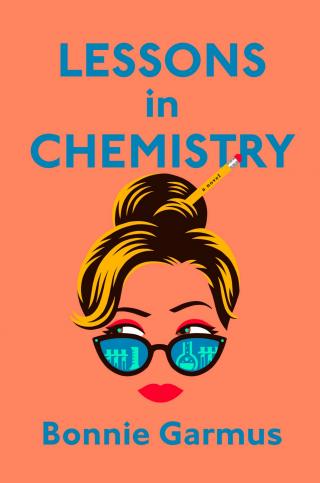
Lessons in Chemistry
- Автор: Garmus Bonnie
- Год: 2022
- Язык: английский
- Год: Doubleday Canada
- Жанр: Современная русская и зарубежная проза

Электронная книга - «Lessons in Chemistry». Краткое содержание книги:
“Harriet, I said I’m not interested,” she snapped. What was the point? Her life was over.
“But what about this unpublished piece of Roth’s,” Harriet said, ignoring Elizabeth’s tone. “The science-y one. I had no idea there were other women scientists — besides you and Curie, I mean. I’ve read the whole thing twice. Found it riveting. Which is saying something because you know. Science.”
“It’s already been rejected by ten scientific magazines,” Elizabeth said in a deadened voice. “Women in science isn’t something people have any interest in.” She picked up her car keys. “I’ll go kiss Mad goodbye, and then I’m off.”
“Do me a favor? Try not to wake her this time.”
“Harriet,” Elizabeth said. “Have I ever?”
—
After hearing Elizabeth back the Plymouth down the drive, Harriet opened Madeline’s lunch box, curious to see what words of wisdom Elizabeth had written this time. It’s not your imagination, said the note on top. Most people are awful.
Harriet pressed her fingertips against her head in worry. She padded around the lab, wiping down counters, the weight of Elizabeth’s depression evident in ways she hadn’t really registered before. The pile of empty research notebooks, the untouched chemical supplies, the unsharpened pencils. Damn that Life magazine, she thought. Despite its name, the magazine had stolen Elizabeth’s life — ended it — due in no small part to fraudulent quotes from people like Donatti and Meyers.
“Oh honey,” Harriet said as Mad appeared in the doorway. “Did your mom wake you?”
“It’s another day.”
They sat down together and picked at the breakfast muffins Elizabeth had baked earlier that morning.
“I’m real worried, Harriet,” Mad said. “About Mom.”
“Well, she’s feeling very down, Mad,” Harriet said. “But she’ll bounce back soon enough. You’ll see.”
“Are you sure?”
Harriet looked away. No, she wasn’t sure. She’d never been less sure of anything in her life. Everyone has a breaking point; she worried that Elizabeth had finally reached hers.
She turned her attention to the latest issue of Ladies’ Home Journal. “Can You Trust Your Hairdresser?” an article asked. “The Year of the Important Blouse” informed another. Sighing, she reached for another muffin. She’d been the one who’d talked Elizabeth into the Life interview. If someone was to blame, it was her.
They sat in silence, Mad picking the paper wrap from her muffin as Harriet replayed Elizabeth’s words about how no one had any interest in reading about women in science. It rang true. Or did it?
She cocked her head to the side. “Wait a sec, Mad,” she said slowly as an idea came to her. “Wait just a goddamn second.”
Chapter 40
Normal
“I think about death a lot,” Elizabeth confessed to Wakely one chilly November evening.
“Me too,” he said.
They sat together on the back step, their voices low. Madeline was just inside watching TV.
“I don’t think it’s normal.”
“Maybe not,” he agreed. “But I’m not sure what normal is. Does science recognize normal? How would you define normal?”
“Well,” she said. “I guess normal is a little like average.”
“I’m not so sure. Normal isn’t like weather; you can’t expect normal. You can’t even make normal. From what I can tell, normal may not exist.”
She looked at him sideways. “Strange words coming from someone who finds the Bible normal.”
“Not at all,” he said. “I can safely say there is not a single normal event in the Bible. Probably one of the reasons it’s so popular. Who wants to believe life is exactly how it seems?”
She looked at him curiously. “But you believe those stories. You preach them.”
“I believe in a few things,” he corrected. “Mostly the things about not giving up hope, not giving in to darkness. As for the word ‘preach,’ I prefer ‘relate.’ Anyway, what I believe is irrelevant. What I think is that you feel dead, so you believe you are dead. But you’re not dead. You’re very much alive. And that puts you in a difficult position.”
“What are you saying?”
“You know what I’m saying.”
“You’re a strange minister.”
“No, I’m a terrible minister,” he corrected.
She hesitated. “I have a confession to make, Wakely. I’ve read your letters. The ones you and Calvin wrote to each other. I’m sure they were private, but they were in his belongings and I read them. Years ago.”
Wakely turned to look at her. “Evans kept them?” He felt a sudden longing for his old friend.
“I don’t know if you know this, but you’re the reason he took the job at Hastings.”
“What?”
“You told him Commons had the best weather.”
“I did?”
“You know how Calvin felt about weather. He could have gone a million other places and made a lot more money, but he came here, to Commons. ‘Best weather in the world.’ I think that’s how you phrased it.”
Wakely felt the weight of his flippant advice. Because of something he’d said, Evans had come to Commons, then died in Commons. “But the weather is only good later in the day,” he explained, as if he had to. “After the morning fog burns off. I can’t believe he moved here to row in the sun. There’s no sun — not when rowers row.”
“You don’t have to tell me that.”
“I’m responsible,” he said, horror-struck, fully recognizing the part he’d played in Calvin’s premature death. “It’s all my fault.”
“No, no.” Elizabeth sighed. “I’m the one who bought the leash.”
They sat together listening to Madeline sing along with the TV theme song playing in the background. A horse is a horse, of course, of course, and no one can talk to a horse of course, that is, of course, unless the horse is the famous Mister Ed!
With a start, Wakely remembered the secret Madeline had whispered in his ear that day in the library. My dog knows 981 words. It’d taken him by surprise. Why would a child like Madeline, obsessed with the truth, choose to share such an obvious lie?
As for what he’d told her? It was the worst. I don’t believe in God.
She closed her eyes briefly, then cleared her throat. “I had a brother, Wakely,” she said as if confessing a sin. “He died, too.”
Wakely’s eyebrows furrowed. “A brother? I’m so sorry. When was this? What happened?”
“It was a long time ago. I was ten. He hanged himself.”
“Good god,” Wakely said, his voice trembling. He suddenly remembered Madeline’s family tree. At the very bottom was a kid with a noose around his neck.
“I almost died once, myself,” she said. “I jumped into a quarry. I couldn’t swim. Still can’t.”
“What?”
“My brother jumped in right after me. Somehow got me to the side.”
“I see,” Wakely said, slowly unraveling her guilt. “Your brother saved you — so you think you should have been able to save him. Is that it?”
She turned to looked at him, her face hollow.
“But Elizabeth, you couldn’t swim — that’s why he jumped in after you. You have to understand, suicide isn’t like that. Suicide is lot more complicated.”
“Wakely,” she said. “He didn’t know how to swim either.”
—
They stopped talking, Wakely despairing because he didn’t know what to say, Elizabeth depressed because she didn’t know what to do. Six-Thirty pushed through the screen door and pressed himself against Elizabeth.