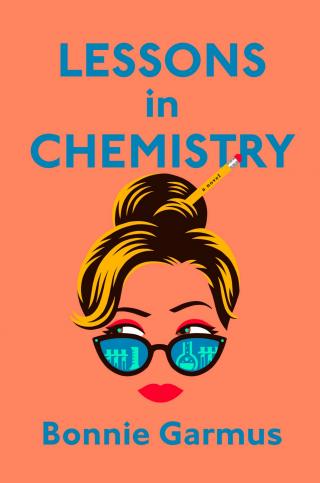
Lessons in Chemistry
- Автор: Garmus Bonnie
- Год: 2022
- Язык: английский
- Год: Doubleday Canada
- Жанр: Современная русская и зарубежная проза

Электронная книга - «Lessons in Chemistry». Краткое содержание книги:
“Excuse me.”
“Geez Louise!” she shouted, pushing herself away from the desk. She swiveled her head to the left to see a skinny child clutching a manila envelope.
“Hi,” the child said.
“What the hell!” Frask gasped.
“Lady, you’re fast.”
Frask pressed her hand on her heart as if to keep it contained. “Th-thank you,” she managed.
“Your pupils are dilated.”
“Ex-excuse me?”
“Is Wakely here?”
Frask sat back in her chair, her heart fibrillating, as the child leaned in to scan the contents of the typewriter.
“Do you mind?” Frask said.
“I’m calculating,” the kid explained. Then she drew back in awe. “Whoa. You’re in Stella Pajunas territory.”
“H-how would you know who Stella—”
“World’s fastest typist. Two hundred sixteen words per—”
Frask’s eyes widened.
“—but I interrupted you so we gotta take that into account—”
“Who are you?” Frask insisted.
“Lady, you’re sweating.”
Frask’s hand flew to her damp forehead.
“You’re at a hundred eighty words per minute. If we round up.”
“What’s your name?”
“Mad,” the kid said.
Frask took in the child’s puffy, purplish lips, her long, clumsy limbs. “Evans?” she filled in without thinking.
They looked at each other in equal astonishment.
—
“Your mom and dad and I used to work together,” Frask explained to Mad over a plate of diet cookies. “At Hastings. I was in Personnel and your mom and dad were both in the Chemistry Department. Your dad was very famous — I’m sure you know that. And now your mom is, too.”
“Because of Life,” the child said, hanging her head.
“No,” Frask said firmly. “In spite of it.”
“What was my dad like?” Mad asked, taking a small bite of cookie.
“He…” Frask hesitated. She realized she had no idea what he’d been like. “He was completely in love with your mother.”
Madeline lit up. “Really?”
“And your mother,” she continued for the first time without jealousy, “was completely in love with him.”
“What else?” Mad asked eagerly.
“They were very happy together. So happy, that before your dad died, he left your mother a gift. You know what that gift was?” She tipped her head toward Mad. “You.”
Madeline rolled her eyes slightly. This was the sort of thing adults said when they were trying to paper over something darker. She’d once heard Wakely tell a librarian that although her cousin, Joyce, had died — dropped dead in the middle of the A&P clutching her heart — Joyce had not suffered. Really? Did anyone ask Joyce?
“And then what happened?”
What happened? Frask thought. Well, I spread vicious rumors about your mother, which culminated in her firing, which led directly to her state of penury, which led to an eventual return to Hastings, which led to your mother screaming at me in the women’s bathroom, which led to the discovery that we’d both been sexually assaulted, which led to our inability to get our PhDs, which led to unfulfilling careers in a company led by a handful of incompetent assholes. That’s what happened.
But instead she said, “Well, your mom decided it would be more fun to stay at home and have you.”
Madeline put down her cookie. There it was again. Adults and their on-again, off-again relationship with the truth.
“I don’t see how that could be fun,” Mad said.
“What do you mean?”
“Wasn’t she sad?”
Frask looked away.
“When I’m sad, I don’t want to be alone.”
“Cookie?” asked Frask half-heartedly.
“Home alone,” Madeline continued. “No dad. No work. No friends.”
Frask took a sudden interest in a publication called Our Daily Bread.
“What really happened?” Mad prodded.
“She was fired,” Frask said, without considering the effect her words might have. “Fired because she was pregnant with you.”
Madeline crumpled as if she’d been shot from behind.
—
“Again, not your fault,” Frask reassured the child, who’d been sobbing for the last ten minutes. “Really. You wouldn’t have believed how close-minded those people at Hastings were. Complete jerks.” Frask, remembering she’d been one of those jerks, ate the rest of the cookies, while Mad, despite her raggedy breath, pointed out that the cookies contained tartrazine, a food coloring additive that had been linked to poor liver and kidney function.
“Anyway,” Frask continued, “you’re looking at this all wrong. Your mother didn’t leave Hastings because of you. She got out thanks to you. And then she made the very poor decision to go back, but that’s another story.”
Madeline heaved a sigh. “I gotta go,” she said, blowing her nose while looking at the clock. “Sorry about wrecking your typing test. Would you give this to Wakely?” She held out the unsealed envelope marked Elizabeth Zott: PRIVATE.
“I will,” Frask promised, giving her a hug. But as soon as the door shut behind her, she ignored the child’s instructions and opened the envelope. “Holy hell,” she fumed as she read Roth’s latest. “Zott really is the real deal.”
—
“Sirs,” she typed ferociously, addressing the editors at Life magazine thirty seconds later. “I read your ridiculous cover story on Elizabeth Zott and I think your fact-checker should be fired. I know Elizabeth Zott— I used to work with Elizabeth Zott — and I know, for a fact, that everything in this article is a lie. I also used to work with Dr. Donatti. I know what he did at Hastings and I have the documents to back it up.”
Her letter went on, listing Elizabeth’s accomplishments as a chemist, most of which she discovered only after reading Roth’s new article, while highlighting the injustices Zott had faced at Hastings. “Donatti reappropriated her funding,” she wrote, “then fired her without cause. I know,” she admitted, “because I was part of it— a sin for which I’m currently trying to atone by typing sermons for a living.” Then she went on to explain how later, Donatti not only stole Zott’s research but lied to important investors. She finished, asserting that while she knew Life would never have the guts to print her letter, she felt she had to write it anyway.
It appeared in the very next issue.
—
“Elizabeth, read this!” Harriet said excitedly, holding the latest copy of Life in her hands. “Women from all over the country have written to Life in protest. It’s a rebellion — everyone’s on your side. There’s even one from someone who claims she worked with you at Hastings.”
“Not interested.”
Having finished her daily lunch box notes to Madeline, Elizabeth closed the lid, then pretended to fuss with a Bunsen burner. For the last few weeks, she’d done her best to keep her head up — ignore the article, she told herself. Carry on. That was the coping strategy that had carried her through suicide, sexual assault, lies, thievery, and catastrophic loss; it would again. Except it hadn’t. This time, no matter how high she lifted her head, Life’s misrepresentation of who she was beat her back down again. The damage felt permanent, like a brand. She would never outrun it.
Harriet read aloud from the letters. “If it weren’t for Elizabeth Zott—”