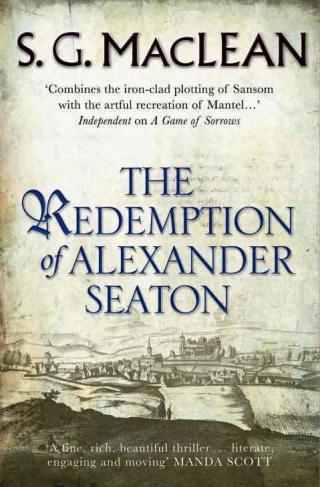
The Redemption of Alexander Seaton
- Автор: Маклин Шона Дж.
- Серия: Alexander Seaton #1
- Год: 2009
- Язык: английский
- Год: Quercus
- ISBN: 1847247911
- Жанр: Исторические детективы

Электронная книга - «The Redemption of Alexander Seaton». Краткое содержание книги:
Is the young man merely drunk or does his tottering walk suggest something more sinister?
When he collapses, vomiting, over the two whores who find him on that dark wet night, they guess rightly that he’s been murdered by poisoning.
So begins this gripping tale set in the town of Banff, Scotland in the 1620s. The body of the victim, the provost’s nephew and apothecary’s apprentice, is found in Alexander Seaton’s school house. Seaton is a school master by default, and a persona non-grata in the town – a disgraced would-be minister whose love affair with a local aristocrat’s daughter left him disgraced and deprived of his vocation. He has few friends, so when one of them is accused of the murder, he sets out to solve the crime, embarking on a journey that will uncover witchcraft, cruelty, prejudice and the darkness in men’s souls.
It is also a personal quest that leads Alexander to the rediscovery of his faith in God as well as his belief in himself.
Among her many strengths, Shona MacLean is brilliant at evoking period and place. You feel you are in those cold, dark, northern rooms, eavesdropping on her characters. You are totally involved in the rich, convincing world she has re-created.
At last I found my way through the throng. I slipped onto a bench and had a platter of food – crackling pork, baked apple with cloves, a dark and peppery gravy and warm bread – pressed into my hand. It was Gilbert Grant who stood above me.
‘Alexander, you look as if you might faint. Eat, my boy, eat. My wife tells me you have had nothing since you returned home to us this day. She bids you eat.’ I accepted the plate and nodded my gratitude towards Mistress Youngson, who had taken over the duties of hostess from the grieving mother. A cup of warm, spiced wine was also handed to me, and as I ate and drank I began to recover myself somewhat. Gilbert Grant seemed content to eat in silence, looking up at me every now and then to make sure I did not flag. I was glad of it, for I was in no mood for conversation, even with this most gentle and genial of men. A reckoning was building in this place tonight that the music and the food and the drink and the dancing flames could not mask, and I was resolved to see it when it came. All around me I could sense a watching and a waiting.
Charles and his boys, the older and better players, embarked upon a courante, and some of the wealthier merchants, along with the landed folk, took up their wives and daughters and set forth to dance, mindful of their status and their dignity. I looked over to the baillie, who kept his place near the music master and the dais. His face was set as a stone; for the baillie, one dance, be it ever so graceful, was as much fuel for the Devil’s fire as the wildest debauch. For myself, I had not seen dancing since that last Christmas at Delgatie, and I was drawn to watch as men and women moved with care in set steps towards each other, turned away, went back and took each other’s hands again to move on in stately, mannered procession. All was propriety, all was order. The faces were as masks, but the eyes, the eyes always gave something away.
The dance came to an end, and before I had stepped back properly into the crowd, another had begun. Unwitting and unwilling, I found myself in a line of four men. Four women faced us, and before me was the pale and wasted form of Geleis Guild. I looked up to where the provost stood: he watched me, motionless. Was this a test? Was I to know that I was not to lay a hand upon this fragile, delicate ornament of his office and his place? I knew that well enough. The music began and I stepped forward and took the slender hand, for there was nothing to step back to. Geleis Guild looked straight ahead into nothing, as if she did not see me, and the dance progressed. No word, no acknowledgement of who I was, escaped her. I had not set eyes on her since that morning when we had brought the lifeless body of Patrick Davidson to her house. The double grief for her friend had almost washed all life from her. I wondered what decoction Jaffray had given her, for she looked as one who is already halfway to the next world. But then, as the dance neared its end, and we passed across one another for the last time, her mouth brushed my hair. The words took whatever strength was left to her. ‘Do not fail them,’ she breathed, and then her hand fell from mine and she had been folded back once again into the crowd. The provost no longer watched me – I could not see him – but the eyes of many others, of Dr Jaffray, of Thomas Stewart, of Baillie Buchan, all were on me now. I would have given much then to pass quietly as a stranger from the company. I stepped back towards the edges of the crowd and waited for it to envelop me.
From somewhere in the darkening gathering, over the aroma of the roasting meat and the pungent spices, over too the thick, warm stench of human sweat and dirt, a new sensation reached my nostrils and my mind. It was not the smoke from the spit-fire, or the bonfire made to warm us, nor yet from the tobacco of Virginia Jaffray so often railed against yet so much enjoyed, but sweet-smelling, of some other leaf dried and burned for the alteration of mind and spirit. It was reaching that time in the evening when such drugs would be smoked and others taken, their seeds crushed into drinks. The baillie and others of his ilk agonised over the danger to our souls from a few harmless songs and dances. How the Devil must have laughed at their simplicity, as he reached into our very minds and visions, with his pagan gifts from the New World. I wanted my wits about me tonight, and moved swiftly away from the source of the strange perfume, wondering at the words of the provost’s wife. Do not fail them.
Some of the younger music scholars had been sent home, their promised penny in their hand to give to their mother, and the music and the dancing was becoming less stately. The doctor stepped up with Ishbel as the players struck up a popular measure. The cittern now came into play for the first time in the evening, and the tabor beat in perfect time to the small pipe over which Charles’s fingers flew, his eyes smiling as Ishbel blushed to the doctor’s exaggerated manners. For all that had occurred these last few days, and for all the dreadful sorrow that had occasioned this celebration, ten years had fallen from the doctor this night. The call went up for a lustier tune. I had avoided lykewakes these many years past – students were banned from them in Aberdeen, but Archie had always made a hearty mourner. I knew that there came a point always when the authorities, in the shape of minister, session clerk, baillie or town serjeant, would call a halt to the festivities, in fear for the public morals and for order in the town. And this was the point at which they would have done so, at the point where the drinking surpassed the eating, when strange substances began to subvert the order of men’s minds, and when good humour threatened to spill over into debauchery.
Tonight though, Banff was a town without minister or session clerk; the town serjeants and all their men needed every resource for the guarding of the prisoners dispersed over town. All the provost’s care and attention was taken up this night on preventing the unravelling of his young wife’s mind and the utter collapse of her spirit. There was only the baillie, but the baillie, like me, was waiting, watching for what was surely to come. After a hesitant glance at William Buchan, which drew no response, Charles took up his fiddle and let fly with the opening notes of the favourite, ‘Gallua Tom’. The piccolo took up the challenge, and the two, with the tabor beating out their time and the cittern struggling to keep pace, flew against one another in speed and dexterity as in battle joined. The courtyard became a mass of bodies, heaving, whirling, laughing, flinging one another across the floor. The flickering light of the torches played upon their writhing forms, catching the glistening beads of sweat that trickled down their foreheads and the glinting, shining, eager eyes, the lascivious, open mouths.