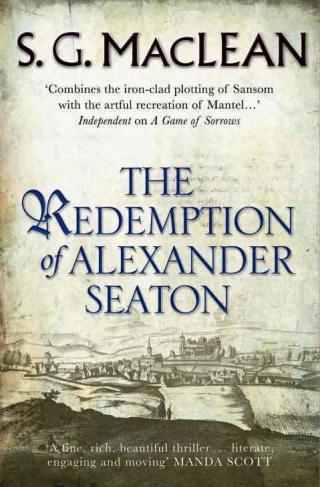
The Redemption of Alexander Seaton
- Автор: Маклин Шона Дж.
- Серия: Alexander Seaton #1
- Год: 2009
- Язык: английский
- Год: Quercus
- ISBN: 1847247911
- Жанр: Исторические детективы

Электронная книга - «The Redemption of Alexander Seaton». Краткое содержание книги:
Is the young man merely drunk or does his tottering walk suggest something more sinister?
When he collapses, vomiting, over the two whores who find him on that dark wet night, they guess rightly that he’s been murdered by poisoning.
So begins this gripping tale set in the town of Banff, Scotland in the 1620s. The body of the victim, the provost’s nephew and apothecary’s apprentice, is found in Alexander Seaton’s school house. Seaton is a school master by default, and a persona non-grata in the town – a disgraced would-be minister whose love affair with a local aristocrat’s daughter left him disgraced and deprived of his vocation. He has few friends, so when one of them is accused of the murder, he sets out to solve the crime, embarking on a journey that will uncover witchcraft, cruelty, prejudice and the darkness in men’s souls.
It is also a personal quest that leads Alexander to the rediscovery of his faith in God as well as his belief in himself.
Among her many strengths, Shona MacLean is brilliant at evoking period and place. You feel you are in those cold, dark, northern rooms, eavesdropping on her characters. You are totally involved in the rich, convincing world she has re-created.
I made no response to this, for it was a distraction from the path my mind was now taking. ‘Marion Arbuthnott came to see you again, did she not?’
‘Aye,’ she responded warily, ‘she did.’
‘What did she come for the second time?’
She looked at me carefully, assessing me. For a moment I feared she might lie, try to tell me that the girl had come for some charm or compound to rid her of her fatherless child. But something set in the crone’s face. A decision, a resolution. She would trust me. ‘She came to ask me about a flower.’
‘Colchicum mortis.’
She nodded slowly. ‘Aye, that. She wanted to know if I knew of it. I have some little knowledge of it, of its nature and properties, but I have never seen nor used it, or known anyone who has. This I told her, and she was greatly disappointed. I told her to ask her father, but she said she could not risk that.’ She stopped. ‘Or did she say risk him? I cannot remember.’
I knew why: Marion Arbuthnott knew that knowledge of this evil was almost as deadly as the poison of the plant itself. It was the knowledge that had made her fear for Charles Thom and a conviction that had been proven correct by her own death. I persisted, nonetheless. ‘Did she tell you why she wanted to know about this plant?’
‘It took much to draw it out from her, for she was a close, strange girl, and frightened. But she told me in the end. The lad, she said, had been quiet, preoccupied, all their journey back to Banff. He had scarcely spoken two words on the long road home. But, as they had crested the Gallowhill and begun their descent into the town, he had stopped dead, as if struck by a vision. And then he had said quietly those two words. Colchicum mortis. He had repeated them, and then had said no more but that he must leave her, for he had urgent business to attend to. She had seen him only once more, at her father’s table the next night. He had eaten nothing and appeared agitated still, excited almost, but it was a dark sort of excitement. She told me she had a presentiment of evil.’ The crone shrugged. ‘And maybe she had; she was a sensitive child, and knowing. Anyhow, the boy had told her he had some business on hand that night, and she was not to ask him of it, or seek to follow him. The next morning he was dead.’ The woman’s tale told, she lifted her pot and set it in a dark recess to cool.
There was no more to be had from her, and I stood up and began to pull on my cloak. She looked up.
‘Where are you going?’
‘I am returning to Banff,’ I said. ‘I must before dark. There is much I must attend to.’
She smiled. ‘You will not get back to Banff this night. The fog will not lift till the morning. You would be lost in five minutes and dead in ten.’ It was not an opinion, but a statement of fact. She lit a small lamp and set it by me. Then she went to a chest in some dark recess of the cavern and brought out a slim volume, old and well read. ‘This is my only book, save the Bible. You may entertain yourself with it if you wish. I do not seek company, and I have spoken more these last two weeks than I would wish to in half a year.’ She brought me also a bowl of mussels and a hunk of bread. It was the last exchange we had for many hours.
I pulled the lamp closer to me and opened the book at the title page: The Poems of William Dunbar. Dunbar. An unexpected warmth spread through me, a memory of childhood evenings by the fire, listening to my father, the day’s toils over, telling stories of his youth, of his journeying with the laird of Delgatie. Those were the nights he would sing the old ballads or say the poems. Those had been the magical nights, when my mother too had been young again and had remembered why she had loved him. For me, it was not the great adventures overseas, nor the ballads of romance, but those poems in our own Scots tongue, written by a court clerk dead a hundred years, that had allowed me to glimpse for a brief hour the humanity of my own father. I had not looked at or listened to one of Dunbar’s poems since the day they told me he was dead. I feared almost to open the book further, for what memory I would find there. I laid the volume down and settled back on the furs and skins beneath me, hoping for sleep. None came. The silence of the sea outside was more terrifying than all the fury of its rages. The crone was oblivious to it. Some powders she had been grinding she now put in a glass jar and was adding distilled water, drop by drop. She would sniff at it every so often, then mutter to herself before adding some other powder.
I had learnt what I had come to learn from her, and had no wish to tarry longer in this place, but her advice was good: there could be no sense in attempting to reach Banff before morning. There was much I could have done in these futile hours, in any other place but this. I had no idea what hour of the day or night it was. I gave over trying to sleep and opened the volume once more, this time having the courage to turn the pages further.
The crone had finished her work and had gone about some necessary business in a place she had shown to me deep into the back of the cave, and I was still reading, lost in another time, my father’s voice resonant in my ear. Even after she had put out the lamp and laid herself out to sleep on her trestle bed, the words echoed in my mind through the darkness from fifteen, twenty years ago. The ballads, the lusty drinking songs, the comic ditties on court life, all had come to life again in my head, and had brought warmth to me. But now, in the darkness of this cavern, with the haar seeping through the silent black, my father’s sonorous voice at last spoke the words that had ended all those evenings, and sent me to my sleep in fear: timor mortis conturbat me. The fear of death disquiets me. It was the only certainty I had now to hold on to: the certainty of death. And the knowledge of death was everywhere in this place where three times now I had been accorded life. I prayed for sleep, for peace, and, many hours into the night, it came.
I was awakened by a blast of fresh air on my face. My eyes sought in vain the familiar objects of my own chamber in the schoolhouse until I remembered where I was. The crone had gone outside. I followed the passage of light to the cave entrance and pushed back the partition myself. Sunlight pierced my eyes. The haar had lifted. A clear, fine spring day spread out the beauty of the firth before me. With little conversation, the old woman busied herself about making some breakfast, and while I ate she worked once more at her potions. As I finished my porridge and rose to gather my few things she turned. ‘Wait. It is not quite ready.’ Without further explanation, she went back to her work, and spent some minutes checking on jars and bottles, finally selecting two small vessels into which she poured different liquids from the concoctions she had been making the previous night. She handed me the bottles. ‘This,’ she said, indicating the one containing a murky, yellowish treacle, ‘you are to give to Baillie Buchan. It is the remedy he seeks.’ I opened my mouth to say something but she silenced me. ‘You know all you need to. Give it to him.’ The other bottle contained a clear, almost blue tonic. ‘This you will take for yourself. One spoonful at night. You will sleep more easy, and the dreams will not bother you.’
‘Did I speak my dreams last night? Did I call out?’ Sometimes lately, I had woken in the night at the sound of my own cry.